This article contains affiliate links: if you buy through them we may earn a commission, at no extra cost to you. Learn more.
Sunday after the big game. The team group chat is full of photos, your hamstrings are grumbling, and lying on the couch all day sounds tempting. But a lot of athletes find that a little easy movement makes them feel better than doing nothing. That’s the idea behind an active recovery day: gentle exercise that gets the blood moving without adding fatigue. Below are 12 active recovery day ideas for every kind of athlete, how easy “easy” should be, and a few simple tools that help.

What is an active recovery day?
It’s a day of low-intensity movement, usually 20–45 minutes, placed after hard training or competition. It’s not a sneaky extra workout. The goal is to feel better tomorrow, not to get fitter today. Research backs the idea: a 2018 meta-analysis of 99 studies in Frontiers in Physiology found active recovery reduced muscle soreness, alongside massage and compression. And in an ACE-sponsored study, exercisers who recovered actively between hard efforts held their endurance and power better than those who rested passively.
How easy should it be?
Easy enough to hold a full conversation. In the ACE-sponsored research, moderate active recovery at roughly 55–60% of heart-rate reserve worked better than harder efforts. A simple rule: on a 1–10 effort scale, stay around 3 or 4. If you wear a heart rate monitor, keep it in your lowest zones. If you finish feeling more tired than when you started, you went too hard.
12 active recovery day ideas
1. An easy swim
Water takes the weight off sore legs. Swim 15–30 minutes of relaxed laps, mixing strokes. Great for runners, soccer players and lifters.
2. Pool walking or aqua jogging
Not a swimmer? Walk or jog in chest-deep water for 20 minutes. It’s low impact and easy on joints, which makes it a favorite for older athletes.
3. A flat, easy bike ride
Spin 30–45 minutes on flat roads or an indoor trainer in an easy gear. Cyclists call it a “coffee ride” for a reason: stopping at a café is allowed.
4. A long walk or easy hike
Thirty to sixty minutes outside, ideally somewhere green. Bring a friend or the dog. Avoid steep downhills if your quads are sore.
5. Gentle yoga
A 20–40 minute restorative or yin class works on breathing and mobility without strain. Skip power or hot yoga on a recovery day.
6. A mobility circuit
Ten to fifteen minutes of slow, controlled moves: hip circles, cat-cow, world’s greatest stretch, thoracic rotations, ankle rocks. Move through comfortable ranges, no forcing.
7. Foam rolling and massage ball work
Spend 10–15 minutes rolling your quads, calves, glutes and upper back, then use a ball for hips and shoulders. A 2019 meta-analysis found rolling after exercise slightly reduced soreness.
8. Easy rowing or elliptical
Twenty minutes at a light, steady pace moves the whole body with no impact. Good for team-sport players who are sore from sprinting and contact.
9. A light technique session
Shoot free throws, hit easy groundstrokes, juggle a soccer ball, or practice your swim drills at low effort. You stay connected to your sport without the load.
10. Band and bodyweight activation
Light band pull-aparts, glute bridges, clamshells and bird dogs, two easy sets each. It wakes up muscles that sit idle in many sports without causing fatigue.
11. A paddle or a surf session for fun
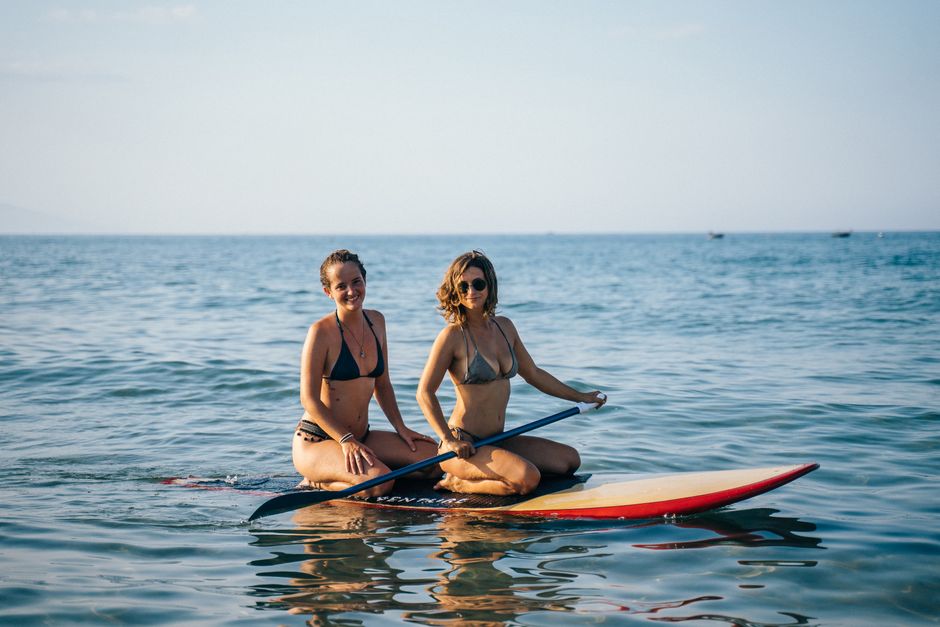
Stand-up paddling on flat water or catching a few small waves is gentle, sociable and good for your head. Keep it short and relaxed.
12. Play something different
A casual round of frisbee, a slow game of pickleball doubles, or kicking a ball around with the kids. Low stakes, easy effort, lots of laughing.
Active recovery by sport
- Runners: swim, pool jog or easy spin to give your legs a break from impact.
- Soccer, rugby, basketball: pool session plus rolling the day after a game; see our soccer page for match-week planning.
- Lifters and CrossFit athletes: walk, row or bike easily, then a mobility circuit.
- Cyclists and triathletes: easy spin or walk, plus upper-body mobility.
- Tennis, pickleball, climbers: walk or swim, and gentle shoulder and forearm work.
- Older athletes: pool walking, gentle yoga and a long walk are great choices.
A sample active recovery day
Here’s how one easy day might look for a soccer player the morning after a Saturday match, though it works for almost any sport:
- Morning: a good breakfast with protein, a big glass of water, and a 30-minute walk outside.
- Midday: 20 minutes of relaxed swimming or pool jogging, then 10 minutes of mobility.
- Afternoon: 10–15 minutes on the foam roller and massage ball while watching the highlights.
- Evening: a normal dinner, no late screens, and an early night.
Total exercise time is under an hour, and none of it should feel like work. If you only have 20 minutes, pick one movement idea and one rolling session. The habit matters more than the exact plan.
When to rest completely instead
Active recovery isn’t always the answer. Take a full rest day if you’re ill, if you have pain that changes how you move, after a very poor night’s sleep, or if you’ve been feeling run-down for several days. Most athletes benefit from at least one full rest day most weeks. If something hurts in a joint or is swollen, see a doctor or physio.
Gear that helps
Polar H10 Heart Rate Sensor
- ECG chest strap
- Bluetooth + ANT+
- Up to 400 hr battery
TriggerPoint GRID 1.0 Foam Roller
- 13 x 5 in
- Multi-density surface
- About $40
TriggerPoint MB5 Massage Ball
- 5 in diameter
- Layered EVA foam
- About $35
The hardest part of active recovery is keeping it easy, and a chest strap helps. The Polar H10 measures heart rate with ECG-style electrodes and pairs over Bluetooth and ANT+ with most watches and apps; Polar lists up to 400 hours on a coin-cell battery and $104.95. The TriggerPoint GRID 1.0 is a durable, portable roller, and the 5-inch TriggerPoint MB5 ball reaches hips, glutes and shoulders. Find more in our best foam rollers and best recovery tools for athletes guides, compare trackers in Whoop vs Oura vs Garmin, or see how it all fits in our athlete recovery routine.
Active recovery questions
Is active recovery better than a rest day?
For soreness after hard training, research suggests easy movement helps more than doing nothing. But you still need some complete rest; most athletes use both.
How long should an active recovery workout be?
Usually 20–45 minutes. Longer is fine for very easy activities like walking, as long as you finish feeling fresher, not more tired.
How often should I do an active recovery day?
Many athletes do one the day after their hardest session or game each week, and another after a second hard day. Plan it like any other session.
Can I lift weights on an active recovery day?
Only very light work, like band exercises or bodyweight activation. Anything that leaves you tired or sore turns it back into a training day.
What heart rate is active recovery?
In ACE-sponsored research, about 55–60% of heart-rate reserve worked well for recovering between hard efforts. In practice, stay in your easiest training zones and at a pace where you can chat comfortably.
Should I stretch on an active recovery day?
Gentle mobility and stretching feel good and help you move freely, so include them if you enjoy them. Just know that in a 2018 meta-analysis, stretching on its own didn’t reduce soreness; easy movement, massage and compression did better. Combine a short mobility circuit with one of the movement ideas above for the best of both.