This article contains affiliate links: if you buy through them we may earn a commission, at no extra cost to you. Learn more.
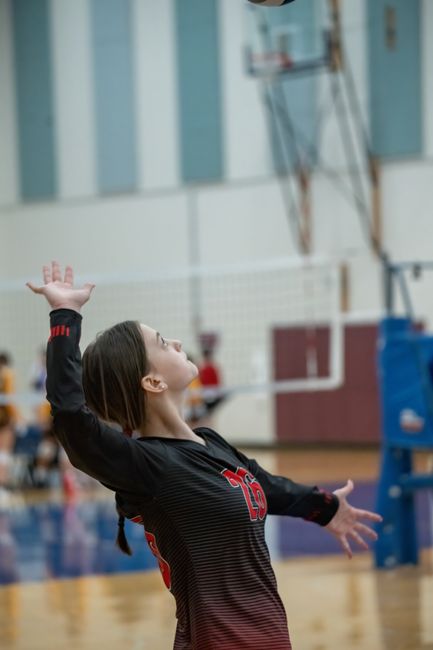
A convention center in June with forty courts going at once, whistles everywhere and parents packed along the end lines with coolers and folding chairs. A Tuesday night high school match where the student section goes quiet on every serve. A doubles game on hot sand at sunset, the ball hanging against an orange sky before someone flies in to dig it. And in December, the college final in a stadium. Volleyball is one of the biggest sports in American schools: in 2024-25, 492,799 girls played it for their high schools, second only to track and field among girls’ sports, and boys’ volleyball grew 12.6% in a single year to 95,972 players, according to the National Federation of State High School Associations (NFHS).
Volleyball, page by page
- Rules: how the game works at every level
- Leagues & associations: pro, college, high school and youth
- Youth & high school: ages, safety and recruiting, for players and parents
- Injuries & sports health: prevention, concussion, when to see a pro
- Training & conditioning: before: off-season to in-season
- Game day: during: fueling, hydration, heat
- Recovery: after: games, tournaments, sleep
- Nutrition & supplements: what to eat, tested supplements
- Best wearables: trackers and watches for the sport
- Gear: the complete equipment list
Buying guide · Our Volleyball buying guide compares the gear we'd pick, with prices and sizing:
This page is volleyball for the people who play it and the people who look after them, indoors and on the beach: how the game works, what it looks like at every level from a 12U club team to the Olympics, and, most of all, how to stay healthy playing it. Sports health is the heart of it: the volleyball injuries players get most, what research says about ankle sprains and jumping knees, how to spot a concussion, sun and heat on the sand, and when to see a professional. Then training, recovery and the gear you really need, with links to every page in our volleyball section.
Volleyball at a glance
| Players per side | Indoor: 6 on the court. Beach: 2, with no substitutes. |
|---|---|
| Scoring | Rally scoring: every rally wins a point. Indoor: best of five sets to 25 (a fifth set to 15), win by 2. Beach: best of three sets to 21 (a third set to 15), win by 2. |
| Court | Indoor 18 × 9 m (about 59 × 29.5 ft); beach 16 × 8 m. |
| Net height | 2.43 m (7 ft 11⅝ in) for men and boys’ high school; 2.24 m (7 ft 4⅛ in) for women and girls. Lower for younger players. |
| Governing bodies | FIVB worldwide; USA Volleyball in the US; NFHS for high school; NCAA, NAIA and NJCAA for college. |
| Most common injuries | Ankle sprains (by far), jumper’s knee and other knee problems, finger and thumb sprains, shoulder overuse, low back pain and concussions. |
How volleyball works
William G. Morgan, the physical director of the YMCA in Holyoke, Massachusetts, invented the game in 1895 as a gentler indoor sport than basketball and called it “Mintonette.” A year later, at a YMCA conference in Springfield, it got a new name: volley ball. The idea is simple. Each team tries to ground the ball on the other side of the net and stop the other team from doing the same. A team gets three hits to return the ball (the block doesn’t count as one indoors), and no player may hit it twice in a row.
Every rally scores a point, whoever served. When the receiving team wins a rally, it gets the serve and its players rotate one position clockwise, so everyone takes a turn at serving and at the net. Three players start in the front row and three in the back; back-row players can’t attack the ball from above the net in front of the attack line, 3 meters from the center line. The details change by level, and our volleyball rules page lays FIVB, NCAA and high school rules side by side.
Teams usually play with a setter (the playmaker who takes the second ball), outside hitters, an opposite, middle blockers and a libero, the defensive specialist in a different-colored jersey who replaces back-row players without counting as a substitution. Apart from the libero, the rulebooks don’t name positions, but these labels describe what each player is asked to do.
Indoor vs beach volleyball
Beach volleyball is its own game. Two players cover a smaller 16 × 8 m court of sand, barefoot unless the referee allows otherwise, with no coaching during matches at the top international level. The block counts as one of the team’s three hits, open-hand tips are a fault, and teams switch sides every 7 points (every 5 in the third set) so nobody plays the whole match into the wind or sun. The beach ball is a little bigger and softer: 66 to 68 cm around versus 65 to 67 cm indoors, at much lower pressure.
Volleyball at every level
Kids and club volleyball
Many kids start at a rec center or school program, and lots of girls (and more and more boys) move into club volleyball, which runs most of the year outside the school season. USA Volleyball’s rules lower the net for younger players: 2.13 m (7 ft) for 11-12 and under, and 1.98 m (6 ft 6 in) for girls 10 and under, with girls reaching the full women’s height at 13-14 and boys reaching the men’s height at 15 and up. Lighter balls made for players 12 and under make passing less painful. Our youth volleyball guide covers net heights by age, club vs school, costs and recruiting.
High school
High school matches follow the NFHS rules: best of five sets to 25 points with a fifth set to 15, or best of three where the state association adopts it, 18 substitutions per set and two time-outs per set. The net is 7 ft 4⅛ in for girls and 7 ft 11⅝ in for boys. Each state association sets its own season and playoffs, and boys’ volleyball added 10,717 high school players in a single year, 2024-25.
College
The NCAA projected 1,055 women’s volleyball teams for 2025-26 across Divisions I, II and III, plus 206 men’s teams and 90 beach volleyball teams. The Division I women’s tournament has a 64-team bracket, and the 2026 finals are on December 17 and 20 at the Alamodome in San Antonio. The men’s National Collegiate championship grew to 12 teams in 2026, and women’s beach volleyball has crowned an NCAA champion since 2016 in Gulf Shores, Alabama. The NAIA and NJCAA run their own championships. See our leagues and associations page for all of them.
Pro
Women’s pro volleyball has taken off in the US. LOVB Pro (League One Volleyball) launched with six teams in 2025 and has 10 for the 2026-27 season, which opens on December 16, 2026, in San Antonio. Major League Volleyball (MLV), the continuation of the Pro Volleyball Federation after a 2025 merger, played its 2026 season with eight teams and says it grows to 12 in 2027. On the sand, the AVP runs the classic beach opens, such as Manhattan Beach in August, plus the AVP League, where eight city teams each field a men’s and a women’s pair.
International and Olympic
The FIVB, founded in Paris in 1947 by 14 countries, governs volleyball worldwide through 222 national federations; USA Volleyball is the US member. Indoor volleyball has been an Olympic sport since Tokyo 1964 and beach volleyball since Atlanta 1996. At Los Angeles 2028, indoor volleyball will be played at an arena in Anaheim and beach volleyball at Alamitos Beach in Long Beach.
Adult and recreational
Rec leagues, coed sixes, grass doubles and beach tournaments make volleyball a sport for life; USA Volleyball even lowers the net for women 45 and over and men 55 and over. Coming back after years off? Build up slowly.
Sports health for volleyball players
Volleyball has no tackling, but it asks for lots of jumps, hard landings, dives and fast arm swings. This section is general information, not medical advice. If you’re hurt, see a professional.
The most common volleyball injuries
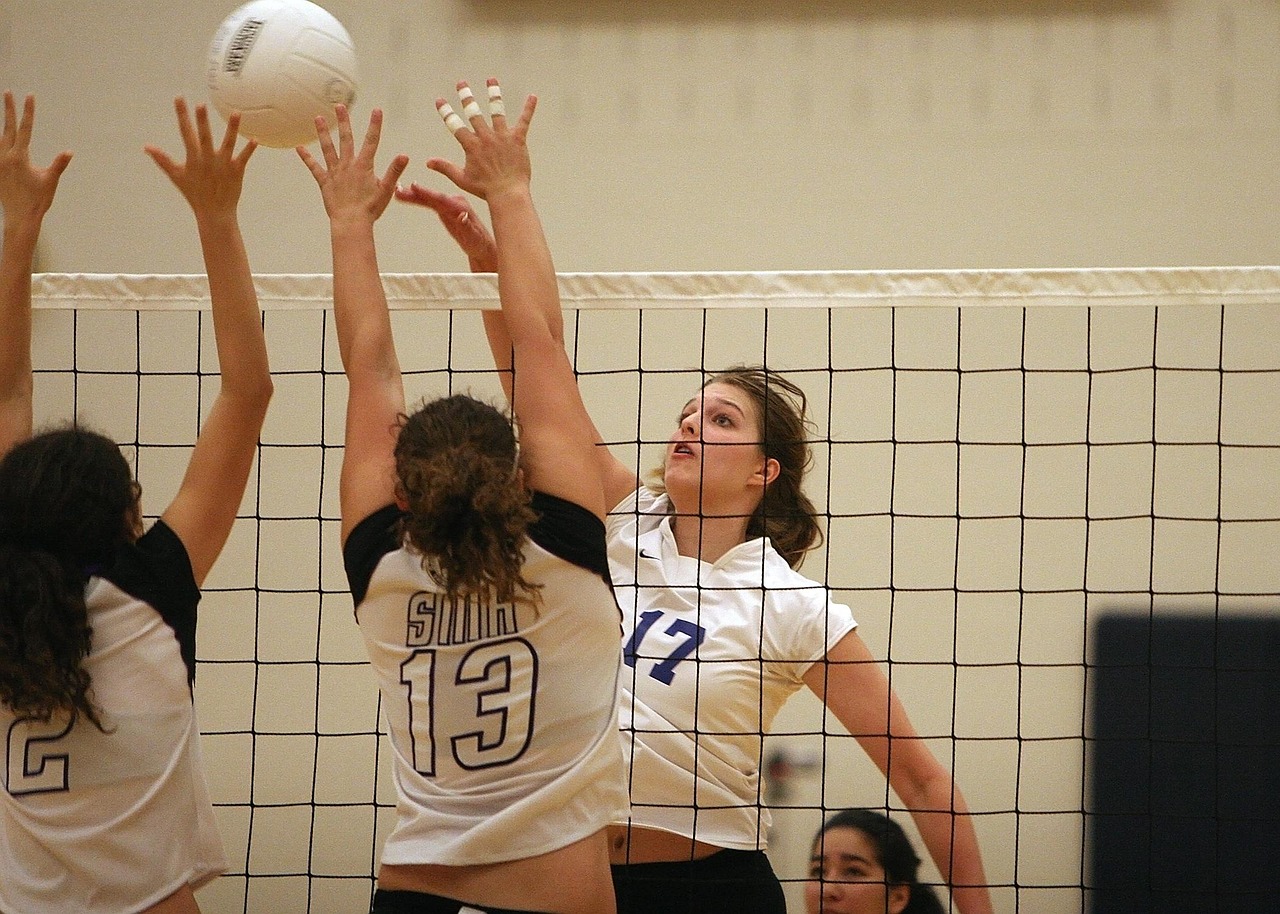
In a study of 2,072 girls on 78 high school teams during the 2018 season, 22.5% had at least one injury. Ankles made up the biggest share of injuries that cost playing time (28%), ligament sprains were 40% of those injuries, and hands and fingers led the minor ones. In NCAA volleyball (2013-14 to 2014-15), the ankle was again the most common time-loss injury for men and women, and concussions made up about 15% of women’s and 19% of men’s time-loss injuries. A 2023 review of volleyball injuries lists the usual suspects: ankle sprains, patellar tendinopathy (jumper’s knee), finger and thumb sprains, shoulder overuse and concussions.
- Ankle sprains: the classic one is landing on a teammate’s or opponent’s foot under the net after a block or attack. In a Norwegian study of top-division players, the ankle was 54% of acute injuries, 79% of ankle injuries were repeat sprains, and an ankle sprained within the past 6 months was far more likely to be hurt again.
- Jumper’s knee and ACL tears: repeated jumping irritates the patellar tendon below the kneecap. ACL tears are less common but serious; a 2025 review found most happen without contact, on spike landings, with the highest rates in female high school players and outside hitters.
- Fingers and thumbs: jammed and sprained fingers from blocking and setting a hard-driven ball.
- Shoulder and back: overuse from thousands of serves and attacks, and low back pain from arching to hit.
- Concussions: most college volleyball concussions in the NCAA study came from being hit by the ball, not from collisions.
Preventing ankle sprains: what the research says
Volleyball has some of the best evidence in sports here. When Norway’s top divisions added an injury-awareness talk, take-off and landing technique for blocking and attacking, and balance-board training for players with past sprains, ankle sprains fell from 0.9 to 0.5 per 1,000 player hours over two seasons. In a Dutch trial of 116 teams, a balance-board program meant fewer ankle sprains, mostly in players who had sprained an ankle before. The National Athletic Trainers’ Association recommends that athletes with a history of ankle sprains wear a brace or tape for all practices and games, and that teams use balance and neuromuscular training. Our ankle brace guide compares the main styles; an athletic trainer can help with fit.
Concussion: recognize and remove
The CDC’s HEADS UP program asks coaches and parents to watch for a player who looks dazed or confused or is suddenly slow to react, and to listen for headache, dizziness or balance problems, sensitivity to light or noise, feeling slowed down, trouble concentrating, irritability or sleep changes. A spiked ball to the head counts.
- Remove the player from play right away if you see signs after a blow to the head, a ball to the face or a hard fall.
- Keep them out for the rest of that day and until a healthcare provider clears them. Don’t try to judge how serious it is yourself.
- Return slowly: getting back to sport goes in steps and usually takes a week or more.
- Call 911 for danger signs: seizures, passing out with growing drowsiness, a headache that gets worse and won’t go away, or one pupil larger than the other or double vision.
Beach volleyball: knees, backs, sun and heat
Sand is softer, and a study of players at the 2001 Beach Volleyball World Championships found the rate of acute time-loss injuries was well below most team sports. Knees, ankles and fingers led the acute injuries, while low back pain, knee pain and shoulder problems were the most common overuse complaints. The bigger day-to-day risks are sun and heat. The CDC recommends a broad-spectrum sunscreen of SPF 15 or higher, put on again after 2 hours in the sun and after sweating or toweling off, plus shade, a brimmed hat and UV-blocking sunglasses. The National Athletic Trainers’ Association advises getting used to the heat gradually, over 7 to 14 days.
Overuse, rest and young players
School, club and summer tournaments can leave young players with no real break. In a survey of 276 girls aged 13 to 18, volleyball-only players played more hours a year, and more volume went with more injuries. The American Academy of Pediatrics warns that specializing too early can harm young athletes physically and mentally.
When to see a doctor, physical therapist or athletic trainer
Don’t play through pain. See a professional for pain that doesn’t settle, swelling, an ankle you can’t put weight on, a knee that gives way or hurts below the kneecap when you jump, a finger that looks out of shape, or any concussion signs. Our volleyball injuries page goes deeper. A sports medicine physician manages most sports injuries without surgery and refers to physical therapy or a surgeon when needed. A physical therapist guides rehab and the return to play. Athletic trainers are licensed or regulated health care professionals in all 50 states who work with physicians; if your school has one, start there.
Training and conditioning for volleyball
Before the season: build leg, hip, core and shoulder strength, practice soft two-foot landings and add balance work, especially after an ankle sprain. The Norwegian program above shows that landing technique is injury prevention, not just style. Our resistance bands guide helps at home.
In season: warm up before every practice and match and watch total jumps and hours, especially for players on a school and a club team. Many athletes track sleep and recovery with a wearable (see Whoop vs Oura vs Garmin and HRV for athletes). More on our volleyball training page.
Match and tournament day: the American College of Sports Medicine and two dietitians’ groups recommend a pre-exercise meal high in carbohydrate, moderate in protein, low in fat and fiber, eaten roughly 1 to 4 hours before. Club tournaments can mean several matches with unpredictable gaps, so pack snacks and fluids (see our electrolyte powder guide), volleyball game day and nutrition and supplements.
Recovery after volleyball matches
Recovery starts with sleep (9 to 12 hours for children 6 to 12, 8 to 10 for teens, 7 or more for adults, per the CDC), food and fluids after the match, and a protein shake when a meal is hours away. Many players also like a foam roller or massage gun for calves and shoulders, compression boots after a long weekend and soft recovery shoes. They’re about comfort, not treatment. More on our volleyball recovery page.
Gear for volleyball
- Shoes: indoor court shoes that grip the floor and hold the heel; the FIVB rules call for light, pliable shoes with rubber or composite soles. Beach players go barefoot.
- Knee pads: for dives and floor burns indoors. They protect from bumps; they don’t fix knee pain.
- Ankle braces: recommended for players with a past sprain; many players wear them anyway.
- Ball: size 5 for teens and adults (65 to 67 cm, 260 to 280 g indoors), lighter balls for kids, and a beach ball for the sand.
- Jewelry off: NFHS rules allow only small, secured stud or post earrings, nothing below the chin.
Four picks for the bag: the Mikasa V200W indoor game ball (about $67 on Amazon in October 2026), Mizuno LR6 knee pads (about $30), the Active Ankle T2 hinged brace (about $35) and the OOFOS OOahh Slide for between matches. Our volleyball gear page covers beach and youth balls too, and best wearables for volleyball goes further.
Mikasa V200W Indoor Volleyball
- Official size 5
- 18-panel design
- Exceeds FIVB standards (maker)
Mizuno LR6 Volleyball Kneepad
- Low-rise, no-fold design
- Kneecap and side protection
- About $30
Active Ankle T2 Ankle Brace
- Rigid hinged shell
- Fits left or right
- Made for volleyball and cheer (maker)
OOFOS OOahh Slide
- OOfoam slide
- APMA Seal of Acceptance
- Machine washable
Volleyball FAQs
How many points is a volleyball set?
Indoors, sets go to 25 points and a deciding fifth set to 15, always won by 2 points. Most matches are best of five; some high school matches are best of three where the state allows it. Beach sets go to 21, with a third set to 15.
What is the most common volleyball injury?
The ankle sprain, usually from landing on another player’s foot near the net. Many are repeat sprains. Balance training, good landing technique and, for players with a past sprain, a brace or tape all lower the risk.
Can you get a concussion playing volleyball?
Yes. In NCAA volleyball, concussions were about 15% of women’s and 19% of men’s time-loss injuries, and most came from being hit by the ball. Any player with concussion signs should come out for the day and be cleared by a healthcare provider before returning.
How tall is a volleyball net?
7 ft 11⅝ in (2.43 m) for men and high school boys, and 7 ft 4⅛ in (2.24 m) for women and girls. USA Volleyball lowers it to 7 ft for players 12 and under, and to 6 ft 6 in for girls 10 and under.
What is a libero in volleyball?
A back-row defensive specialist in a different-colored jersey who can replace any back-row player without using a substitution. The libero can’t block or attack the ball from above the net. Under FIVB rules the libero can’t serve; in high school and NCAA women’s volleyball the libero may serve in one rotation.
Is beach volleyball easier on the body than indoor?
Sand is softer and elite beach players have fewer acute injuries than most team sports, but low back, knee and shoulder overuse is common, and sun and heat add their own risks.
Volleyball gives back a lot: friends, fitness, the noise of a full gym and a game you can take to the beach for life. The players who last warm up well, land softly, sleep, eat, protect their ankles and listen to pain. Keep exploring: our recovery tools guide, Nutrition & Supplements for tournament days, our basketball guide for another jumping sport, and every other sport on our sports hub.