This article contains affiliate links: if you buy through them we may earn a commission, at no extra cost to you. Learn more.
A Saturday tournament in July: four games before dinner, a canopy over the folding chairs, coolers of sliced oranges, and a 12-year-old pitcher throwing windmill from 40 feet while her dad pretends not to watch the speed gun. A high school game in April, when it’s still cold enough for hand warmers in the dugout. And in early June, the Women’s College World Series in Oklahoma City, where the whole sport seems to gather at once. Softball is one of the biggest girls’ sports in the country: 338,315 girls played fastpitch for their high schools in 2024-25, at 15,726 schools, according to the National Federation of State High School Associations (NFHS).
Softball, page by page
- Rules: how the game works at every level
- Leagues & associations: pro, college, high school and youth
- Youth & high school: ages, safety and recruiting, for players and parents
- Injuries & sports health: prevention, concussion, when to see a pro
- Training & conditioning: before: off-season to in-season
- Game day: during: fueling, hydration, heat
- Recovery: after: games, tournaments, sleep
- Nutrition & supplements: what to eat, tested supplements
- Best wearables: trackers and watches for the sport
- Gear: the complete equipment list
Buying guide · Our Softball buying guide compares the gear we'd pick, with prices and sizing:
This page is softball for the people who play it and the people who look after them. It covers mostly fastpitch, the game kids, high schools, colleges and the Olympics play, with a short look at slowpitch for adult leagues. You’ll find how the game works, what it looks like at every level, and, most of all, how to stay healthy playing it: the softball injuries players get most, why pitchers need rest, face protection, concussion and when to see a professional. Then training, recovery and the gear you really need, with links to every page in our softball section.
Softball at a glance
| Players per side | 9 on defense; in fastpitch, teams can add a Designated Player (the “DP/Flex” rule) and bat 10. |
|---|---|
| Game length | 7 innings in high school, college and USA Softball play; youth tournaments often add time limits. |
| Field | Bases 60 feet apart in fastpitch at every level. Women’s pitching distance: 43 feet in high school and college; 35 feet at 10U and 40 feet at 12U (USA Softball). |
| Ball | A 12-inch ball for most players; 11-inch for 10U and younger (USSSA rules). |
| Pitching | Underhand. Fastpitch pitchers use a fast “windmill” motion; slowpitch pitches go up in a slow arc. |
| Governing bodies | WBSC worldwide; USA Softball in the US; NFHS for high school; NCAA, NAIA and NJCAA for college; USSSA and others for travel ball. |
| Most common injuries | Ankle sprains, concussions and other head and face injuries from batted or thrown balls, knee injuries, and overuse pain in pitchers’ shoulders, backs and arms. |
How softball works
Softball started indoors. On Thanksgiving Day 1887, at the Farragut Boat Club in Chicago, a reporter named George Hancock tied up a boxing glove as a ball, chalked a diamond on the floor and used a broom handle as a bat. The game moved outside, grew up, and in 1933 got a national governing body, the Amateur Softball Association, now called USA Softball.
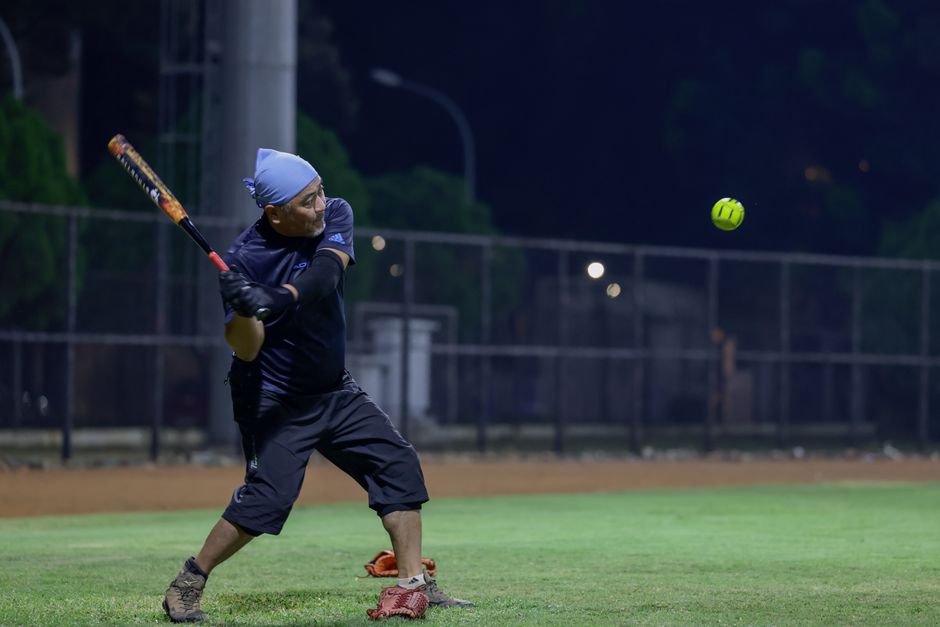
The idea is the same as baseball: get on base, come around to score, and get three outs on defense each inning. The differences make it its own game. The field is smaller, the ball is bigger, and the pitch comes underhand. In fastpitch, a good high school or college pitcher throws hard from just 43 feet, so batters have very little time to react. Bunts, slap hitting and stolen bases are a big part of the game. In slowpitch, the pitch goes up in an arc (USA Softball requires it to peak between 6 and 12 feet) and the game is about hitting and fielding, not pitching.
Three rulebooks matter most in the US: USA Softball (youth travel ball, adult leagues and national teams), the NFHS (high school) and the NCAA (college). They agree on most things and differ on details like run rules, tiebreakers and bat lists. Our softball rules page puts them side by side, with pitching distances for every age.
The positions are the same as in baseball: pitcher, catcher, first base, second base, shortstop, third base and three outfielders. In fastpitch, the pitcher and catcher run the game, and the corner infielders play very close to the batter to cover bunts.
Softball at every level
Kids and youth
Most girls start in a rec league or Little League Softball, often with coach pitch or machine pitch, then move to kid pitch around 9 or 10. Travel teams (“travel ball”) play by age group, from 8U up to 18U, in tournaments sanctioned by USA Softball, USSSA and other groups. The game grows with the players: under USA Softball rules, girls pitch from 35 feet at 10U, 40 feet at 12U and 43 feet from 14U on, and the youngest players use an 11-inch ball. Our youth softball guide covers ages, ball sizes, face masks, pitching rest and recruiting.
High school
High school games follow NFHS rules: seven innings, a 43-foot pitching distance for girls, and batting helmets with a face mask for every batter, on-deck batter and runner, a rule since 2006. Each state association runs its own season and playoffs, and states can add their own rules, such as game-ending rules or masks for fielders.
College
The NCAA runs softball in Divisions I, II and III. Division I ends with a 64-team tournament and the eight-team Women’s College World Series at Devon Park in Oklahoma City. In 2026, Texas beat Texas Tech in the best-of-three finals to win its second straight title. Saint Leo won Division II and Redlands won Division III, both for the first time. The NAIA crowns its champion in Columbus, Georgia (Madonna, in 2026), and the NJCAA has three divisions for two-year colleges. More routes are on our leagues and associations page.
Pro
Pro softball has a real summer home now. The Athletes Unlimited Softball League (AUSL), backed by an investment from MLB, played its second season in 2026 with six city-based teams: the Carolina Blaze, Chicago Bandits, Oklahoma City Spark, Portland Cascade, Texas Volts and Utah Talons. The Talons won the title for the second year in a row in July 2026.
International and Olympic
The World Baseball Softball Confederation (WBSC), formed in 2013, governs softball worldwide. Softball joined the Olympics at Atlanta 1996 and was played through Beijing 2008, then again at Tokyo 2020. The US won gold in 1996, 2000 and 2004; Japan won in 2008 and 2020. It’s back for Los Angeles 2028, with the games played at Devon Park in Oklahoma City, the same stadium as the Women’s College World Series. In September 2026, the US and Mexico qualified there for the finals of the WBSC Women’s Softball World Cup, to be played in Australia in April 2027.
Adult and recreational
For grown-ups, softball usually means slowpitch: company teams, church leagues, co-ed leagues and weekend tournaments. USA Softball registers more than a million players, coaches and umpires and more than 120,000 teams in all 50 states. Slowpitch is easier on the arm but not on the hamstrings: sprinting to first after months on the couch is how a lot of adult injuries start. Warm up and build up slowly.
Sports health for softball players
Softball has fewer collisions than many team sports, but the ball is hard and comes fast, and pitchers throw a lot. This section is general information, not medical advice. If you’re hurt, see a professional.
The most common softball injuries
A national study of high school and NCAA softball, using injuries reported by athletic trainers over about a decade, found that ankle sprains and concussions were the most common injuries at both levels, and many injuries happened while fielding or running the bases. College players were injured at a higher rate than high school players (3.19 vs 1.16 injuries per 1,000 athlete-exposures), and game rates were higher than practice rates. The authors called for strength and prevention programs for ankle sprains and more protection for batters and fielders.
- Ankle sprains: stepping on a base, a bad slide or an uneven outfield. Balance work and, for players with past sprains, a brace help many athletes (see our ankle brace guide).
- Head and face injuries: in a study of US emergency room data (2013–2017), about three in four softball head and face injuries came from being hit by a ball, and most of those were fielders hit by a batted or thrown ball.
- Knee injuries: the knee is among the most often injured body parts in high school- and college-aged players treated in emergency rooms.
- Pitchers’ overuse injuries: the American Orthopaedic Society for Sports Medicine (AOSSM) lists shoulder tendinitis, back and neck pain, and elbow, forearm and wrist tendinitis as the most common overuse injuries in pitchers.
- Throwing arms: repeated overhand throwing strains the shoulder and elbow, for catchers and fielders too.
Pitchers need rest too
An old idea says the underhand motion is “natural,” so softball pitchers can throw every day. Doctors no longer see it that way. The American Academy of Orthopaedic Surgeons (AAOS) notes that windmill pitching can cause biceps tendinitis, and a 2025 research review found that pitchers report more fatigue and pain as a game and a tournament weekend go on. It also found that, as of 2023, there were no established pitch count rules in the US or Canada. AOSSM’s STOP Sports Injuries campaign offers guidelines by age: for example, no more than 65 pitches a game and 95 a day at ages 10–12, no pitching more than two days in a row until age 13, and rotating to other positions. Little League Softball limits pitchers to 12 innings a day in its younger divisions. Our youth page has the full table.
Face masks and helmets
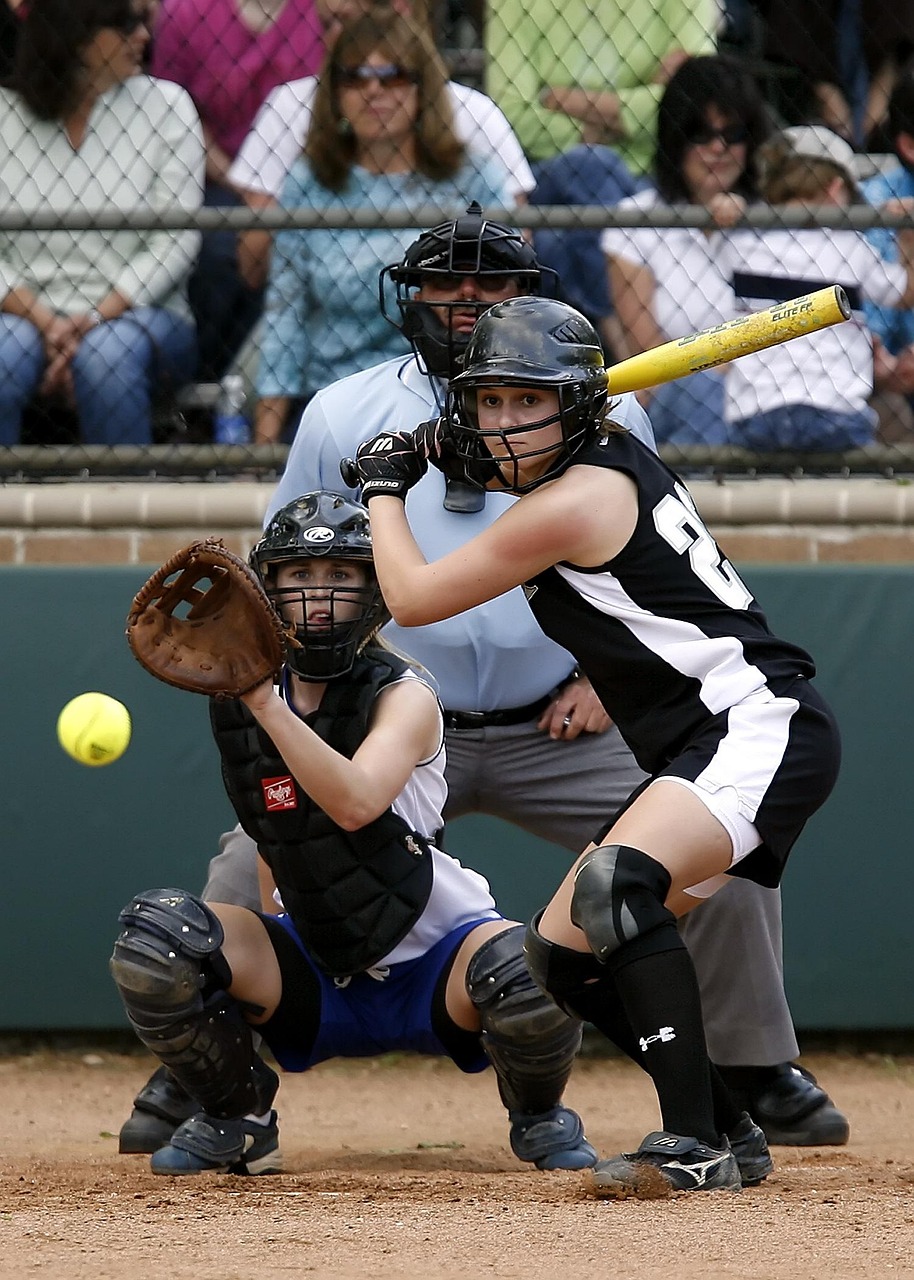
Batting helmets with face masks are required in high school and USA Softball fastpitch, and catchers wear a helmet and mask with a throat protector. Fielder’s masks are optional nationally, but more and more pitchers and corner infielders wear one, and Kentucky’s high school association made them mandatory for pitchers, first basemen and third basemen in 2018. In lab tests, metal masks that sat far enough from the face did the best job of lowering facial fracture risk. More in our softball gear guide.
Concussion: recognize and remove
The CDC’s HEADS UP program asks coaches and parents to watch for a player who looks dazed or confused or is suddenly slow to react, and to listen for headache, dizziness or balance problems, sensitivity to light or noise, feeling slowed down, trouble concentrating, irritability or sleep changes.
- Remove the player from play right away if you see signs after a ball to the head, a collision or a hard fall.
- Keep them out for the rest of that day and until a healthcare provider clears them. Don’t try to judge how serious it is yourself.
- Return slowly: getting back to sport goes in steps and usually takes a week or more.
- Call 911 for danger signs: seizures, passing out with growing drowsiness, a headache that gets worse and won’t go away, or one pupil larger than the other or double vision.
Heat and hydration
Summer tournaments mean long days on hot dirt. AAOS suggests about 24 ounces of fluid two hours before exercise, 8 ounces right before, and 8 ounces every 20 minutes during play. Shade between games, a labeled water bottle and electrolytes on the longest days help many players (see our electrolyte powder guide). Confusion, collapse or a very high body temperature in the heat is an emergency: call 911.
When to see a doctor, physical therapist or athletic trainer
Don’t pitch or play through pain. AOSSM’s advice for pitchers is simple: if pain lasts, see a sports medicine professional. Get checked for arm or shoulder pain that comes back every time you throw, an ankle you can’t put weight on, a knee that pops or gives way, any concussion signs, or a ball to the face. A sports medicine physician manages most sports injuries without surgery, a physical therapist guides rehab and return to play, and an athletic trainer at school is often the first and fastest person to see. Our softball injuries page goes deeper.
Training and conditioning for softball
Off-season and preseason: softball is short bursts: a sprint to first, a dive, a throw across the diamond. Build leg, hip and core strength, sprint speed and shoulder strength, and ease back into throwing before the season starts. AAOS recommends a warm-up of light running, calisthenics and stretches before every practice and game, and AOSSM advises against playing year-round or on overlapping teams. For speed and agility tools, see our speed training equipment guide.
In season: keep some strength work, warm up before every game, and count pitches, including warm-ups and bullpens. Many athletes track sleep and recovery with a wearable (see Whoop vs Oura vs Garmin and HRV for athletes), and a two-strike count with the bases loaded is as mental as it is physical: mental training tools for athletes. More on our softball training page.
Game day: the sports-nutrition position statement from the American College of Sports Medicine and two dietitians’ groups recommends a pre-exercise meal that is high in carbohydrate, moderate in protein, low in fat and fiber, made of familiar foods and eaten roughly 1–4 hours before. On tournament days, plan real snacks and fluids between games. See softball game day and nutrition and supplements.
Recovery after softball games
Recovery starts with the basics. Sleep comes first: the CDC recommends 9–12 hours a night for children 6–12, 8–10 hours for teens and 7 or more for adults. Then real food and fluids after the last game; many players reach for a protein shake when dinner is hours away (see our protein powder guide). AAOS also recommends a cool-down with stretches held about 30 seconds.
Simple tools help many players feel better between games: a foam roller or massage gun for tight legs and forearms, compression boots after a tournament weekend, and soft recovery shoes once the cleats come off. They’re about comfort, not treatment; for a pitcher, real rest from pitching matters more than any gadget. More on our softball recovery page.
Gear for softball
- Bat: it must carry the right certification for your league. High school requires the USA Softball mark; college uses the NCAA Approved Softball Bat List; USSSA events use USSSA-marked bats.
- Helmet: a NOCSAE-approved batting helmet with a face mask.
- Glove: a softball glove, not a baseball glove: the pocket is made for the bigger ball.
- Fielder’s mask: strongly worth it for pitchers and corner infielders.
- Cleats: AAOS recommends supportive cleats with good traction. Younger divisions ban metal cleats.
Three picks to start with: the Easton Ghost OG Double Barrel fastpitch bat (about $300 on Amazon in October 2026), which Easton lists as USA Softball and USSSA certified and which appears on the NCAA approved bat list; the RIP-IT Defense fielder’s mask, made for female players, with room for a ponytail (about $40); and the OOFOS OOahh Slide from our recovery shoes guide for after the last out. Our softball gear page and best wearables for softball go further.
Easton Ghost OG Double Barrel Fastpitch Bat
- 2-piece composite
- USA Softball and USSSA marks (maker)
- On the NCAA approved list
RIP-IT Defense Fielder's Mask
- Made for female players
- Ponytail-friendly strap
- Washable padding
OOFOS OOahh Slide
- OOfoam slide
- APMA Seal of Acceptance
- Machine washable
Everything in our softball section
- Rules: fastpitch vs slowpitch, USA Softball vs NFHS vs NCAA, and pitching distances by age.
- Leagues and associations: USA Softball, USSSA, college, the Women’s College World Series, the AUSL and the Olympics.
- Youth softball: age groups, ball sizes, face masks, pitching rest and recruiting.
- Injuries, training, game day and recovery.
- Nutrition and supplements, best wearables and gear.
Softball FAQs
What is the difference between fastpitch and slowpitch softball?
In fastpitch, the pitcher throws hard underhand with a windmill motion, and bunting and stealing are big parts of the game. In slowpitch, the pitch goes up in a slow arc (6 to 12 feet high under USA Softball rules) from farther away, so the game is about hitting and fielding. Youth, high school, college and Olympic softball are fastpitch; most adult rec leagues are slowpitch.
How far is the pitching distance in softball?
For girls’ and women’s fastpitch, it’s 43 feet in high school and college. USA Softball uses 35 feet at 10U, 40 feet at 12U and 43 feet from 14U up. Men’s and boys’ older divisions use 46 feet. Slowpitch pitchers stand farther back: 46 to 50 feet for teenagers in USA Softball and high school slowpitch.
What is the most common softball injury?
In high school and college surveillance studies, ankle sprains and concussions were the most common. Pitchers also get overuse injuries in the shoulder, back and arm, and fielders hit by batted balls account for many head and face injuries.
How many pitches can a softball pitcher throw?
There’s no national pitch count rule in softball. AOSSM’s STOP Sports Injuries guidelines suggest limits by age, such as 50 pitches a game for ages 8–10 and 100 a game for 15 and older, plus rest days. Little League Softball limits pitchers by innings instead.
Is softball in the Olympics?
Yes, at Los Angeles 2028. Softball was played at five Olympics, from Atlanta 1996 through Tokyo 2020 (with a break for 2012 and 2016). The LA28 games will be played at Devon Park in Oklahoma City.
Softball gives back a lot: friends, long summer weekends and a game you can play for life, fast or slow. The players who last warm up, rest their arms, protect their faces, sleep, eat and listen to pain. Keep exploring: our recovery tools guide, Nutrition & Supplements for tournament days, our basketball guide for the winter season, and every other sport on our sports hub.