This article contains affiliate links: if you buy through them we may earn a commission, at no extra cost to you. Learn more.
Recovery isn’t one thing. It’s the five-minute warm-up with a foam roller before Saturday’s match, the legs-up session in compression boots after a long ride, the cold plunge on a frosty deck after a heavy lift, and the number on your wrist the next morning telling you whether to push or ease off. Whether you swim, box, play tennis or just refuse to miss your Sunday league, these are the best recovery tools for athletes in 2026: one top pick for each type, what each one is really for, and when in your week to use it.

Prices change often. The prices below are what we saw at the maker or a major retailer in October 2026; check the current price before you buy.
Our top picks
Hypervolt 3
- 60 lb stall force
- Heated head included
- Up to 4 hr battery
Hyperice Normatec 3 Legs
- 7 levels, 40–110 mmHg
- 5 zones with ZoneBoost
- Up to 3 hr battery
TriggerPoint GRID 1.0
- 13 in, hollow core
- Multi-density surface
- About $40
Compex Sport Elite 3.0
- 10 programs incl. TENS
- Up to 8 hr stimulation
- 2-year warranty
Ice Barrel 300
- 77 gal, up to 6 ft tall
- Insulated, chiller-ready
- Made in the USA
HigherDOSE Infrared Sauna Blanket
- Up to 175°F
- Heat levels 1–9, 1 hr timer
- 120-day money-back
WHOOP Peak (WHOOP 5.0)
- Daily recovery score
- No screen, 14+ day battery
- $239/year, band included
Recovery tools compared
| Tool | Type | When most athletes use it | Key fact | About (Oct 2026) |
|---|---|---|---|---|
| Hypervolt 3 | Massage gun | Warm-up and after training | 60 lb stall force, 2 lb | $249 |
| Normatec 3 Legs | Compression boots | After training, rest days | 5 zones, 7 levels | $899 |
| TriggerPoint GRID 1.0 | Foam roller | Before and after, anywhere | 13 in, hollow core | $40 |
| Compex Sport Elite 3.0 | EMS / TENS | Warm-up, recovery programs | 10 programs | $279–$320 |
| Ice Barrel 300 | Cold plunge | After hard sessions | 77 gal, insulated | $1,150 |
| HigherDOSE Sauna Blanket | Sauna blanket | Rest days, evenings | Up to 175°F | $699 |
| WHOOP Peak | Recovery tracker | Every morning | 14+ day battery | $239/year |
The best recovery tools, one per type
1. Hypervolt 3: best massage gun
A massage gun is the most versatile tool here: a quick, light pass on the calves and hips as part of your warm-up, a slower one on sore quads and shoulders afterwards. The Hypervolt 3 (new in March 2026) gives you 60 lb of stall force, 5 speeds, up to 4 hours of battery and a heated head in the box, at about 48 dB, so it’s quiet enough to use on the sofa. It weighs 2 lb and comes with 5 heads and a carry case.
- Good: strong, quiet, heat included, fair price.
- Watch out: Hyperice doesn’t publish stroke depth; for the deepest stroke, see the Theragun PRO in our best massage guns guide.
- Best for: almost everyone; tennis, swimming, climbing, lifting.
Check the Hypervolt 3 price on Amazon
2. Hyperice Normatec 3 Legs: best compression boots
Compression boots squeeze your legs in waves from feet to hips while you sit still, which is why runners, cyclists and soccer players love them after big days. The Normatec 3 has 7 levels (40–110 mmHg), 5 overlapping zones, ZoneBoost for extra pressure where you need it, Bluetooth app control and up to 3 hours of battery. Hip and arm attachments are sold separately. For hose-free and cheaper options, see our best compression boots guide.
- Good: the proven standard; expandable.
- Watch out: a big spend; hose and control unit to manage.
- Best for: leg-heavy sports and high training volume.
Check the Normatec 3 Legs price on Amazon
3. TriggerPoint GRID 1.0: best foam roller
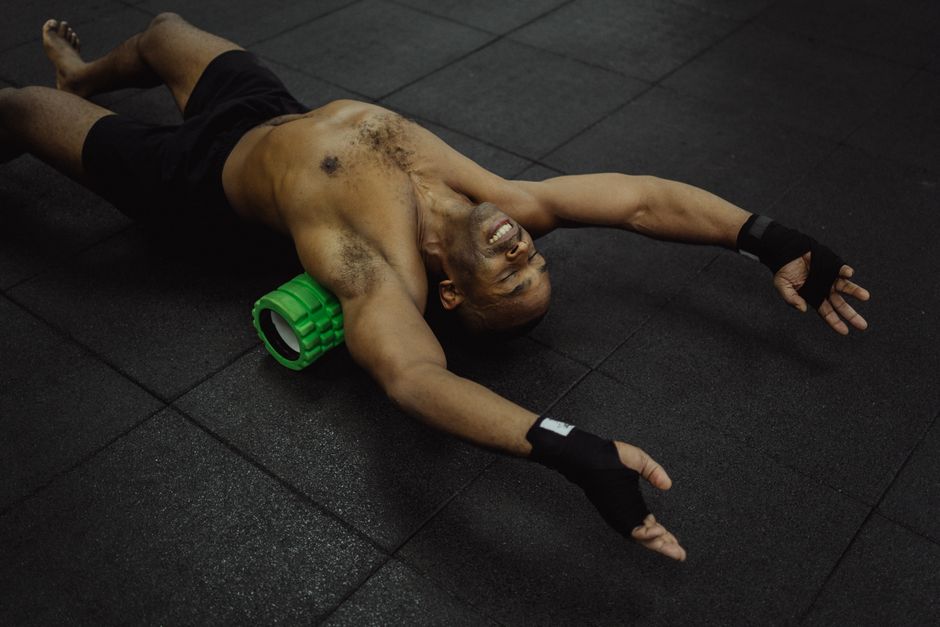
The cheapest tool on this list might be the one you use most. The GRID is 13 in long with a rigid hollow core wrapped in EVA foam, and its multi-density surface of ridges and nodules lets you choose a softer or firmer area for each muscle. Retailers say it’s tested to 500 lb, and it’s small enough to fit in a gym bag or carry-on. Roll before a run or a match to loosen up, and after to cool down.
- Good: about $40; holds its shape; travels well.
- Watch out: firmer than a plain foam roller; beginners may want something softer at first.
- Best for: everyone, every day.
Check the TriggerPoint GRID price on Amazon
4. Compex Sport Elite 3.0: best EMS / TENS unit
An electrical muscle stimulator sends small pulses through pads on your skin to make the muscle contract. Compex’s Sport Elite 3.0 has 10 programs (2 warm-up, 4 strength, 3 recovery and 1 TENS), a rechargeable battery good for up to 8 hours of stimulation, a water-resistant silicone sleeve and a 2-year warranty. Compex says you can use it before, during or after a workout. We saw it at about $279 on Amazon and $319.99 on sale at Compex (regular $419.99).
- Good: warm-up, strength and recovery programs in one unit; long battery.
- Watch out: pads wear out and need replacing; there’s a learning curve with placement.
- Safety: don’t use EMS or TENS if you have a pacemaker or other implanted device, and check with your doctor first if you’re pregnant, have epilepsy or a heart condition.
Check the Compex Sport Elite 3.0 price on Amazon
5. Ice Barrel 300: best cold plunge
You sit upright in an Ice Barrel, so it fits on a patio or in a garage corner. The 300 holds 77 gallons, fits people up to 6 ft tall, weighs 61 lb empty and is insulated with thick polyurethane foam in the barrel and lid. Start with ice; later you can connect Ice Barrel’s chiller (about $4,000 more) through the built-in ports. It’s made in the USA from recycled plastic with a limited lifetime warranty. More tubs, from inflatables to chilled systems, are in our best cold plunges guide.
- Good: small footprint; insulated; upgradeable.
- Watch out: no chiller included; taller athletes need the bigger Ice Barrel 500.
- Safety: start short and not too cold, never plunge alone, and ask your doctor first if you have a heart or blood-pressure condition or are pregnant.
Check the Ice Barrel 300 price on Amazon
6. HigherDOSE Infrared Sauna Blanket: best sauna blanket
A sauna blanket gives you a sweaty, heavy-eyed sauna evening without building a sauna. You zip in on the floor or a bed, with long sleeves or HigherDOSE’s insert between you and the blanket. It heats up to 175°F with levels 1–9, has a 1-hour timer and a handheld controller, and folds into a bag. HigherDOSE gives a 1-year limited warranty and a 120-day money-back guarantee. See our best sauna blankets guide for cheaper options.
- Good: the best-known blanket; long trial period.
- Watch out: $699 is a lot for a blanket; you need to clean it after each use.
- Safety: drink water, keep sessions moderate, and skip it if you’re pregnant or ask your doctor first if you have a heart condition or low blood pressure.
See the Sauna Blanket at HigherDOSE
7. WHOOP Peak: best recovery tracker
All the tools above help you feel better; a tracker tells you how your body is actually coping. WHOOP gives you a recovery score each morning from your sleep and heart data, and has no screen, so you can wear it during matches and in bed. The Peak membership is about $239 a year and includes the WHOOP 5.0 sensor, a band and a wireless battery pack; the battery lasts 14+ days. (WHOOP One is about $199 and Life about $359.) Prefer a ring? The Oura Ring 4 costs from $349 plus $5.99 a month. Compare them in WHOOP vs Oura vs Garmin and our best smart rings.
- Good: hardware included; long battery; nothing on your wrist to distract you.
- Watch out: you pay every year; no screen means no time or pace on the wrist.
- Best for: athletes who want to decide when to push hard and when to rest.
See WHOOP memberships at WHOOP
How to build your recovery kit
- Start cheap and daily. A foam roller and a massage gun cover warm-ups and cool-downs for under $300 together, and you’ll use them most.
- Match the tool to your sport. Leg-heavy sports (running, cycling, soccer) get the most from compression boots; racket and throwing sports from a massage gun on shoulders and forearms; combat sports and CrossFit often add cold.
- Think in phases. Before training: rolling, a light massage-gun pass, EMS warm-up. After: boots, massage, cold. Rest days: sauna, longer boot sessions, sleep. Every day: your tracker.
- Don’t skip the basics. Sleep, food and easy days do more than any gadget; these tools help you stick to good habits.
- Respect the health warnings. These are consumer products, not medical treatment. If you have a heart condition, a pacemaker, a history of blood clots, or are pregnant, ask your doctor before cold, heat, compression or electrical stimulation.
Ready to go deeper? Browse the whole Recovery & Regeneration section, including foam rollers and TENS & EMS, the cold plunges and recovery trackers sections, our Plunge vs Ice Barrel comparison, the best red light therapy devices, and the best recovery shoes for the walk home from the gym.
Recovery tool questions
What’s the one recovery tool to buy first?
For most athletes, a foam roller (about $40) and then a massage gun. They’re cheap compared with boots or a plunge, work for every sport and fit in a gym bag.
Massage gun or compression boots?
A massage gun works on any muscle, takes minutes and costs $150–$530. Boots work only on legs (unless you buy attachments) but need no effort; you sit for 20–30 minutes. If your sport is mostly legs and you train a lot, boots; otherwise, start with a gun.
Should I use cold or heat after training?
Both are popular, for different moments. Many athletes like cold after hard sessions and heat on rest days or in the evening. Some research suggests cold right after strength training may blunt muscle gains, so lifters often keep cold away from lifting days. If in doubt, ask a coach or sports doctor.
Can I use EMS if I have a pacemaker?
No. Electrical stimulators like Compex and PowerDot are not for people with pacemakers or other implanted electronic devices. Check the manual’s full warning list and ask your doctor.
Do I need a subscription for a recovery tracker?
For WHOOP, yes: the band comes with a membership from about $199 a year. Oura sells the ring (from $349) plus a $5.99 monthly membership. Garmin watches show recovery data without a required subscription.