This article contains affiliate links: if you buy through them we may earn a commission, at no extra cost to you. Learn more.
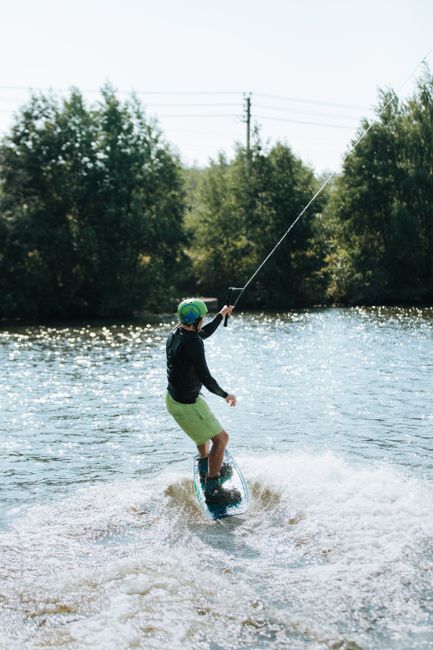
Glassy water at 7 a.m., before the lake wakes up. A rider sits in the water at the back of the boat, board sideways and tip up, and calls “Hit it!” The rope comes tight, the board planes, and a few seconds later they’re standing, edging out toward the wake while the observer in the back seat gives a thumbs-up to the driver. Two passes later they’re popping off the wake and landing soft on the other side. Across town, at a cable park, a kid in a helmet slides a rail with no boat in sight. Wakeboarding is all of this: a family lake sport, a park sport with a skateboard-style culture, and a competitive sport with national and world championships every summer.
Wakeboarding, page by page
- Rules: how the game works at every level
- Leagues & associations: pro, college, high school and youth
- Youth & high school: ages, safety and recruiting, for players and parents
- Injuries & sports health: prevention, concussion, when to see a pro
- Training & conditioning: before: off-season to in-season
- Game day: during: fueling, hydration, heat
- Recovery: after: games, tournaments, sleep
- Nutrition & supplements: what to eat, tested supplements
- Best wearables: trackers and watches for the sport
- Gear: the complete equipment list
Buying guide · Our Wakeboarding buying guide compares the gear we'd pick, with prices and sizing:
This page is for riders of every level and the people who look after them: how wakeboarding works behind a boat and at a cable park, what it looks like from first ride to world championships, and, most of all, how to stay healthy doing it. Sports health is the heart of it: the injuries that show up most (knees, faces and heads), why the propeller and the exhaust matter as much as the jumps, what the Coast Guard’s numbers say about life jackets, and when to see a professional. Then training, lake-day fuel, recovery and the gear you really need. Water skiing has its own guide: /sports/water-skiing/.
Wakeboarding at a glance
| The sport | One board, both feet in bindings, riding sideways like a snowboard on water. Riders are pulled by a boat (and use its wake as a ramp) or by an overhead cable around a lake at a cable park. |
|---|---|
| Competition | Judged, not timed: two passes behind the boat, or laps of a cable course with kickers, rails and boxes. Judges score difficulty, risk, intensity, variety and execution. |
| Governing bodies | The International Waterski & Wakeboard Federation (IWWF) worldwide; USA Water Ski & Wake Sports (its USA Wakeboard division) in the US; the World Wake Association (WWA) for the pro tour and most amateur events. |
| Olympics? | No. The IWWF is recognized by the International Olympic Committee, but wakeboarding is not on the Olympic program. It is in the Pan American Games (men since 2007, women since 2019) and the World Games. |
| Main physical demands | Legs to absorb landings, a strong back and core to hold an edge against the pull, grip and forearms, and balance. Big landings and face-first falls are the main injury risks. |
| Biggest safety rules | A Coast Guard-approved life jacket, an observer watching the rider, hand signals everyone knows, the engine off whenever someone is near the back of the boat, and a helmet on cable features. |
How wakeboarding works
Where it came from
Wakeboarding grew out of surfing. USA Water Ski & Wake Sports traces it to the Skurfer, a cross between a water ski and a surfboard made in 1985 by San Diego surfer Tony Finn, and to Herb O’Brien’s Hyperlite, the first compression-molded wakeboard with neutral buoyancy. That floatier board made deep-water starts much easier, and the sport took off. Today the same board shape is ridden behind ski boats, purpose-built wake boats and cables.
Behind the boat
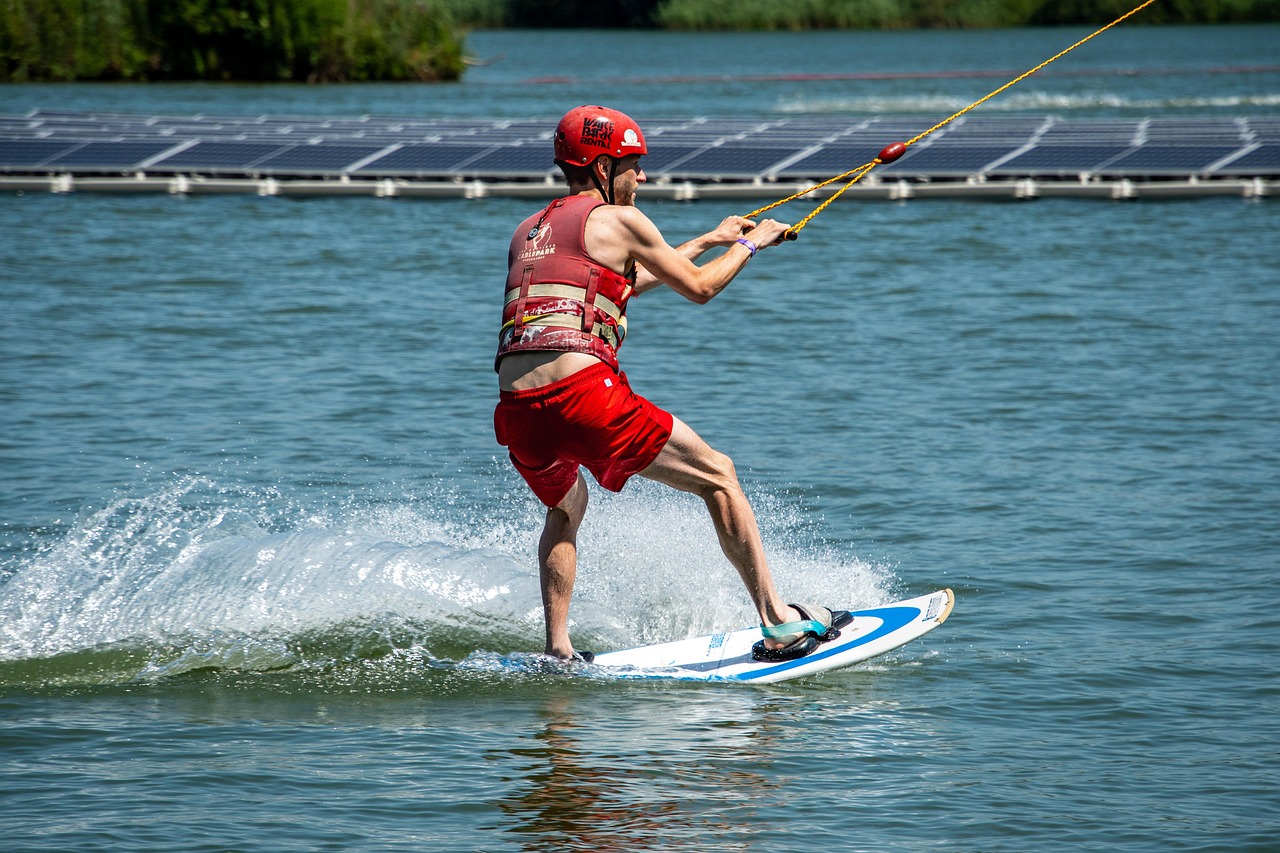
You start in the water with the board in front of you, knees bent to your chest, and let the boat pull you up. Most riders stand with the left foot forward (regular) or the right foot forward (goofy), and ride on the heelside or toeside edge. Edging away from the wake and cutting back into it turns the wake into a ramp for jumps, spins and, for advanced riders, inverts. There’s no set speed: in WWA competition, the rider tells the driver the speed they want. Many wake boats add water ballast to make a bigger wake.
At a cable park
At a cable park, riders are pulled by an overhead cable, much like a ski lift, strung around a lake. Parks have full-size cables that carry many riders at once and smaller two-tower (“2.0”) systems, and they add features: kickers (ramps), rails, boxes, A-frames and even quarter pipes. No boat needed: you buy a session pass. Cable riding is its own competition discipline at the IWWF and in the WWA Wake Park series, and it has its own culture of rail contests and wakeskates (boards without bindings). Each park sets its own rules; in WWA competitions, any rider who hits a feature must wear a helmet.
How contests are judged
In a boat contest, each rider gets two passes through the course and may perform any routine they choose. Under the WWA rule book, judges score difficulty, risk, intensity, variety and execution, three or more judges are used, pro divisions are limited to four tricks per pass, and a second fall ends the run. Our rules page explains it in full.
Wakeboarding at every level
Kids and families
Many kids first ride on a family boat or at a cable park’s beginner line. There’s no official minimum age; what matters is that a child is comfortable in the water, wears a well-fitted, Coast Guard-approved life jacket and has fun. Kids’ boards come with junior bindings sized by shoe size. The WWA runs youth divisions for riders under 13, and the IWWF has an under-14 category at its world championships. Our youth wakeboarding page covers ages, kids’ boards and parents’ questions.
Teens and college
Teens ride in the WWA’s amateur divisions as they age out of youth, and the IWWF world championships have an under-18 category. Wakeboarding isn’t an NCAA sport. US college water sport competition is built around three-event water skiing (see our water skiing organizations page); college-age wakeboarders usually keep competing in WWA amateur divisions or riding for fun at cable parks.
Adults, masters and the pros
USA Water Ski & Wake Sports, the national governing body for towed water sports, has more than 11,000 members and about 600 affiliated clubs. On the wake side, the WWA, founded by riders in 1989, runs the Nautique Wake Series for boat wakeboarding and the Wake Park series for cable. The 2026 WWA wakeboard nationals were held in July in Boca Raton, Florida, with 240 competitors across every level, and the 2026 Wake Park World Championships are set for October 8–11 in Valdosta, Georgia. Masters riders have their own place too: the 2026 IWWF World Wakeboard Championships had 30-and-over, 40-and-over and 50-and-over categories.
International
The IWWF, founded in Geneva in 1946, has 91 member federations and governs boat wakeboard and cable wakeboard alongside the water ski disciplines. The 2026 IWWF World Wakeboard Championships were held August 3–8 at Lago del Salto, Italy. Men’s wakeboarding has been in the Pan American Games since 2007 and women’s since 2019. The full story is on our leagues and associations page.
Sports health for wakeboarders
Wakeboarding mixes speed, hard water, fixed bindings and, behind a boat, a spinning propeller, so the risks come from two places: the falls and landings themselves, and the boat. This section is general information, not medical advice. If you’re hurt, see a professional. Our wakeboarding injuries page goes deeper.
The most common injuries
- Head and face: a study of US emergency department visits from 2001 to 2003 estimated about 4,810 wakeboarding injuries. Head injuries were 28.8% of them, against 4.3% of water skiing injuries in the same study, and traumatic brain injuries were 12.5%. Cuts (lacerations) were the most common wakeboarding diagnosis, and most were to the face. A later study (2000–2007) also found wakeboarding injuries more often involved the head and neck.
- Knees and ACL tears: in a survey of orthopedic surgeons, ACL tears were the most common wakeboarding injury they had treated (31%). In a survey of 123 riders, 42% reported an ACL tear while wakeboarding; most described a pop after landing a big jump, not a twisting edge catch. It was a self-selected survey, but it points to landings as the moment to respect.
- Ankles: with both feet locked in bindings, ankle sprains were 17% of the injuries riders reported in the 2004 survey.
- Shoulders: shoulder dislocations were 15% of the wakeboarding injuries surgeons had treated, and 21% of all injuries were fractures of some kind. Holding the handle against the pull also loads shoulders, elbows and grip every set.
Concussion: recognize and remove
Because head injuries are so common in wakeboarding, everyone on the boat or the dock should know the CDC’s HEADS UP signs: a rider who looks dazed or confused, is slow to answer or can’t remember the fall, or who reports headache, dizziness, nausea, blurry vision or sensitivity to light. Stop riding for the day and keep them out until a healthcare provider clears them. Call 911 for danger signs such as a worsening headache, repeated vomiting, seizures, passing out or one pupil larger than the other. A water sports helmet (look for CE EN 1385 on the label) is standard on cable features and worth wearing behind the boat while learning to jump, especially for kids.
The boat: propellers and carbon monoxide
In the Coast Guard’s 2024 statistics, there were 169 incidents in which someone was struck by a propeller, with 30 deaths and 158 injuries, and towed water sport mishaps caused another 15 deaths and 189 injuries. The Coast Guard’s advice is simple: shut off the engine when people in the water are near the boat, keep a downed rider on the driver’s side and in view, and never let anyone sit, “teak surf” or hang on the swim platform while the engine runs. Exhaust collects at the stern, and carbon monoxide poisoning looks like seasickness: irritated eyes, headache, nausea, weakness or dizziness. Move the person to fresh air and get medical help if needed.
Life jackets and drowning
In 2024, 87% of boaters who drowned, where life jacket use was known, weren’t wearing one, and alcohol was the leading known factor in boating deaths. State laws set the rules for riders: Florida and Pennsylvania, for example, require anyone being towed to wear a Coast Guard-approved, non-inflatable life jacket. Check the label too: some approved jackets say they are not approved for water skiing, wakeboarding or tubing. Competition-style “impact vests” that aren’t Coast Guard approved don’t count. Our wakeboarding gear page compares approved vests.
Cold water, sun and storms
Early- and late-season water is cold even when the air is warm. The Coast Guard notes that cold shock from a sudden plunge passes in about a minute, but you can lose useful movement in your hands and arms within about 10 minutes, so dress for the water temperature with a wetsuit and keep sessions short. On sunny days, UV comes from above and reflects off the water. The American Academy of Dermatology recommends a broad-spectrum, water-resistant SPF 30 or higher sunscreen, reapplied every two hours and after getting wet. When thunder roars, get off the water.
When to see a doctor, physical therapist or athletic trainer
See a professional for a knee that pops, swells or gives way, an ankle you can’t walk on, a shoulder that slipped out or won’t lift, any concussion signs, or a cut on the face that gapes. A sports medicine physician manages most sports injuries without surgery and refers to a surgeon when needed; a physical therapist guides rehab and the return to riding; an athletic trainer, if your school or club has one, is a good first stop.
Training and conditioning for wakeboarding
Every wake jump ends in a landing that loads the legs like a heavy squat, and every cut is a long, hard pull against the rope. Off the water, many riders build single-leg strength and landing control (step-downs, controlled jumps that land soft with knees over toes), a strong posterior chain (rows, deadlift patterns, back extensions), a solid core for holding an edge, plus grip and forearm work. Shoulder strength, especially the rotator cuff, helps keep the handle in good positions. Warm up on the dock before the first set. Learn new tricks small, progress gradually, and stop when your legs are cooked: the ACL survey above suggests big landings, not the bindings, are when knees get hurt. See our training page.
Lake day: fuel, hydration and recovery
A lake or cable day is long, sunny and stop-and-go. Bring real food (sandwiches, fruit, something salty) and more water than you think, and on hot days many riders add an electrolyte tablet such as Nuun Sport (see our electrolyte powder guide). After riding, recovery starts with the basics: the CDC recommends 7 or more hours of sleep for adults and 8–10 for teens. A foam roller for the back and legs and a small massage gun for forearms and shoulders are popular for comfort; they’re not treatment, and pain that lasts needs a professional. Our recovery tools guide compares the options, and our wakeboarding recovery page covers the rest.
Gear for wakeboarding
- A Coast Guard-approved life jacket that fits snugly and is labeled for towed sports. The Hyperlite Indy (about $70) is a neoprene vest with Coast Guard Level 70 approval.
- A board and bindings that match your size and level. The O’Brien System wakeboard package (about $300) comes with bindings mounted, a continuous rocker and an extra-buoyant core the maker says makes getting up easier. For riders starting to jump the wake, the Ronix Vault (about $500 with Divide boots) has a hybrid three-stage rocker.
- A low-stretch wakeboard rope so the pull stays steady when you cut and jump. See our rules and hand signals page for rope and boat safety.
- A helmet for cable parks and for learning new tricks, such as the Pro-Tec Ace Water (about $85, CE EN 1385), plus sun protection and recovery gear for after the session.
O'Brien System Wakeboard Package
- Bindings already mounted
- Continuous rocker
- Extra-buoyant foam core
Hyperlite Indy Life Jacket
- USCG approved, Level 70
- Neoprene, snug fit
- Drains quickly
Pro-Tec Ace Water Helmet
- Meets CE EN 1385
- 15 drain vents
- XS to XL
Our full wakeboarding gear guide covers boards, bindings, vests, ropes, helmets and recovery gear. For more after the lake, browse Recovery & Regeneration.
Wakeboarding FAQs
Is wakeboarding harder than water skiing?
They’re different skills: skiers face forward on two skis or one, while wakeboarders ride sideways on one board, like a snowboard. Neither is required first. The injuries differ too: wakeboarding has a much bigger share of head and face injuries because riders jump the wake. Our water skiing guide covers the other side.
Do you need a spotter to wakeboard?
Usually, yes. Observer rules come from the states, not federal law: Florida requires an observer besides the driver or a wide-angle rear-view mirror, and Pennsylvania requires a competent observer in the boat. Even where it isn’t required, the BoatUS Foundation advises an observer whose only job is to watch the rider.
Is wakeboarding an Olympic sport?
No. Its world federation, the IWWF, is recognized by the IOC, but wakeboarding is not on the Olympic program. It is part of the Pan American Games and the World Games.
Should wakeboarders wear a helmet?
In WWA competitions, any rider who hits a feature must wear one, and cable parks set their own helmet rules, so ask yours. Behind the boat it’s optional, but researchers who found head injuries were nearly 29% of wakeboarding injuries said helmets and other protective gear deserve a closer look. Many parents put one on kids and on anyone learning new tricks.
Can I learn at a cable park instead of behind a boat?
Yes. Many parks have a beginner cable or a two-tower system, rent boards, vests and helmets, and let you ride without owning a boat. Read the park’s rules before your first lap.
What should I eat and drink on a lake day?
Familiar food you can eat between sets, plenty of water and, on hot days, electrolytes. Skip alcohol while driving, spotting or riding: it’s the leading known factor in boating deaths.
Wear the vest, spot every rider, shut off the engine near people in the water and look after your knees and head. Next: rules, hand signals and boat safety, youth wakeboarding, leagues and associations, gear, or compare with our water skiing, surfing and snowboarding sections.