This article contains affiliate links: if you buy through them we may earn a commission, at no extra cost to you. Learn more.
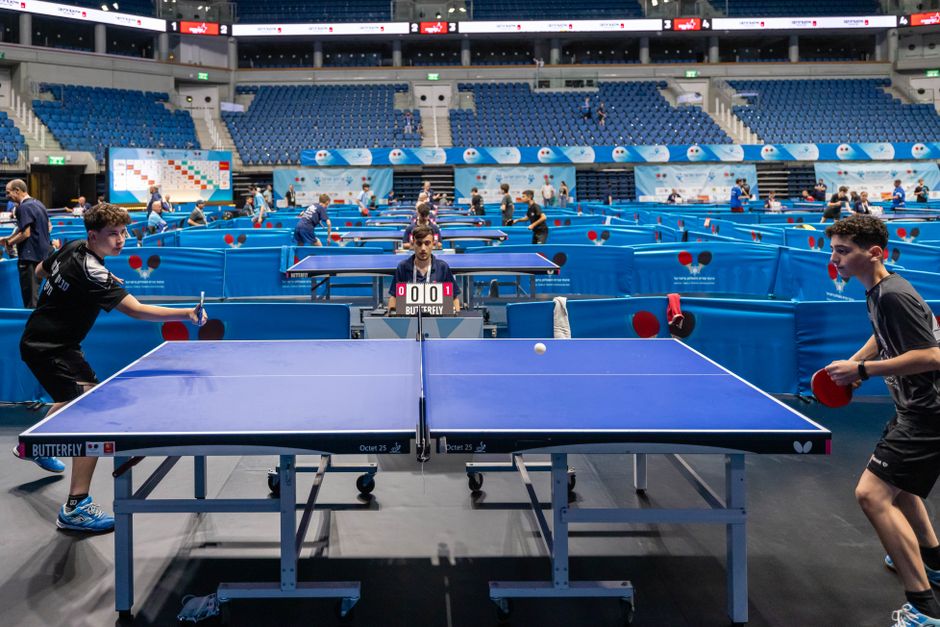
A basement table on a rainy Saturday, the whole family arguing over whether that edge ball counted. A Tuesday-night club league in a community center, a dozen tables going at once and the steady click-clack of rallies. A packed convention hall at the U.S. Nationals, where kids of eleven and veterans of seventy play in the same building. And on the biggest stage, an Olympic final where the ball crosses the net faster than you can follow it. Table tennis, which most Americans grew up calling ping pong, is one of the few sports you can start in a garage and keep playing for the rest of your life.
Table Tennis, page by page
- Rules: how the game works at every level
- Leagues & associations: pro, college, high school and youth
- Youth & high school: ages, safety and recruiting, for players and parents
- Injuries & sports health: prevention, concussion, when to see a pro
- Training & conditioning: before: off-season to in-season
- Game day: during: fueling, hydration, heat
- Recovery: after: games, tournaments, sleep
- Nutrition & supplements: what to eat, tested supplements
- Best wearables: trackers and watches for the sport
- Gear: the complete equipment list
Buying guide · Our Table Tennis buying guide compares the gear we'd pick, with prices and sizing:
This page is table tennis for the people who play it and the people who look after them: how the game works, what it looks like at every level from a first club night to the Olympics and Paralympics, and, most of all, how to stay healthy playing it. Sports health is the heart of it: which injuries table tennis players get (mostly the shoulder, the low back and the knees, and mostly from overuse), how to warm up and build up training, and when to see a professional. Then training, recovery and the gear you really need.
Table tennis at a glance
| Players | 1 against 1 (singles) or 2 against 2 (doubles, including mixed doubles). Team events combine singles and doubles matches. |
|---|---|
| Table | 2.74 m long and 1.525 m wide (about 9 × 5 feet), 76 cm (about 2.5 feet) off the floor. The net is 15.25 cm (6 inches) high. |
| Ball | 40 mm, 2.7 grams, plastic, white or orange. |
| Scoring | Games to 11, won by 2 at 10-all. Each player serves 2 points in a row (1 each from 10-all). A match is the best of an odd number of games, for example best of five or seven. |
| Governing bodies | The ITTF writes the Laws of Table Tennis; World Table Tennis (WTT) runs the pro series; USA Table Tennis (USATT) governs the sport in the US; the NCTTA runs college table tennis. |
| Most common injuries | Overuse problems more than accidents: shoulder, low back, knee and other lower-limb injuries, strains and sprains, and tendon irritation (tenosynovitis). |
How table tennis works
One player serves, the other returns, and the ball has to bounce once on the opponent’s side each time. Miss, hit it into the net or off the end of the table, and the other side scores a point. The first to 11 wins the game, but at 10-all you have to win by two. Players swap serve every two points (every point from 10-all) and change ends after every game; in the deciding game they change ends when the first player reaches 5.
The serve is where most beginners pick up bad habits. Under the ITTF laws the ball starts on a flat, open palm behind the end line and above the table, is tossed nearly straight up at least 16 cm (about 6 inches) without spin, and is struck on the way down so it bounces once on your side and then on your opponent’s. You can’t hide the ball from the receiver with your body or arm. In doubles, the serve goes diagonally from the server’s right half-court to the receiver’s right half-court, and partners must hit alternately. A serve that clips the net and lands correctly is a let and is replayed. Our table tennis rules page walks through all of it, including the “expedite” rule for very long games.
The racket, which most people call a paddle or bat, can be any size or shape, but the blade must be at least 85% natural wood. In sanctioned play the rubber on each hitting side must be on the ITTF’s authorized list, with one side black and the other a bright color such as red. That’s why the spin game matters so much: smooth, grippy rubbers let good players make the ball curve, kick and skid.
Table tennis at every level
Kids and juniors
Most kids start at home, at school or at a community center, and the ones who catch the bug move to a club with a coach. In the US, competitive junior table tennis runs mainly through clubs and USATT tournaments, with junior events in age groups from under 11 to under 19. USATT picks youth national teams in five age groups (U11, U13, U15, U17 and U19) from points earned at its junior ranking tournaments, regional championships and the U.S. Nationals. Internationally, the WTT Youth Series uses the same U11 to U19 categories. Our youth table tennis guide covers starting ages, junior programs and parents’ questions.
College
Table tennis is not an NCAA sport. College play is organized by the National Collegiate Table Tennis Association (NCTTA), a nonprofit founded as a Northeast league in 1992 and national since 1999. Schools play in regional divisions in the fall and spring, and the best teams and players go on to the national championships; the 2026 College Table Tennis Championships were held April 10–12 in Rockford, Illinois, with men’s and women’s singles, doubles and team events. NCTTA’s FAQ lists a handful of schools that offer table tennis scholarships.
Pro, Olympic and Paralympic
The International Table Tennis Federation (ITTF), founded in 1926, governs the sport worldwide and runs the World Championships; the 2026 World Team Championships Finals were played in London from April 28 to May 10. Its events company, World Table Tennis (WTT), set up in 2019, runs the pro circuit: from Feeder and Contender events up through Star Contender and Champions to the Grand Smashes, the top tier. The first Grand Smash on American soil, United States Smash, was played in Las Vegas in July 2025.
Table tennis has been an Olympic sport since Seoul 1988. At Los Angeles 2028 it will award a record six titles, at the Los Angeles Convention Center from July 15 to 29, 2028: men’s and women’s singles, men’s and women’s doubles (back for the first time since 2004), mixed doubles and, for the first time, a mixed team event. Para table tennis has been on the Paralympic program since the first Games in Rome in 1960; athletes compete in 11 classes, 1–5 for wheelchair players, 6–10 for standing players and 11 for players with an intellectual impairment. More on all of this in our leagues and associations guide.
Adults and recreational players
This is where table tennis shines. Clubs run league nights, round robins and rating events for every level, and USATT tournaments have age events for seniors and rating events where you only play people near your level. Your USATT rating, a number based on the Elo system used in chess, goes up when you beat people and down when you lose. The 2026 U.S. Nationals in San Jose had more than 100 events across open, junior, senior, para, hardbat and rating divisions, so there really is a place for everyone. A 2026 review of 17 studies on recreational table tennis found it linked with better fitness, balance and agility and with mental and social benefits, though the authors called the evidence promising but preliminary.
Sports health for table tennis players
Table tennis is usually counted among the lower-risk sports. At the Rio 2016 Olympics, table tennis was in the group of sports with the lowest injury rates, 0–3% of athletes injured during the Games. But “lower risk” isn’t “no risk”: thousands of fast, twisting strokes and low, quick footwork add up. This section is general information, not medical advice. If you’re hurt, see a professional.
The most common table tennis injuries
- Overuse first: a 2022 scoping review of 42 studies found tenosynovitis (irritated tendon sheaths), minor muscle injuries, strains and sprains were the most common injury types, and the lower limb, shoulder and spine the most affected areas. The authors noted most of the studies were small or low quality.
- Shoulder: the forehand loop puts big rotational forces through the playing shoulder. A 2021 review of shoulder biomechanics in table tennis linked these forces with problems such as impingement and a loss of internal rotation, though it said the evidence is still thin.
- Low back and knees: the low stance and constant rotation load the lumbar spine and knees. In a 17-year study of 139 national-level young players (average age 13), 83% of injuries were overuse injuries; knees, feet, the low back and shoulders were hurt most often.
- Growing bodies: in that same study, 40% of injuries were growth-related, such as Osgood-Schlatter disease at the knee and Sever’s disease at the heel. Pain at the knee or heel in a growing player is a reason to see a doctor, not to play through.
A 2024 systematic review of competition injuries in 873 professional players found an overall rate of 10 injuries per 1,000 playing hours in the studies it pooled, with more than half happening in training and most not causing time away from play. Our table tennis injuries page goes deeper.
Prevention that makes sense
- Warm up before you loop. A few minutes of easy movement, then shoulder and hip mobility, then gentle rallies before hard hitting. At sanctioned events you only get up to 2 minutes on the match table, so warm up beforehand.
- Build up gradually. Most table tennis injuries are overuse, so sudden jumps in hours, multiball or robot sessions are the thing to avoid. Add rest days, especially for juniors.
- Strengthen the shoulder, core and legs. Band work for the rotator cuff and shoulder blade, plus hip and leg strength for the low stance (see our resistance bands guide).
- Wear proper indoor court shoes with grip, and keep the floor around the table clear of stray balls, which are an easy way to roll an ankle.
Head knocks, heat and long tournament days
Concussions are rare in table tennis, but falls and collisions in doubles happen. The CDC’s HEADS UP advice applies to every sport: if a player looks dazed or reports headache, dizziness, balance problems or sensitivity to light or noise after a knock to the head or body, remove them from play, keep them out for the rest of the day, and get them checked by a healthcare provider. Call 911 for danger signs such as a seizure, worsening headache, repeated vomiting or one pupil larger than the other.
Halls are indoors, but big tournaments can mean many matches in a day in a warm, crowded room. Bring plenty of water, a snack for between matches and a dry shirt; the rules allow a quick towel break every 6 points. On long days many players add electrolytes (see our electrolyte powder guide).
When to see a doctor, physical therapist or athletic trainer
See a professional for shoulder pain that comes back every time you loop, low back pain that doesn’t settle, knee or heel pain in a growing player, a joint that swells or gives way, or any concussion signs. The American Academy of Orthopaedic Surgeons’ advice for every sport is simple: don’t play through pain. A sports medicine physician manages most sports injuries without surgery, a physical therapist guides rehab and the return to play, and athletic trainers are licensed or regulated health care professionals in all 50 states who work with physicians.
Training and conditioning for table tennis
Technique and footwork first. A coach and regular club sessions make the biggest difference: grip, stance, the basic forehand and backhand drives, then footwork patterns, serve and receive, and topspin. Multiball (a coach feeding ball after ball) and a table tennis robot let you groove strokes at home or in an empty club. Serve practice costs nothing: a bucket of balls and twenty minutes.
Fitness for the game. Table tennis is short bursts of quick, low movement with brief rests, so it rewards leg strength, agility and quick feet more than long-distance endurance. Off the table, many players add two short strength sessions a week (legs, hips, core and shoulder), some agility and ladder work (see our speed training equipment guide) and mobility for the hips and upper back. The mental side matters too: mental training tools for athletes. Our table tennis training page has the details.
Tournament day. The sports-nutrition position statement from the American College of Sports Medicine and two dietitians’ groups recommends a pre-exercise meal that is high in carbohydrate, moderate in protein, low in fat and fiber, made of familiar foods and eaten roughly 1–4 hours before. Keep snacks and fluids in your bag for the gaps between matches; see our tournament day page.
Recovery after table tennis
Recovery starts with the basics. Sleep comes first: the CDC, citing the American Academy of Sleep Medicine, recommends 9–12 hours a night for children 6–12, 8–10 hours for teens and 7 or more for adults. Then real food and fluids after training; for a personal plan, the same position statement recommends a registered dietitian. After a long session, an easy cool-down with some shoulder, hip and upper-back mobility helps many players feel looser the next day.
Simple tools help too: a foam roller or massage gun for tight calves, quads and upper back, and soft recovery shoes after a weekend on your toes. They’re about comfort, not treatment; pain that doesn’t go away needs a professional. If you track sleep and readiness with a wearable, our HRV for athletes guide explains what the numbers mean. More on the table tennis recovery page.
Gear for table tennis
- A real paddle: a pre-made racket with ITTF-authorized rubber is the best start. Serious players later build a custom racket: a blade plus two rubber sheets they choose.
- Balls: today’s balls are plastic (“40+”) since the ITTF moved away from celluloid in 2014. Three-star balls are the competition grade; cheaper training balls are fine for drills.
- A table at home: regulation size is 9 × 5 feet with the top 30 inches off the floor, and many indoor tables fold up for solo practice (“playback mode”).
- Shoes: light indoor court shoes with a grippy sole, not running shoes.
Three simple picks: the Butterfly 603 paddle set, a pre-made shakehand racket the maker builds with ITTF-approved Wakaba rubber; the JOOLA 15mm indoor table, a regulation-size table with a quick-clamp net and playback mode; and the OOFOS OOahh Slide from our recovery shoes guide for after a long day of play. Our full table tennis gear guide covers blades, rubbers, balls, robots and shoes.
Butterfly 603 Table Tennis Racket Set
- Pre-made shakehand racket
- ITTF-approved Wakaba rubber (maker)
- Case included
JOOLA 15mm Indoor Ping Pong Table
- Regulation size
- Quick-clamp net set
- Single-player playback mode
OOFOS OOahh Slide
- OOfoam slide
- APMA Seal of Acceptance
- Machine washable
For more after training, browse Recovery & Regeneration and Training & Performance.
Table tennis FAQs
Is ping pong the same as table tennis?
Yes. It’s the same game on the same table; “ping pong” is the everyday name and “table tennis” is the name the sport’s governing bodies use. The official rules, from the ITTF, apply whichever name you use.
Do you play table tennis to 11 or 21?
To 11, won by 2. The ITTF switched from 21-point games with five serves each to 11-point games with two serves each in 2001. Plenty of basement games still go to 21, but every sanctioned match today is played to 11.
Is table tennis an Olympic sport?
Yes, since Seoul 1988. Los Angeles 2028 will have six events: men’s and women’s singles and doubles, mixed doubles and a new mixed team event. Para table tennis has been in every Paralympic Games since 1960.
How do I find a table tennis club near me?
USA Table Tennis lists its member clubs and sanctioned leagues and tournaments; many community centers, YMCAs and colleges also have tables and open play. A club is the fastest way to improve, because you’ll play people at your level and can find a coach.
What are the most common table tennis injuries?
Mostly overuse: the shoulder of the playing arm, the low back, the knees and other lower-limb problems, plus strains, sprains and tendon irritation. Build training up gradually, strengthen the shoulder and legs, and see a sports medicine doctor or physical therapist if pain keeps coming back.
Is table tennis good exercise for older adults?
Many older adults play for years, and tournaments have senior age events. Research reviews link recreational table tennis with better balance, agility and fitness and with social benefits, though the studies are small. If you have a heart condition or balance problems, check with your doctor before starting.
Table tennis rewards the players who keep showing up: warm up, build up slowly, look after the shoulder and back, and sleep well. Keep exploring: the rules, gear and youth pages in this section, our recovery tools guide, other racket sports like tennis and pickleball, and every other sport on our sports hub.