This article contains affiliate links: if you buy through them we may earn a commission, at no extra cost to you. Learn more.
The last ten yards of a breakaway with a defender closing. The first step to a drop shot on the tennis or pickleball court. The kick in the final 400 meters of a 5K, or the jump on a wheel in a crit. Speed decides a lot of moments in sport, and the right speed training equipment gives you simple ways to practice it: ladders and hurdles for quick feet, chutes, bungees and sleds for resisted sprints, a weighted vest for extra load, and timing or reaction lights so you know whether you’re actually getting faster. Below are eight real, currently sold picks across every budget, and how to choose.
Prices change often. The prices below are what we saw at the maker or a major retailer in October 2026; check the current price before you buy.
Our top picks
SKLZ Quick Ladder
- 15 ft, 11 flat rungs
- 17 in wide
- Carry bag included
SKLZ Speed Hurdle Pro (set of 6)
- 6, 9 or 12 in heights
- One-button adjust
- Folds into a case
SKLZ Speed Chute
- 54 in chute
- About 15–30 lb resistance
- Quick-release belt
SKLZ Recoil 360
- Cable 8 to 22 ft
- 15 to 50 lb resistance
- Solo or partner
Rogue Dog Sled 1.2
- Grass, turf or concrete
- 103 lb, made in USA
- Push poles + carabiner
Hyperwear Hyper Vest PRO
- Up to 20–40 lb by size
- 2.25 oz steel micro-weights
- Side lacing for fit
Freelap Timing Pack 112
- 0.02 s accuracy (maker)
- Chip + 2 transmitters
- iOS / Android app
BlazePod Starter Kit
- 4 light-up pods
- Charging base + case
- Free app, 500+ activities
Speed and agility training equipment compared
| Product | Type | Key spec | Key feature | About (Oct 2026) |
|---|---|---|---|---|
| SKLZ Quick Ladder | Agility ladder | 15 ft, 11 rungs | Flat plastic rungs | $30 |
| SKLZ Speed Hurdle Pro | Hurdles (6) | 6 / 9 / 12 in | Bounce-back construction | $70 |
| SKLZ Speed Chute | Resistance chute | 54 in, ~15–30 lb | Quick-release buckle | $30–$40 |
| SKLZ Recoil 360 | Bungee harness | 8–22 ft, 15–50 lb | 360° free-floating ring | $75 |
| Rogue Dog Sled 1.2 | Push/pull sled | 103 lb, 40 x 24 in | Grass, turf, concrete | $335 |
| Hyperwear Hyper Vest PRO | Weighted vest | Max 20–40 lb by size | Thin steel micro-weights | $240 |
| Freelap Timing Pack 112 | Sprint timing | Chip + 2 Tx Junior Pro | No cables or photocells | $535 and up |
| BlazePod Starter Kit | Reaction lights | 4 pods | App-run drills | $329 list ($263 on sale) |
The best speed training gear for 2026
1. SKLZ Quick Ladder: best agility ladder
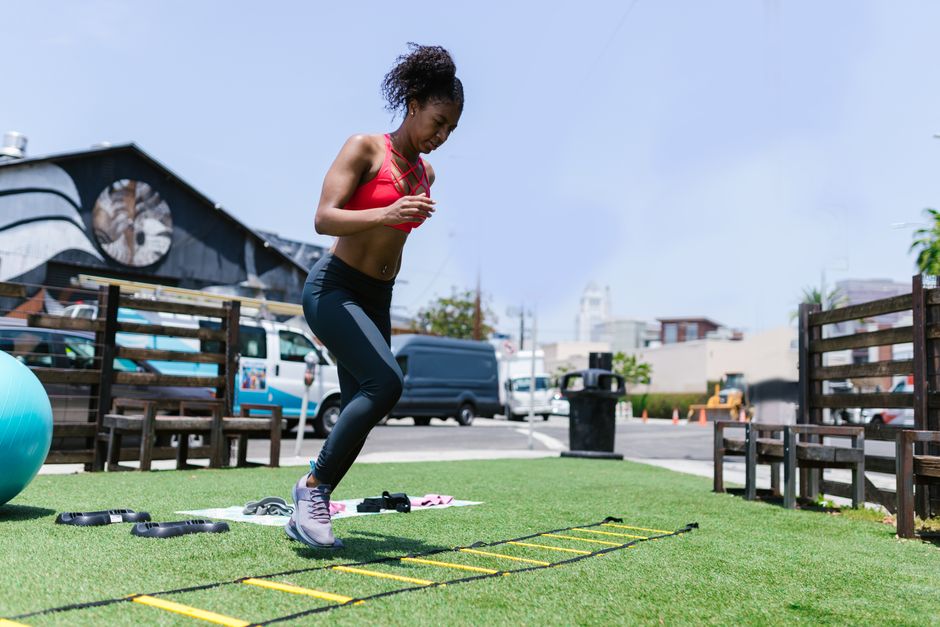
The agility ladder is the cheapest way to start, and the SKLZ Quick Ladder is the one you see at youth practices, tennis clinics and boot camps everywhere. It’s 15 feet long and 17 inches wide with 11 heavy-duty flat plastic rungs, folds up small and comes with a carry bag. SKLZ pitches it for acceleration, lateral speed and change of direction, built through fast, light foot strikes.
- Good: about $30; light; works for every sport and age.
- Watch out: fixed rung spacing; straps can get tangled if you pack it in a hurry.
- Best for: soccer, basketball, tennis and pickleball players, and anyone new to footwork drills.
Check the SKLZ Quick Ladder price on Amazon
2. SKLZ Speed Hurdle Pro: best hurdles
Mini hurdles teach you to pick your knees up and spend less time on the ground. The Speed Hurdle Pro set has six hurdles that adjust to 6, 9 or 12 inches with one button, so the same set works for quick-step runs and higher hops. They have a low-profile base and bounce-back construction, so a clipped hurdle springs back instead of snapping, and they fold flat into a carrying case.
- Good: three heights in one set; forgiving if you clip one; packs flat.
- Watch out: costs more than fixed-height hurdles; 12 inches is the top height.
- Best for: sprinters, football and lacrosse players, and plyometric circuits.
Check the SKLZ Speed Hurdle Pro price on Amazon
3. SKLZ Speed Chute: best budget resistance
A resistance parachute is the most fun piece of speed gear you can buy. You sprint, the chute opens behind you, and you feel it pull. The SKLZ Speed Chute is 54 inches across and SKLZ says it gives roughly 15 to 30 lb of resistance (it rises the faster you run). The belt rotates 360° on a free-motion ring, mesh panels help keep the strings from tangling, and a quick-release buckle lets you drop the chute mid-sprint for a burst. SKLZ lists it at about $40 with a one-year warranty; we also saw it nearer $30 at a retailer.
- Good: cheap and light; packs small; no partner needed.
- Watch out: resistance isn’t adjustable and wind changes it; needs open space.
- Best for: runners, field-sport athletes and anyone training alone on a track or field.
Check the SKLZ Speed Chute price on Amazon
4. SKLZ Recoil 360: best resisted sprint harness
A bungee harness lets you sprint, shuffle, backpedal or jump against a pull, then let it help you on the way back for an overspeed feel. On the Recoil 360, the sheathed cable stretches from 8 to 22 feet and resistance rises from 15 to 50 lb as it stretches. A free-floating ring on the belt lets you turn and move in any direction. Use it with a partner holding the other belt, or anchor it to a post for solo work. It comes with both belts and a carry bag, for about $75.
- Good: works in every direction; great for first-step and change-of-direction drills.
- Watch out: needs a partner or a solid anchor; check the cable for wear before each session.
- Best for: basketball, tennis, combat sports and anyone working on lateral speed.
Check the SKLZ Recoil 360 price on Amazon
5. Rogue Dog Sled 1.2: best sled
Sled pushes and pulls build the drive phase of a sprint with load you can change plate by plate. Rogue’s Dog Sled 1.2 is made in the USA from 11-gauge tube and quarter-inch plate steel, weighs 103 lb empty and measures 40 x 24 inches. Rogue says it works on grass, turf and concrete; optional plastic skis (about $80) protect floors and cut friction on hard surfaces. It comes with removable push poles, a pair of 3-foot uprights and a carabiner for a strap or harness (sold separately). The lighter Rogue Echo Dog Sled (87 lb, about $290) is a cheaper option.
- Good: very tough; push or pull; heavy or light loads; works on grass.
- Watch out: heavy to move and store; plates and a pull strap cost extra.
- Best for: football, rugby and hockey players, lifters and teams with a field or backyard.
See the Rogue Dog Sled 1.2 at Rogue
6. Hyperwear Hyper Vest PRO: best weighted vest
Most weighted vests flop around once you start running. The Hyper Vest PRO is built from stretch compression fabric with thin steel micro-weights (2.25 oz each) spread over the torso, plus side lacing to snug the fit. It ships with 10, 15 or 20 lb depending on size, and you can add weight up to 20 lb (Small), 25 lb (Medium), 30 lb (Large) or 40 lb (X-Large). The fabric is washable once the weights are out. Hyperwear sells it for about $240.
- Good: slim, close fit; small weight steps for gradual progress.
- Watch out: pricey; extra 5 lb weight sets are sold separately; buy by chest size.
- Best for: jumpers, field-sport athletes and older athletes adding load to walks and drills.
Check the Hyperwear Hyper Vest PRO price on Amazon
7. Freelap Timing Pack 112: best sprint timing
If you want to know whether all that work is paying off, you need a clock you trust. Freelap places small magnetic transmitters on the ground; a chip clipped to your shorts detects them as you pass and sends the times to an iOS or Android app over Bluetooth. No cables or photocells. Freelap says its Tx Junior Pro transmitters are accurate to 0.02 seconds, detect within 1.5 meters and run about 150 hours per charge. The Timing Pack 112 includes one FxChip BLE (or an FxMotion chip), two Tx Junior Pro transmitters and a case, for $535 and up depending on options.
- Good: real split times for solo training; flying, rolling and standing starts.
- Watch out: serious money; you pass close to the transmitter for it to read.
- Best for: sprinters, coaches and field-sport athletes tracking 10-, 20- and 40-yard times.
See the Freelap Timing Pack 112 at Freelap USA
8. BlazePod Starter Kit: best reaction training
Game speed is also seeing and reacting. BlazePod pods light up in patterns you set in the app, and you tap or touch them out as fast as you can, on the floor, a wall or a fence. The Starter Kit has four pods, a charging base and a case. The free BlazePod Go membership opens 500+ community activities; BlazePod Pro adds structured programs and deeper analytics ($10.39 a month during the 20%-off sale we saw). List price is $329; it was $263 in a fall sale on the maker’s site. BlazePod offers a 30-day money-back guarantee and a one-year warranty.
- Good: makes drills feel like a game; works indoors in small spaces.
- Watch out: needs a phone; the best features sit behind the paid membership.
- Best for: tennis and pickleball players, goalkeepers, fighters and older athletes working on reaction.
See the BlazePod Starter Kit at BlazePod
How to choose
- Start with your sport’s speed. Short bursts and changes of direction (tennis, basketball, soccer) point to a ladder, hurdles, a bungee harness or reaction lights. Straight-line acceleration (sprinting, football, rugby) points to a chute or a sled.
- Check your space and surface. Chutes need open field. Sleds need grass, turf or a surface the maker approves, and the right skis for indoor floors. Ladders, hurdles and pods fit a garage or court.
- Train alone or with others? A chute, sled, vest and Freelap work solo; a bungee harness is easiest with a partner; reaction pods are great for groups.
- Keep resistance light. Many coaches use resisted sprints with loads that don’t wreck your running form. Pick gear that lets you start light and progress slowly.
- Measure something. A stopwatch over the same distance tells you more than how a drill feels.
- Play it safe. Warm up first, build volume gradually, use sleds and chutes only on suitable surfaces, and check with a doctor or physio before sprint work if you’re coming back from an injury.
Sprint work is hard on the body, so plan the other side too: browse best recovery tools for athletes, slip into something soft from our best recovery shoes guide after a session, top up with the best electrolyte powder on hot days, and track readiness with Whoop vs Oura vs Garmin. Speed also lives in the head, so our companion guide to the best mental training tools for athletes is worth a look. More gear in Training & Performance and Running.
Questions buyers ask
What’s the best speed training equipment for beginners?
An agility ladder and a set of mini hurdles. Together they cost about $100, take up little space and cover footwork, rhythm and quick ground contact for almost any sport.
Parachute or sled: which is better?
They do different jobs. A chute is cheap, portable and gives a fairly light pull that grows as you speed up. A sled lets you set an exact load with plates, push or pull, and suits heavier drive work, but it costs much more and needs a suitable surface.
Can I use a sled on grass or turf?
Many sleds are made for it. Rogue says the Dog Sled 1.2 works on grass, turf and concrete. Check your field’s rules first, since some fields don’t allow sleds.
Do I need a timing system?
Not to start. A stopwatch and a measured distance will show progress. Systems like Freelap make sense for coaches and serious sprinters who want consistent split times without a partner on the watch.
Is speed training only for young athletes?
No. Many weekend warriors and older athletes use ladders, hurdles and reaction lights to stay quick. Start with low volume, keep the intensity sensible, and talk to your doctor if you have a heart condition or a past injury.