This article contains affiliate links: if you buy through them we may earn a commission, at no extra cost to you. Learn more.
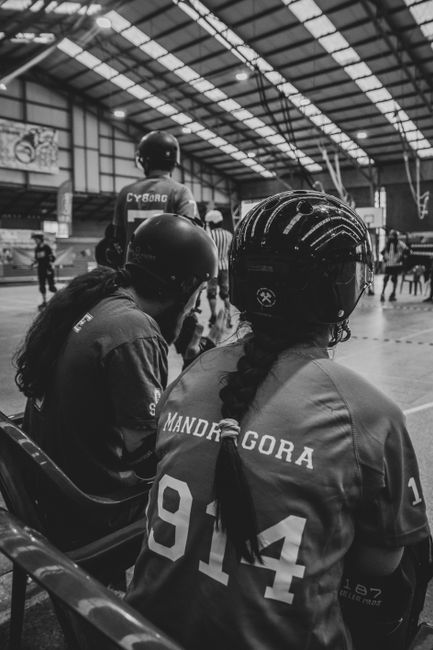
Saturday night in a converted warehouse. The bleachers are packed, the DJ drops the beat, and eight blockers crouch shoulder to shoulder at the pivot line. Behind them, two skaters with stars on their helmets bounce on their toe stops. One short whistle. The jammers hit the pack at full speed, one gets knocked flying out of bounds, the other spins off a hip and bursts out the front, and the whole crowd stands up. That’s roller derby: a full-contact team sport on quad skates, played by thousands of skater-run leagues around the world, from first-night “fresh meat” to the World Cup.

Roller Derby, page by page
- Rules: how the game works at every level
- Leagues & associations: pro, college, high school and youth
- Youth & high school: ages, safety and recruiting, for players and parents
- Injuries & sports health: prevention, concussion, when to see a pro
- Training & conditioning: before: off-season to in-season
- Game day: during: fueling, hydration, heat
- Recovery: after: games, tournaments, sleep
- Nutrition & supplements: what to eat, tested supplements
- Best wearables: trackers and watches for the sport
- Gear: the complete equipment list
Buying guide · Our Roller Derby buying guide compares the gear we'd pick, with prices and sizing:
This is our complete guide to roller derby for skaters, parents and anyone thinking about joining a league: how the game works, who runs it, how it looks from junior derby to the world championships, and, most of all, how to keep skating and hitting for years. Sports health runs through all of it: the injuries derby players report most (ankles, knees and concussions), the protective gear the rules require, and when to see a professional. Then training, bout day, recovery and the gear that matters.
Roller derby at a glance
| The game | Two teams on a flat oval track. Each team puts up to five skaters on the track per jam: four blockers and one jammer. Jammers score one point for every opposing blocker they lap. |
|---|---|
| Game length | 60 minutes in two 30-minute periods, played in jams of up to two minutes with 30 seconds between them (WFTDA rules). |
| Skates | Quad-style roller skates only; inline skates aren’t allowed. |
| Required gear | Helmet, mouthguard, wrist guards, elbow pads and knee pads. |
| Governing bodies | WFTDA (women’s and gender-expansive flat track derby, more than 400 member leagues on 6 continents), MRDA (men’s and open-gender), JRDA (junior derby in the US), World Skate internationally and USA Roller Sports in the US. |
| Biggest events | WFTDA Championships (Malmö, Sweden, October 15–18, 2026), the Roller Derby World Cup (Innsbruck 2025), the Men’s Roller Derby World Cup (Orléans 2026), MRDA postseason and the World Skate Games. |
| Most common injuries | Ankle and knee injuries, concussions, wrist and other upper-limb fractures, bruises and “rink rash.” |
Where roller derby came from
Roller derby started in Chicago in 1935, when promoter Leo Seltzer staged the Transcontinental Roller Derby, a month-long race between two-person teams that simulated skating across the country. It grew into a contact game on banked tracks and a TV show. The modern sport was reborn in Austin, Texas, in the early 2000s as an all-female, woman-organized amateur sport, and that do-it-yourself spirit still runs it: most leagues are skater-owned and skater-run, skaters often play under punny “derby names,” and the Women’s Flat Track Derby Association (WFTDA), which began in 2004 as the United Leagues Coalition, is a nonprofit run democratically by its member leagues. Most of today’s derby is played on a flat track marked on a sports-hall floor, which is why the game is called flat track roller derby; a few leagues still skate on banked tracks.
How roller derby works
Jams, jammers and blockers
Under The Rules of Flat Track Roller Derby, written by the WFTDA and used by most of the derby world, play is broken into jams of up to two minutes. Each team fields four blockers (one may be the pivot, with a striped helmet cover) and one jammer, who wears the star helmet cover. Blockers from both teams form the pack, and they play offense and defense at the same time: stopping the other jammer while opening a path for their own. The jammers start behind the pack, fight through it, lap the track, and on every trip after that score one point for each opposing blocker they pass.
The first jammer to get through cleanly becomes lead jammer, the only skater who can call off the jam early, by repeatedly putting their hands on their hips. That’s the big tactical lever: a lead jammer who has scored can end the jam before the other jammer gets a scoring pass. A jammer can also hand the star to the pivot (a “star pass”), who then becomes the jammer.
Contact with limits
Derby is full contact, but only to certain parts of the body and with certain parts of the body. You may hit an opponent’s chest, the front and sides of the torso, arms, hips and the front and sides of the legs above mid-thigh, and you may block with your torso, arms above the elbow and legs above mid-thigh. No hits to the head, back, knees or lower legs; no elbows, forearms, headbutts or tripping. Illegal play earns a penalty served as 30 seconds of jam time in the penalty box; seven penalties and a skater fouls out. Those limits exist to keep hits away from the head, spine and knees. Our roller derby rules page walks through it step by step, including officials, timeouts and overtime.
Roller derby at every level
Junior derby
The WFTDA says some leagues are affiliated with junior programs that let kids start as young as 6. In the US, the Junior Roller Derby Association (JRDA) works with junior leagues for skaters up to 18 and uses three levels: Level 1 is no contact, Level 2 is light contact made without accelerating, and Level 3 is full contact. Skaters move up by passing written and physical skills assessments, and every JRDA volunteer completes the CDC HEADS UP concussion course. WFTDA Insurance’s junior coverage groups skaters 6 to 11 and 12 to 17, and requires a background check for every adult who works with a junior league. See our junior roller derby guide for parents.
High school and college
Roller derby isn’t a high school (NFHS) or NCAA sport. Teens play junior derby through 17 or 18; after that, adult leagues take over. The WFTDA notes that most adult leagues require skaters to be at least 18, and some 21, depending on league policy, local law and insurance. College students skate with their city’s league rather than a school team.
Adult leagues
This is the heart of the sport. As of 2026, the WFTDA represents more than 400 member leagues on 6 continents and welcomes skaters of marginalized genders, including cis, trans, intersex and gender-expansive women and nonbinary skaters. The Men’s Roller Derby Association (MRDA) describes itself as a worldwide nonprofit network of over 40 open-gender teams and plays a gender-neutral version of the WFTDA rules. Many leagues also field B teams, home teams and recreational “rec league” sessions, and most run beginner intakes (“fresh meat”) that teach skating, falling and stopping before any contact. Before playing in WFTDA-sanctioned games, charter skaters pass the WFTDA Minimum Skills Requirements, including the famous “27 in 5”: 27 laps of a regulation track in five minutes.
Elite and international
WFTDA rankings send teams to regional championships in Latin America, North America, Europe and Oceania, and the best 16 go to the WFTDA Championships, held in 2026 on October 15–18 at Baltiska Hallen in Malmö, Sweden. National teams meet at the Roller Derby World Cup: the 2025 edition in Innsbruck, Austria, had 48 teams and 80 games, and Team USA beat Australia 208–55 in the final, with England taking bronze. The MRDA hosted the Men’s Roller Derby World Cup in Orléans, France, from April 30 to May 3, 2026. Roller derby is also one of the sports at World Skate’s World Skate Games, held in Asunción, Paraguay, in October 2026. It isn’t an Olympic sport. Our roller derby leagues and associations page has the full picture.
Sports health for roller derby skaters
Derby asks a lot of the body: low skating stances for an hour, sprints, hard hits and plenty of falls. This section is general information, not medical advice. If you’re hurt, see a professional.
The most common roller derby injuries
- Ankles and knees. In a survey of 1,395 women’s derby skaters, 48.7% reported at least one injury in the previous 12 months; the most common were ankle injuries (22.5%) and knee injuries (21%).
- Head injuries and concussion. Head injuries made up 11% in that survey, and 75% of them were diagnosed as concussions. A 2022 study of 665 players from 25 countries found that players reported roughly one concussion for every two years of play.
- Upper-limb fractures, ligament tears and sprains. The same 2022 study lists extremity fractures, torn knee ligaments and sprained ankles among derby injuries. Falls onto an outstretched hand are why wrist guards are required.
More detail, including prevention and getting back on skates, is on our roller derby injuries page.
Protective gear: required, and backed by evidence
The WFTDA rules make five pieces of gear mandatory: helmet, mouthguard, wrist guards, elbow pads and knee pads. Gear can’t come off during play, and a mouthguard that falls out and isn’t put back can stop the jam and earn a penalty. The evidence from general skating backs the rule: the American Academy of Pediatrics (AAP) says wrist guards can reduce skating injuries by almost 90%, elbow pads by 80% and knee pads by 30%, and a large US study found in-line skaters without wrist guards had about 10 times the odds of a wrist injury. For helmets, the Consumer Product Safety Commission (CPSC) points skaters who do aggressive or trick skating to a helmet certified to ASTM F1492; many derby skaters choose one that’s dual-certified to that and the CPSC bike standard.
Concussion: recognize and remove
The CDC’s HEADS UP program asks skaters, coaches, officials and parents to watch for anyone who looks dazed or confused or is slow to react after a fall or hit, and to listen for headache, dizziness, balance problems, sensitivity to light or noise, or feeling “off.”
- Remove: off the track for the day. No “shake it off and get back in the pack.”
- Get checked by a healthcare provider before practicing or scrimmaging again, and return step by step only once cleared.
- Call 911 for danger signs: a headache that gets worse, repeated vomiting, a seizure, slurred speech, unusual drowsiness or passing out.
Heat and hydration
Summer warehouses and tournament halls get hot, and pads and helmets trap heat. The National Athletic Trainers’ Association (NATA) recommends easing into hot-weather training over 7–14 days. Drink through practice, use the breaks between jams, and call 911 for confusion or collapse in the heat. Our bout day page has the fluids and food timeline.
When to see a doctor, physical therapist or athletic trainer
See a professional for an ankle you can’t put weight on, a knee that gave way or swelled up, a wrist that’s swollen or painful to move after a fall (a broken wrist can feel like a sprain), a joint that looks out of shape, pain that doesn’t settle, or any concussion signs. A sports medicine physician manages most injuries without surgery (the American Medical Society for Sports Medicine says about 90% of sports injuries are non-surgical). A physical therapist guides rehab and the return to contact, and athletic trainers are licensed or regulated health care professionals in all 50 states.
Training for roller derby
Derby is a sport of short, hard efforts: a jam is up to two minutes of sprinting, holding a low stance, hitting and taking hits, with 30 seconds before the next one. Most leagues build skills in order: stance, strides and crossovers, stops (plow, T-stop, hockey stop, turnaround toe stops), falls (single-knee, double-knee and small falls), then positional blocking, then contact. The “27 in 5” lap test is the endurance benchmark for charter skaters. Off skates, many skaters train squats, lunges and lateral lunges, single-leg balance, glute and hip strength, a strong trunk for absorbing hits, and intervals that mimic jams. Our roller derby training page has the plan, and resistance bands for athletes make easy hip work at home.
Bout day, recovery and fuel
On bout day, eat a carb-based meal of familiar foods 1–4 hours before skating, as the American College of Sports Medicine’s sports-nutrition position statement recommends, and sip fluids through warm-up and the game; many skaters add electrolytes on hot days (see our electrolyte powder guide). Afterward, sleep comes first: the CDC recommends 8–10 hours a night for teens and 7 or more for adults. Then food, fluids and an easy day after a tournament weekend. Many skaters roll out quads, glutes and hips with a foam roller or a small massage gun, and slip into soft recovery slides after hours in tight skate boots; they’re for comfort, not treatment. See our roller derby recovery page, our roller derby nutrition and supplements page and the best wearables for roller derby.
Gear for roller derby
Start with quad skates that fit and the five pieces of required protection. The Riedell R3 is Riedell’s entry-level quad (it also comes in a derby version), with a nylon plate, metal trucks, ABEC-5 bearings and 62 mm, 95A indoor wheels (about $199 in October 2026). For knees, the 187 Killer Pads Pro Derby knee pad is designed specifically for derby, with removable, washable foam and a hinge that moves with the leg (about $115), and the 187 Killer Pads Derby wrist guards slide on with a wide, cupped palm plate (about $36). The Triple Eight Dual Certified helmet meets the CPSC bike standard and ASTM F1492, and the maker lists roller derby among its uses (about $46). Add a mouthguard such as the Shock Doctor Gel Max (about $12). After practice, a foam roller like the TriggerPoint GRID 1.0 (about $40) is a skater’s staple. Full details on our roller derby gear page.
Riedell R3 Indoor Quad Roller Skates
- Nylon plate, metal trucks
- 62 mm 95A wheels, ABEC-5
- About $199
187 Killer Pads Pro Derby Knee Pad
- Designed for roller derby
- Removable, washable foam
- About $115
187 Killer Pads Derby Wrist Guards
- Slide-on design
- Cupped, contoured palm plate
- About $36
Triple Eight Dual Certified Helmet
- CPSC bike (5+) and ASTM F1492
- 2 sets of fit pads
- About $46
Shock Doctor Gel Max Mouthguard
- Adult and youth sizes
- Gel-Fit liner
- About $12
TriggerPoint GRID 1.0 Foam Roller
- 13 x 5 in
- Multi-density surface
- About $40
Roller derby FAQs
How does scoring work in roller derby?
Only the jammer, the skater with the star on the helmet, scores. After a first pass through the pack, the jammer earns one point for each opposing blocker they pass on every lap until the jam ends. Jams last up to two minutes, and the lead jammer can call one off early.
Can adults with no skating experience join roller derby?
Yes. Many leagues run beginner (“fresh meat”) programs that start with skating, falling and stopping and add contact only once skaters are ready. Most adult leagues require skaters to be at least 18; ask your local league about loaner gear for the first sessions.
Is roller derby dangerous?
It’s a full-contact sport, so injuries happen: in one large survey, about half of skaters reported an injury in the past year, most often to an ankle or knee, and concussions are common. Required gear, legal-hitting rules, coached falls and removing anyone with concussion signs all lower the risk.
Can you play roller derby on inline skates?
No. WFTDA rules require quad-style roller skates and don’t allow inline skates.
Is roller derby an Olympic sport?
Not as of 2026. Roller derby is part of World Skate and is played at the World Skate Games and at the women’s and men’s Roller Derby World Cups, but skateboarding is the only World Skate sport on the Olympic program.
Is there men’s roller derby?
Yes. The Men’s Roller Derby Association governs men’s and open-gender flat track derby, plays a gender-neutral version of the WFTDA rules and hosted the 2026 Men’s Roller Derby World Cup in Orléans, France.
Prefer cruising to hitting? Our roller skating section covers rink, trail, artistic and speed skating. Keep exploring: the recovery tools guide, knee sleeves for skaters coming back from a knee injury, ankle braces, and the other sports on our sports hub.