This article contains affiliate links: if you buy through them we may earn a commission, at no extra cost to you. Learn more.
Match point in a packed college arena. The ball is blocked out, the referee on the stand signals a point, and the coach on the losing side forms a “C” with one hand: challenge. Everyone watches the replay on the big screen to see if a fingertip touched the block. Volleyball looks simple from the stands, but the volleyball rules change more by level than most fans realize. A libero who can serve in a high school match can’t serve in an international one; a block that’s “free” indoors uses up a hit on the beach. Here are the rules side by side: FIVB, NCAA and high school, rally scoring, rotations, the libero, the newest changes and the beach game.
Back to our volleyball hub for the overview, or see who runs each level.
Who writes the rules
- FIVB, the world governing body, publishes the Official Volleyball Rules and the Official Beach Volleyball Rules. The current editions cover 2025-2028 and are used in international play, the Olympics and most pro leagues.
- USA Volleyball publishes its own indoor rules book (2025-2027), the FIVB rules with US additions such as net heights by age. Club, junior and adult USA Volleyball events use it, and so does NCAA men’s volleyball.
- NCAA writes the women’s volleyball rules for college (the current book covers 2026 and 2027).
- NFHS writes the high school rules, and each state association can adopt some options, such as best-of-three matches.
FIVB vs NCAA vs NFHS: the big differences
| FIVB (international) | NCAA women | NFHS (high school) | |
|---|---|---|---|
| Match | Best of 5 | Best of 5 | Best of 5 (best of 3 by state adoption) |
| Sets | 25 points, 5th to 15, win by 2 | 25 points, 5th to 15, win by 2 | 25 points, 5th to 15, win by 2, no cap |
| Substitutions per set | 6 | 15 in Division I; 18 in Divisions II and III | 18 |
| Time-outs per set | 2, 30 seconds each | 2, 75 seconds by default | 2, up to 60 seconds |
| Libero | Up to 2 listed, 1 on court; may not serve | Up to 2; may serve in one rotation | 1 per set; may serve in one position of the order |
| Time to serve | 8 seconds after the whistle | 8 seconds | 5 seconds |
| Net | 2.43 m men, 2.24 m women | 2.24 m (7 ft 4⅛ in) | 7 ft 4⅛ in girls, 7 ft 11⅝ in boys |
| Video challenges | In top FIVB events | Yes, where a Challenge Review System is used | No |
NCAA men’s volleyball plays the USA Volleyball rules, which follow the FIVB on most points, with NCAA modifications. Always check the rules your league or tournament actually uses.
Rally scoring, sets and matches
Volleyball uses rally scoring at every level: the team that wins the rally scores a point, whether it served or not. If the serving team wins, it serves again; if the receiving team wins, it gets the serve. A set ends when a team reaches 25 with at least a two-point lead, so 24-24 goes on to 26-24, 27-25 and so on. The fifth set, if needed, goes to 15, also by two. High school rules spell out “no cap”: there is no point at which the next point wins.
Rotation, positions and serving
Six players start in a fixed order: three front-row and three back-row. When a team wins the serve back, its players rotate one position clockwise and the player moving to right back serves. At the moment of the serve, each player must be in the right spot relative to the players beside and in front of them; a team that’s out of place commits a positional (overlap) fault. Once the ball is served, players can move anywhere, which is how a setter gets to the net from the back row.
The server stands behind the end line and has 8 seconds after the referee’s whistle under FIVB and NCAA rules, and 5 seconds in high school. Players on the serving team can’t screen the receivers’ view of the server. In NCAA women’s volleyball from 2026, players on the serving team may not raise their hands above their heads during the serve until the ball crosses the net.
Three contacts, the block and the net
- Three hits: each team gets up to three hits to return the ball, and a player can’t hit it twice in a row. Indoors, a block touch doesn’t count as one of the three, and the blocker can play the next ball.
- Back-row attacks: a back-row player may not attack a ball that’s entirely above the net from in front of the attack line, 3 meters (about 10 feet) from the center line.
- Double contacts: NFHS rules changed in 2025 so that a “double” on a team’s second contact isn’t whistled when the ball goes to a teammate; the team still gets one more contact. A prolonged contact (a lift or carry) is still a fault.
- The center line: under FIVB rules you may touch the opponents’ court with a foot if part of that foot stays on or above the center line and you don’t interfere. From 2026, NCAA women’s rules make it a fault to completely cross the center line and touch the other court with one or both feet, and coaches can challenge it.
The libero, explained
The libero is a back-row defensive specialist who wears a jersey that clearly contrasts with the rest of the team. The libero can replace any back-row player, and these replacements don’t count against the substitution limit. A libero may not block or attempt to block, and may not attack a ball that’s entirely above the net. Under FIVB rules, a front-row teammate also can’t attack above the net from a ball the libero sets with an overhand finger pass from in front of the attack line. The biggest difference is serving: FIVB liberos never serve, while high school and NCAA women’s rules let the libero serve in one rotation. FIVB and NCAA teams can name two liberos, with one on the court at a time.
Ball and equipment rules
The FIVB indoor ball is 65 to 67 cm around and weighs 260 to 280 grams. High school rules call for a ball 25 to 27 inches around weighing 9 to 10 ounces, and starting in 2026-27 state associations may approve textured balls, common in boys’ volleyball, for boys or girls. NFHS rules also require jewelry to come off, except small, secured studs or posts, with nothing below the chin. The FIVB asks for light, pliable shoes with rubber or composite soles. Our volleyball gear page covers balls, knee pads and braces.
For practice at home, four game balls fit the rules at each level: the Mikasa V200W, which the maker says exceeds FIVB standards (about $67 in October 2026); the Molten FLISTATEC, listed as the official ball of the NCAA men’s championships (about $55); the Tachikara Sensi-Tec SV5WSC, an NFHS-approved size 5 ball (about $34); and for the sand, the Mikasa Beach Pro BV550C, the ball Mikasa says is used in FIVB beach events (about $80).
Mikasa V200W Indoor Volleyball
- Size 5
- 18-panel design
- Exceeds FIVB standards (maker)
Molten FLISTATEC Volleyball
- Microfiber composite cover
- Indoor use
- NCAA men's championships ball (listing)
Tachikara Sensi-Tec SV5WSC
- NFHS approved
- Size 5, 260-280 g
- Microfiber composite cover
Mikasa Beach Pro BV550C
- Official FIVB beach ball (maker)
- Soft touch
- For all levels
Beach volleyball rules in short
- Two players per team on a 16 × 8 m sand court, with no substitutions. Players play barefoot unless the referee allows socks or shoes.
- Best of three sets: the first two to 21 and a third to 15, all won by two.
- Switch sides every 7 points in sets 1 and 2 and every 5 in set 3, to even out wind and sun.
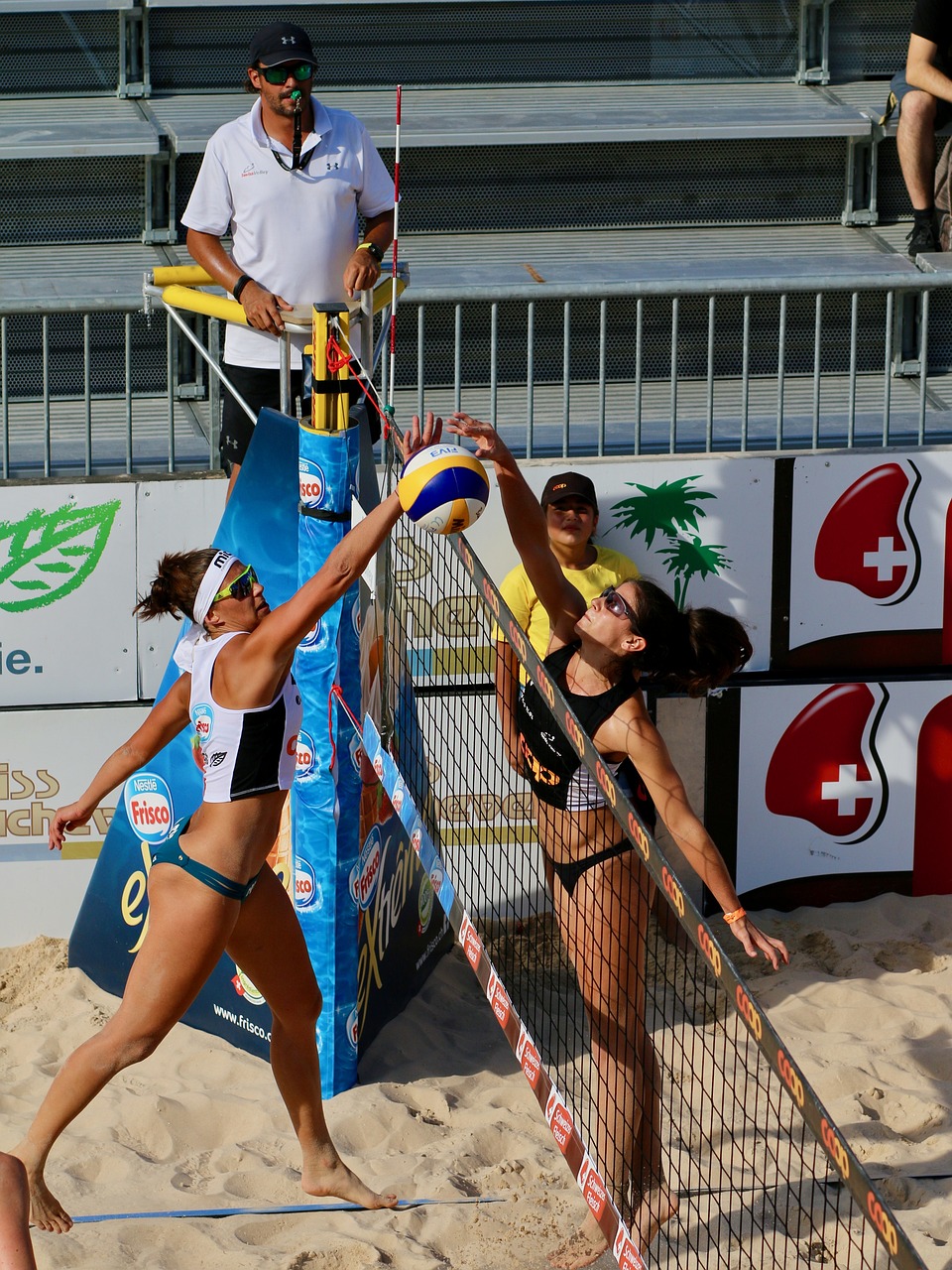
- The block counts as one of the three team hits, so after a block a team has two more.
- No open-hand tips: an attack with open, soft fingers is a fault; a “poke” with rigid fingertips held together is legal.
- One 30-second time-out per team per set, a 5-second serve clock and, in FIVB events, no coaching during the match.
The beach net is the same height as indoors, 2.43 m for men and 2.24 m for women, and the FIVB lowers it for youth events: 2.12 m for 14 and under and 2.00 m for 12 and under. The beach ball is slightly bigger (66 to 68 cm) and much softer than the indoor ball.
Rules for younger players
USA Volleyball lowers the indoor net for younger players: 2.13 m (7 ft) for 11-12 and under, and for girls 10 and under 1.98 m (6 ft 6 in). Girls play at the women’s height from 13-14; boys play at 7 ft 4⅛ in at 13-14 and reach the men’s height at 15. Many youth leagues also use lighter balls. Our youth volleyball guide has the full table. Rules don’t prevent injuries on their own; for that, see volleyball injuries and our ankle brace guide. Curious how another sport does it? Compare with our basketball rules.
Volleyball rules FAQs
Can the libero serve?
It depends on the level. Under FIVB international rules, no. In high school (NFHS) and NCAA women’s volleyball, the libero may serve in one rotation of the serving order.
Is there a cap on points in a volleyball set?
No. Sets go to 25 (15 in a deciding set) but must be won by two points, so play continues until one team leads by two.
Does a block count as a hit in volleyball?
Indoors, no: after a block the team still has three hits, and the blocker may take the next one. In beach volleyball, yes: the block counts as one of the three team hits.
How many substitutions are allowed in volleyball?
Six per set under FIVB rules, 18 in high school, and 15 in NCAA Division I women’s volleyball (18 in Divisions II and III). Libero replacements don’t count. Beach volleyball has no substitutions.
Can you touch the net or cross the center line?
Touching the net while playing the ball is generally a fault. Under FIVB rules a foot may land on the other court as long as part of it stays on or over the center line and doesn’t interfere; NCAA women’s rules from 2026 call a fault when a foot completely crosses the line and touches the other court.