This article contains affiliate links: if you buy through them we may earn a commission, at no extra cost to you. Learn more.
A fencer’s first rating is a small, proud moment: after a long Saturday of pools and eliminations at a local tournament, the results go in and a “U” next to your name becomes an “E26.” It’s also the first time many families meet the alphabet soup of fencing organizations: FIE, USA Fencing, RYC, NAC, JO. This page sorts them out: who runs fencing worldwide and in the US, how USA Fencing ratings and age categories work, the national event calendar, college fencing in the NCAA and club leagues, and the road to the Olympics and Paralympics, including wheelchair fencing.
For an overview of the sport, see our fencing hub.
FIE: the International Fencing Federation
The Fédération Internationale d’Escrime (FIE) was founded in Paris in 1913 and is based in Lausanne, Switzerland. The International Olympic Committee recognizes it as the world governing body of fencing, and it has 156 member federations. The FIE writes the rules of competition and the safety standards for equipment, homologates (approves) uniforms and masks for international events, and runs the Senior, Junior, Cadet and Veteran World Championships and the World Cup circuit. Its rules are the basis for almost every national rulebook, including the American one.
USA Fencing
USA Fencing, founded in 1891 as the Amateur Fencers League of America, is the national governing body recognized by the US Olympic & Paralympic Committee and the FIE. It reached a record 45,157 members and 752 affiliated clubs in the 2024-25 season, beating a 700-club goal it had set for 2028. Members compete through local divisions, regions and national events, and USA Fencing’s FenceSafe program handles athlete safety (SafeSport) policies, including the rules on adults’ interactions with minor athletes. Event officials at rated tournaments need a background screen and SafeSport training.
Ratings: from U to A
- The letters: A (highest), B, C, D, E and U (unclassified). Each is written with the year it was earned or re-earned, such as C25.
- One per weapon: you can be a C in foil and a U in sabre.
- How you earn one: at USA Fencing-sanctioned, electrically scored tournaments. The event’s rating depends on how many fencers enter and how they’re rated; the smallest rated event (six fencers, no rated fencers needed) gives the winner an E, while stronger fields award higher letters to more places.
- How long it lasts: four seasons. If you don’t re-earn it, it drops one letter on August 1 (a B20 became a C24 on August 1, 2024).
- Why it matters: ratings seed pools and decide eligibility for Division I (A, B, C), Division II (C, D, E, U) and Division III (D, E, U) events.
Age categories (2026-27 season)
| Category | Born |
|---|---|
| Y8 (8 and under) | 2018–2020 |
| Y10 | 2016–2019 |
| Y12 | 2014–2017 |
| Y14 | 2012–2015 |
| Cadet | 2010–2013 (2011–2014 after the February NAC) |
| Junior | 2007–2013 (2008–2014 after the February NAC) |
| Division I, II, III (open) | 2013 or earlier |
| Veteran | 1987 or earlier, in 10-year groups from 40-49 to 80 and older |
Tournaments: local, regional, national
- Local and division events: club tournaments and division qualifiers, where most fencers earn their first ratings.
- Regional circuits: the Regional Youth Circuit (RYC) and Super Youth Circuit (SYC) for Y10, Y12 and Y14; the Regional Junior Cadet Circuit (RJCC) for Juniors and Cadets; the Regional Open Circuit (ROC) for Division IA, II and III, Adult and Veteran fencers. Their points lead to national events.
- National events: the North American Cups (NACs) through the season, Junior Olympics (January 2026 in Kansas City, for Juniors and Cadets), the Division I and Parafencing National Championships (April 2026 in Richmond), and Summer Nationals (June 27–July 6, 2026 in Portland, Oregon). The March NAC is the big one for Y10, Y12 and Y14.
A new points and events structure for Cadet, Junior and Senior fencers took effect on August 1, 2026 as a two-year trial, so qualification paths may change; check USA Fencing’s field guide before you plan a season.
College fencing: NCAA and club teams
As of August 2024, 45 NCAA schools in 16 states sponsored varsity fencing across Divisions I, II and III. Unlike most sports, fencing has one combined national championship for all divisions, held every year since 1941 except during World War II. The 2026 championships at Notre Dame (March 19–22) drew 144 fencers from 26 schools in six events. Each event is a 24-fencer round robin of five-touch bouts; the top four fence 15-touch semifinals and a final for the individual title. Team scores come only from round-robin wins, and schools may qualify at most two fencers per weapon, so depth matters. In 2026, for the first time since 1990, the NCAA awarded separate men’s and women’s team titles instead of one combined title, a change that helps women’s-only programs.
Outside the NCAA, many colleges have club fencing teams, and the USA Collegiate Fencing Conference (USACFC) organizes competition for them. New varsity programs are also coming: Trinity College is adding women’s fencing in 2027-28 and men’s in 2028-29. For recruiting and ages, see our youth fencing page.
The road to the Olympics
Fencing is one of five sports on the program of every modern Olympics since 1896. At Los Angeles 2028 it runs July 15–23 in Hall 1 of the LA Convention Center, with 12 medal events: individual and team foil, épée and sabre for women and men. Team matches are relays to 45 touches. Team USA won four fencing medals across the Paris 2024 Olympic and Paralympic Games.
Wheelchair fencing and the Paralympics
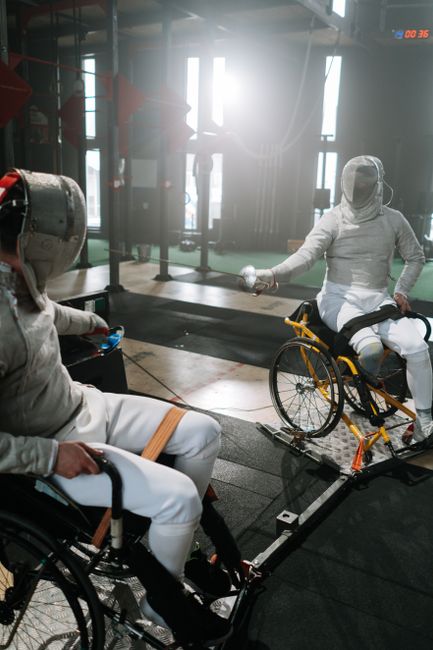
Wheelchair fencing was on the program of the first Paralympic Games in Rome in 1960. Fencers sit in wheelchairs fixed to a metal frame, so the bout is all blade work, distance and torso movement. Internationally there are two Paralympic categories: Category A for athletes with full trunk control and impairment in the legs, and Category B for athletes whose impairment also affects the trunk or arms. USA Fencing adds a national Category C for more severe impairments. The International Paralympic Committee lists World Para Fencing as the sport’s global governing body; it was long run under the International Wheelchair and Amputee Sports Federation (IWAS). LA 2028 adds mixed team épée and foil to the Paralympic program, held in the same LA Convention Center hall.
In the US, USA Fencing holds parafencing events at two North American Cups each season and a Parafencing National Championships, usually alongside the Division I Championships. They’re open to parafencers 13 and older, with all classifications in the same event. Many clubs welcome parafencers; ask about adaptive programs.
Adult and veteran fencing
USA Fencing’s Veteran categories run in 10-year age groups from 40-49 to 80 and older, with 10-touch elimination bouts and a Veteran World Championships at the FIE level. There’s also an Adult category (born 1987–2005 for 2026-27), plus Division II and III events by rating. Plenty of fencers take up the sport as adults; most clubs run adult beginner classes.
Gear for your first season
Most clubs lend gear for beginner classes. Once you start entering rated tournaments, you’ll want your own: a CE 350N mask like the LEONARK épée mask (or the foil version with a conductive bib), a glove, an electric weapon and two body cords, and a bag to carry it all, such as the LEONARK wheeled fencing bag. After the tournament, a foam roller like the TriggerPoint GRID 1.0 is a good friend to tired quads. Our fencing gear page has the full list.
LEONARK Fencing Épée Mask (CE 350N)
- CE 350N certified
- Adjustable back
- About $74
LEONARK Fencing Wheel Bag
- 1680D Oxford fabric
- Holds weapons, uniform and mask
- 43.3 in long, about 2.9 lb
TriggerPoint GRID 1.0 Foam Roller
- 13 x 5 in
- Multi-density surface
- Hollow core
Keep exploring: fencing rules, youth fencing, tournament day and our recovery tools guide. For a team sport’s version of this page, see soccer leagues and associations.
Fencing organizations: questions
How do fencing ratings work?
USA Fencing rates fencers A, B, C, D, E or U in each weapon, with the year earned (for example D26). You earn or raise a rating by placing high enough at a sanctioned tournament with a strong enough field. Ratings last four seasons and then drop one letter if not renewed.
What is the FIE?
The International Fencing Federation, founded in 1913 and based in Lausanne. It’s fencing’s world governing body, with 156 member federations; it writes the rules and runs World Cups and World Championships.
How many colleges have NCAA fencing?
Forty-five as of August 2024, in 16 states and all three divisions, competing for one national championship. Many more colleges have club teams.
What are the categories in wheelchair fencing?
Category A for fencers with full trunk control and impaired legs, and Category B for fencers whose impairment also affects the trunk or arms. USA Fencing also uses a Category C nationally for more severe impairments.
How many fencing events are in the Olympics?
Twelve at Los Angeles 2028: individual and team foil, épée and sabre for both women and men.