This article contains affiliate links: if you buy through them we may earn a commission, at no extra cost to you. Learn more.
Sunday morning, ballast filling, music low. Before the first rider jumps in, the driver goes through it out loud: vests on and buckled, who’s watching the rider, which side the wave is on, “nobody on the swim platform while the engine’s running,” and “if you feel a headache, tell me.” It takes a minute and it’s the minute that matters. This page covers the wakesurfing rules that keep riders and everyone else on the lake safe: why it’s inboard-only, carbon monoxide and propeller safety, observers, hours and life jackets, hand signals, how far from shore to surf (with real state laws), and how competitions are run.

Boating laws differ by state and sometimes by lake. This page explains common rules in plain words; check your state’s boating agency and local ordinances for the exact law where you ride.
Who makes the rules
The US Coast Guard sets the federal minimums for every recreational boat: life jackets aboard, engine cut-off switches and a ban on negligent operation, which the Coast Guard says can include “hazardous water skiing or other water sports practices.” States add the rules for towing and wakesurfing: observers, hours, life jackets for riders and, more and more, how far from shore a wakesurf boat must stay. Lakes and towns may add their own. Competitions follow the rule books of the World Wake Association (WWA), the International Waterski & Wakeboard Federation (IWWF) and other organizers.
Rule 1: inboard drive only
A wakesurfer rides a few feet off the stern, so the boat type is the first safety rule. Board maker CWB’s owner’s manual says its wakesurfers “must be used behind boats with an inboard drive only,” and not behind outboard, inboard/outboard (sterndrive) or jet drive boats. On an inboard the propeller sits under the hull, not right behind it where a rider might fall. Other makers give the same warning, so read the manual that comes with your board and the boat maker’s guidance before you surf.
Engine off: propeller safety
Even an inboard propeller spins whenever the boat is in gear. The Coast Guard’s 2024 statistics list 169 incidents in which someone was struck by a propeller, with 30 deaths and 158 injuries. The Coast Guard says most propeller injuries involve open motorboats 16 to 25 feet long and come from operator inattention, inexperience and carelessness, and that “the best and safest action when people are in the water near your boat is to shut off your engine(s).”
- Pick up a fallen rider slowly, on the driver’s side and in view, and put the engine in neutral or shut it off before they’re near the boat.
- Engine off for boarding. The BoatUS Foundation says never leave the boat running while someone climbs back aboard, and never use the engine or propeller as a step.
- Wear the engine cut-off switch lanyard. Federal law requires operators of boats under 26 feet to use an installed cut-off switch when on plane or above displacement speed.
Carbon monoxide and the swim platform
Slow speed plus a rider close to the stern is exactly where exhaust gathers. In a 2004 NIOSH study done with the Coast Guard, a wake surfer about 10 feet behind a ski boat averaged about 17 ppm of carbon monoxide; an exhaust system that moved the outlet cut it by about 80%. The rules that follow from this:
- Nobody on the swim platform or rear deck while the engine or generator runs. The Coast Guard says never sit, hang on the platform or “teak surf,” which it calls “NEVER a safe activity.”
- Ride far enough back and limit time in the wave, as board makers advise, and take turns so no one surfs for too long.
- Know the signs: irritated eyes, headache, nausea, weakness or dizziness can look like seasickness. Get the person into fresh air and get medical help if it doesn’t clear quickly.
Observer and hours rules
Some states now name wakesurfing in their towing laws, even though the rider isn’t on a rope:
- Minnesota: you may not “create a wake for a wake surfer” unless another person in the boat is in a position to continually watch the rider, or the boat has a wide-angle rear-view mirror. Wake surfing is banned from half an hour after sunset to sunrise.
- Pennsylvania: at least one competent observer in the boat besides the operator, and boat-towed watersports are banned between sunset and sunrise.
Even where a mirror is legal, the BoatUS Foundation advises an observer “whose only job is to watch the skier, receive signals and alert the boat operator if the skier falls.” For wakesurfing, the observer also watches for a rider who looks unwell in the exhaust zone.
Life jacket rules
- Federal minimums: an approved wearable life jacket aboard for each person, used according to its label, and children under 13 must wear one while underway unless below deck or in an enclosed cabin (or as state law says).
- State rules for riders: Pennsylvania requires a Coast Guard-approved wearable life jacket for towed riders and prohibits inflatables, but lets a wakesurfer wear a water ski wetsuit instead. Other states differ, so check yours.
- Read the label: the Coast Guard notes some approved jackets are labeled not approved for water skiing, wakeboarding, tubing or personal watercraft. A “comp vest” without Coast Guard approval doesn’t meet these rules.
Neoprene vests approved for towed sports fit well for surfing: the O’Brien Traditional Neoprene (about $85) is approved in the US and Canada, and the O’Neill SuperLite (about $50) is a Type III vest the maker labels for wake, ski and tubing.
Hand signals for wakesurfers
Once the rope is dropped, the rider can’t tug it to say anything, so signals matter. These standard ones come from the BoatUS Foundation:
| Signal | Meaning |
|---|---|
| Thumb up | Speed up |
| Thumb down | Slow down |
| “OK” sign | Speed is good, or understood |
| Slashing motion across the neck | Cut the motor / stop |
| Pat on the head | Back to the dock |
| Hands clasped over the head (after a fall) | I’m OK |
The rope
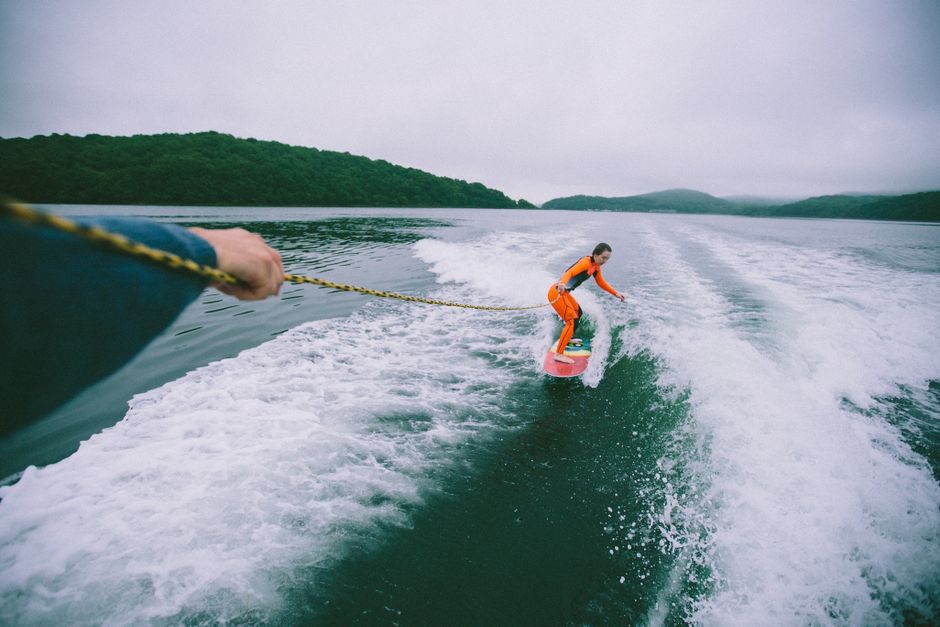
Use a short, thick, floating wakesurf rope, never a long wakeboard rope. Hold the handle, not the line, and never loop the rope around a hand, wrist or arm: in a 2023 case report, a wakesurfer’s arm got tangled in the rope during a fall and his biceps muscle ruptured, and the authors warned that beginners are the ones at risk. Once you drop the rope, the crew pulls it in so it isn’t trailing near the rider. The SWELL Pro Wakesurf Rope (about $80) is 24 feet in three removable sections of 3/4-inch floating line with foam floats that keep it on the surface.
How far from shore to wakesurf
Wakesurf boats make big waves on purpose. A University of Minnesota study of four boats found wakesurf boats needed more than 500 feet in typical use (and more than 425 feet when every boat was making its biggest wake) before their waves dropped to the level of ordinary recreational boats, more than twice the 200 feet Minnesota recommended for common boats. Here’s how the rules look as of the 2026 season:
| Where | Rule |
|---|---|
| Industry guideline (WSIA Wake Responsibly) | Stay at least 200 feet from shore, docks and other boats; keep music reasonable; don’t make repeated passes in the same spot. |
| Pennsylvania (law) | Boats engaged in wakesurfing must be at slow, no-wake speed within 200 feet of the shoreline, docks, launch ramps, swimmers, downed skiers, people wading and anchored, moored or drifting boats. |
| Maine (law) | No wakesurfing in less than 15 feet of water or within 300 feet of the shoreline. |
| Vermont (rule) | Wake sports only in designated zones on listed lakes (zones at least 500 feet from shore, 20 feet deep and 200 feet wide), and not within 500 feet of a person in the water or another boat. |
| Minnesota | State guidance recommends at least 200 feet from shore and other boats; some lakes have local ordinances with larger buffers, such as 500 feet. |
More states and lakes are debating wakesurf rules, so check before each season. Deeper water and more distance are kinder to shorelines, docks, swimmers and paddlers.
Competition rules
- The run: two passes through a course about 750 to 900 feet long (about 45–60 seconds each). Judging starts when the rider has left the dock, entered the course and dropped the rope.
- Falls: up to two falls per pass; a third fall ends the run.
- Judging: three or more judges score difficulty, risk, intensity, variety and execution.
- Boards and transfers: riders may use two boards (swapping between passes or at a pickup) and may transfer across the wake as often as they like.
- Boat settings: the rider must tell the driver the settings before leaving the dock, and there are no re-rides for miscommunication.
- Divisions and styles: surf and skim (defined by board thickness, volume, rocker and fin size), youth 12 and under, amateur, semi-pro, pro, Masters 35+, adaptive and open foil.
- Safety gear: every contestant wears a Coast Guard-approved life jacket or one that will float an unconscious rider.
Gear that helps you follow the rules
An approved vest for every rider, a proper wakesurf rope and sunscreen for everyone in the boat, such as Blue Lizard Sport SPF 50 (about $9, 80 minutes water resistant). Our wakesurfing gear guide compares more.
O'Brien Traditional Neoprene Life Jacket
- US Coast Guard and Transport Canada approved
- Neoprene
- Adjustable straps and buckles
O'Neill SuperLite USCG Life Vest
- USCG Type III
- Four quick-release buckles
- Sizes S to 4XL
SWELL Pro Wakesurf Rope
- 24 ft, 3 sections
- 3/4 in floating line
- Foam floats
Back to the wakesurfing hub, or see youth wakesurfing, wakesurfing injuries and competitions and associations. Riding on a rope instead? See the wakeboarding section.
Wakesurfing rules questions
Can you wakesurf behind an outboard or sterndrive boat?
Board makers say no: use wakesurf boards only behind inboard-drive boats, where the propeller is under the hull, and never behind outboard, sterndrive or jet boats.
How far from shore do you have to wakesurf?
It depends on where you are: 200 feet at no-wake speed in Pennsylvania, 300 feet and at least 15 feet of water in Maine, designated zones in Vermont. The industry guideline is at least 200 feet, and research suggests more is better for shorelines.
Do you need a spotter for wakesurfing?
Often, yes. Minnesota requires an observer or wide-angle mirror when making a wake for a wake surfer, and Pennsylvania requires an observer for towed sports. Use one everywhere.
Is it safe to sit on the swim platform while someone surfs?
No. The Coast Guard says to keep people off the swim platform and rear deck while the engine runs because carbon monoxide collects there, and it calls teak surfing never safe.
Can you wakesurf at night?
Generally no. Minnesota bans wake surfing from half an hour after sunset to sunrise, and Pennsylvania bans boat-towed watersports between sunset and sunrise. Check your state.