This article contains affiliate links: if you buy through them we may earn a commission, at no extra cost to you. Learn more.
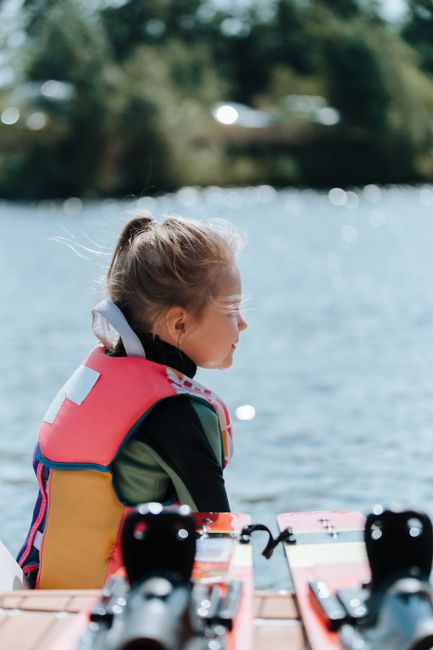
A six-year-old floats behind the boat in a bright vest, a pair of short skis tied together at the tips, both hands on a double handle. Dad’s in the water beside her, holding the ski tips up. “Ready?” She nods, the boat creeps forward, she pops up, wobbles, and holds it all the way across the cove while the whole boat cheers. That first ride is how most water skiers start. This guide is for parents: when kids can start, how to keep them safe in and around the boat, what gear they need, and where the sport goes from there, from junior tournaments to college teams.
When can kids start water skiing?
USA Water Ski & Wake Sports doesn’t set a minimum age, and trainer skis are made for small children. Readiness matters more than age. A child is ready to try when they:
- are comfortable in deep water in a life jacket, including putting their face in and floating on their back;
- can listen to and follow simple instructions (“knees bent, arms straight, let the boat pull you up”);
- want to do it. A scared child on a first ride usually has a bad day; try again later.
Tournament skiing starts early: USA Water Ski’s youngest division is Boys and Girls 1, for skiers 9 and under, with age counted on December 31 of the ski year.
Swimming first, life jacket always
Drowning is the leading cause of death for children ages 1 to 4, according to the CDC, and formal swimming lessons can reduce the risk. The American Academy of Pediatrics recommends layers of protection around water: swim lessons, close supervision and life jackets, and it warns that teens tend to overestimate their skills. Water skiing adds a moving boat, so every layer counts.
Choosing a life jacket for a child
- Coast Guard approved, and labeled for towed sports. Some approved jackets say they are not approved for water skiing, so read the label. Many states require a non-inflatable approved jacket on anyone being towed, and the Coast Guard advises against inflatables for children under 16 and for weak swimmers.
- Sized by weight. Kids’ jackets come in weight ranges, such as less than 30 lb, 30–50 lb and 50–90 lb. Buy for today’s weight, not to grow into.
- Snug but not tight. Buckle everything, then lift the jacket by the shoulders: if it rides up past the chin or ears, it’s too big. A crotch strap on small kids’ vests helps keep it in place.
- Federal rule: children under 13 must wear a life jacket on a moving boat unless they’re below deck or in an enclosed cabin, or a state rule says otherwise. On a ski boat, that means the whole ride, not just their turn.
For little ones, the Stearns kids’ vest for 30–50 lb (about $33) is a Coast Guard-approved Type III with three buckles and a leg strap; bigger kids can move to the Stearns youth jacket for 50–90 lb (about $47) or a neoprene vest like the Airhead Wicked NeoLite youth (about $54), which the maker says may run a little small.
Trainer skis and the first rides
Trainer skis keep a child’s skis together and pointed forward, which is the hardest part for small legs. The Airhead Watermelon 47″ combo skis (about $125) have a removable cross bar and a double-handle rope, and the maker sizes them for US kids’ shoe sizes 5–12 and up to 100 lb. The Airhead EZ-Ski Trainer (about $345) is an inflatable platform with built-in trainer skis for one rider up to 120 lb, sold as the official youth trainer of USA Water Ski. Once kids outgrow trainers, a junior combo pair is next; the O’Brien Celebrity 64″ junior combo (about $270) is sized for riders 100 to 200 lb, and the maker says it’s too heavy for children under 80 lb.
A few habits make first rides go well:
- Practice on land first: sit, knees to chest, arms straight around the knees, and let a parent pull the handle so the child stands up slowly.
- Slow and smooth. The right speed depends on weight and ski size, so a small child needs far less than an adult, and the driver should ease the throttle so the pull never jerks. Ask the child what feels good and use the “faster” and “slower” signals.
- Teach “let go.” If they’re falling, let go of the handle. Never wrap the rope around a hand or arm.
- Short sets. Small bodies tire and get cold quickly. Stop while it’s still fun.
Kids in and around the boat
- Engine off near kids in the water. The Coast Guard counted 169 propeller-strike incidents in 2024, with 30 deaths. Shut the engine off when a child is in the water near the boat, and never let anyone use the propeller or lower unit as a step.
- Off the swim platform while the engine runs. Carbon monoxide collects at the stern. Headache, nausea, dizziness or unusual sleepiness in a child near the back of the boat means fresh air and medical help. Never let kids “teak surf” (hold the platform and ride the wake); the Coast Guard says it’s never safe.
- Kids as observers. A responsible older kid can be the observer, watching the skier and calling falls. California sets the observer’s minimum age at 12, so check your state.
- Teens driving. Boat operator ages are set by the states. California, for example, doesn’t allow anyone under 16 to run a motorboat over 15 horsepower alone; 12- to 15-year-olds may if someone 18 or older is aboard to supervise.
Teach the hand signals on the dock before anyone gets in. Our water skiing rules page has the full list.
Young bodies: backs, shoulders and heads
Most kids’ skiing is gentle, but parents of young competitors should know a few things. A review of tournament water skiing found a high rate of lower-back injuries in the jump event and warned that a young spine may be damaged by overuse before it matures, so young jumpers need careful coaching and limits on volume. Getting up puts real force through the arms (about one and a half times body weight in a study of adult skiers), which is another reason for a smooth, slow pull. Head injuries are less common in skiing than in wakeboarding, but if a child seems dazed, confused or has a headache, dizziness or nausea after a fall, follow the CDC’s HEADS UP advice: out for the day and checked by a healthcare provider before skiing again. See our water skiing injuries page for more.
Sun and cold
Sun reflects off the water, so kids burn fast on a boat. The American Academy of Dermatology recommends a broad-spectrum, water-resistant SPF 30 or higher, reapplied every two hours and after swimming; a rash guard and hat help between turns. Cold water chills small bodies quickly too: in spring and fall a wetsuit under the life jacket and a towel or dry layer in the boat keep the day going.
From first rides to junior tournaments and college
Kids who get hooked have a clear path. USA Water Ski & Wake Sports runs basic skills clinics and “Get On the Water” programs, and grassroots tournaments are a low-pressure first competition. Junior skiers compete in Boys and Girls divisions 1 to 5 (up to 17 and under) in slalom, tricks and jump. The junior development program adds beginner and advanced clinics, regional all-star teams (six skiers and an alternate from each of five regions) and a National Junior Team picked from the national rankings. Internationally, the IWWF holds Under-17 and Under-21 world championships; the next Under-21 Waterski Worlds are set for January 2027 in Peru. Show ski clubs take members of every age, from children to seniors. After high school, about 71 college club teams in the NCWSA (as of 2026) ski slalom, trick and jump; it isn’t an NCAA sport. See our leagues and associations page.
Airhead Watermelon 47" Kids' Combo Skis
- Removable cross bar
- Double-handle rope
- Kids' shoe sizes 5-12, up to 100 lb
Airhead EZ-Ski Trainer
- 1 rider, up to 120 lb
- Built-in trainer skis
- Official youth trainer of USA Water Ski (maker)
Stearns Kids Life Vest, 30-50 lb
- USCG approved Type III
- Three buckles and leg strap
- Open sides
Stearns Youth Life Jacket, 50-90 lb
- USCG-approved Type III
- Fits 50-90 lb
- Closed sides, three buckles
More gear, including junior combo skis and ropes, is on our water skiing gear page. Back to the water skiing hub, or see youth pages for wakeboarding and swimming.
Parents’ questions about youth water skiing
What age can a child start water skiing?
There’s no official minimum age. Many kids start on trainer skis when they’re comfortable in deep water in a life jacket and can follow simple instructions. Tournament skiing has a division for 9 and under.
Does my child need to know how to swim to water ski?
Strong swimming isn’t required to try, because the life jacket keeps them up, but comfort in deep water is. Swim lessons are one of the layers of protection the AAP recommends for every child, and they make the sport safer and more fun.
What kind of life jacket does a kid need for water skiing?
A Coast Guard-approved, non-inflatable jacket in the right weight range, not labeled “not approved for water skiing,” that passes the lift test: it shouldn’t ride up past the chin or ears when you lift it by the shoulders.
Are trainer skis worth it?
For small kids, usually. Trainer skis tie the tips together so the skis don’t drift apart, which lets a child focus on standing up. Most kids move to regular combo skis after a few good rides.
Can my child be the spotter?
An older child who can watch the skier the whole time and knows the signals can. California sets the minimum observer age at 12; check your state’s rule.
Is water ski jumping safe for kids?
Jumping is a coached tournament event with set ramp heights by division and required helmets. Researchers have warned that repeated jumping can stress a young lower back, so keep jumping coached, gradual and limited, and see a professional for back pain that lasts.