This article contains affiliate links: if you buy through them we may earn a commission, at no extra cost to you. Learn more.
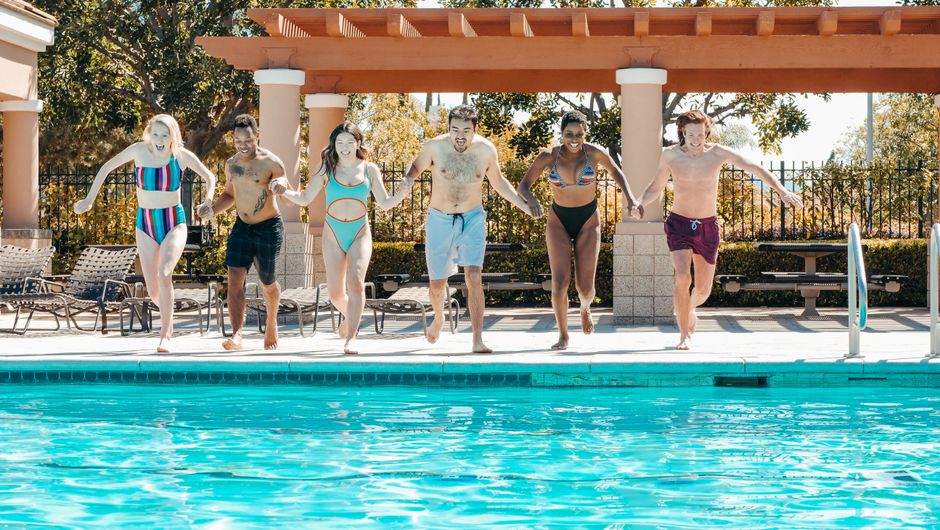
It usually starts at the pool on a summer afternoon. A kid who has already done every cannonball and handstand they know walks out to the end of the diving board, bounces a few times and tries something new. Some of them get hooked. A few years later the same kid is doing back somersaults on a trampoline in a spotting belt, warming up on the 1-meter at a regional meet and asking about the 3-meter. Youth diving is a wonderful sport for brave, coordinated kids. It also asks a lot of growing bodies. This guide is for parents: when kids can start, how learn-to-dive programs work, how to keep dryland training and the pool safe, and how high school diving and college recruiting work.
When can kids start diving?
Swimming comes first. A child needs to be comfortable in deep water and able to swim to the side on their own before they go near a diving board. The American Academy of Pediatrics (AAP) says swim lessons can begin after age 1, but lessons are only one layer of protection; kids still need an adult watching every time they’re near water.
Competitive diving has no single starting age. USA Diving’s youngest junior age group is 11 and under (Group D), and many clubs run beginner classes for younger children who swim well. A lot of divers come from gymnastics or trampoline, and some start as teenagers through their high school team. The AAP lists diving among the few sports, with gymnastics and figure skating, where elite athletes may need to specialize early. A 2025 survey of 182 US divers aged 8 to 25 even found fewer injuries in elite youth divers who specialized before 13. That’s one study, and it doesn’t mean younger kids need year-round diving to enjoy the sport or to do well later.
Learn-to-dive programs and the junior path
- Learn-to-dive classes: many clubs, park districts and summer pools run beginner classes on the 1-meter board. Look for a coach with diving experience, deep water that meets the depth rules below and small groups.
- Future Champions: USA Diving’s starter competition for beginning divers. It has eight levels, starting with six skills from a “skill bank” of safe progressions and building up to voluntary and optional dives.
- Junior Competition Circuit: age groups by age on December 31: 11 and under, 12–13, 14–15 and 16–18. The older groups (14–18) start at Regional Championships and qualify for Zones; the younger groups start at Zones. From there, divers move on to the East, West or Central Championships or to the Junior National Championships. Platform becomes an official qualifying event at Zones.
- High school diving: 1-meter only, part of the swimming and diving team. Six dives in dual meets and 11 at championships, under NFHS rules.
Before you sign up, ask the club whether its head coach holds a current USA Diving “Competition Coach” membership. That requires Safe Sport training, concussion training and a background screening.
Dryland and trampoline safety
Divers spend a lot of time on land. Coaches use trampolines, dry boards that bounce into foam pits, tumbling mats and spotting belts (a harness held by the coach, sometimes from an overhead rig) so a diver can learn a new somersault or twist safely many times. That’s very different from a backyard trampoline. HealthyChildren.org, from the AAP, says jumping under a trained coach isn’t the same as bouncing at home or at a trampoline park, and notes that coaches may use a harness to teach new moves.
At home, the AAP strongly discourages trampolines. Most trampoline injuries happen with several kids on the mat at once, and neck injuries often come from falls or from somersaults and flips. If a family has one anyway, the AAP’s rules are: no children under 6, one jumper at a time, no flips or somersaults, a net that stays zipped and an adult always watching. Tell your young diver plainly: new dives and flips are for practice with the coach, not the backyard or the hotel pool.
Keeping young divers healthy
- Deep water only. The NCAA’s minimum depth under a 1-meter board is 11 ft 2 in. The American Academy of Orthopaedic Surgeons counts more than 1,900 spinal cord injuries a year from diving. Teach kids never to dive into shallow water or water where they can’t see the bottom, even when they’re experienced.
- Head knocks. In US high schools, more than a third of diving injuries were to the head or face, mostly from contact with the board or water. Follow the CDC’s HEADS UP rule: if your child seems dazed or has a headache, dizziness or blurry vision after a hit, they come out for the day and don’t return until a health care provider clears them.
- Wrists. Every head-first entry loads the wrists. An MRI study of adolescent divers found growth-plate injuries at the end of the radius in 43% of painful wrists, and many wrist injuries had no clear symptoms. Wrist pain that keeps coming back needs a doctor’s check, not just tape.
- Backs and shoulders. Low back pain is the most common complaint in divers. In elite junior divers in Japan, tight shoulders went with back pain in the boys, likely because the lower back arches when the arms can’t reach fully overhead at entry. Shoulder flexibility work is part of good coaching.
- Rest. The AAP recommends at least one or two days off a week and two to three months off a year (in one-month blocks) from a single sport, and watching for burnout. Pain, poor sleep, falling grades or dread before practice are signs to talk to the coach and a doctor.
- Ears. The CDC suggests a cap or ear plugs, tilting the head and towel-drying the ears after the pool, and no cotton swabs in the ears.
For an ongoing problem, see a sports medicine physician or physical therapist, or start with the school’s athletic trainer. Our diving hub covers diving injuries in more detail, and the youth gymnastics guide covers many of the same wrist and back questions.
What young divers need
Not much: a practice suit, a shammy towel, a water bottle and, for kids prone to swimmer’s ear, ear plugs. The Flow Swim Chamois comes in bright colors and a storage tube, which helps it survive a kid’s pool bag. Mack’s AquaBlock ear plugs are reusable soft silicone. A Nalgene 32 oz bottle gets through a long meet day. See the full diving gear list.
Flow Swim Chamois
- 13 x 17 in when wet
- Five colors
- Storage tube included
Mack's AquaBlock Swimming Earplugs (2 pair)
- Soft silicone, triple flange
- Reusable and washable
- Carry case included
Nalgene Sustain 32 oz Wide Mouth
- 32 oz, wide mouth
- BPA-free Tritan
- Made with 50% plastic-waste material
Prices change often. We saw the Flow Swim Chamois at about $13 on Amazon in October 2026; check the current price before you buy.
College recruiting for divers
- Boards matter. High school diving is 1-meter only, while college meets use 1-meter and 3-meter, and some include platform. Club diving is usually where divers get 3-meter and platform experience and the meet results coaches look for.
- When coaches can reach out: in NCAA Division I swimming and diving, coaches can start contacting recruits on June 15 after sophomore year, and official visits can start August 1 before junior year. Division II, Division III, the NAIA and junior colleges have their own rules.
- Roster spots: Division I schools that opted into the House settlement have a limit of 30 swimmers and divers per team.
- Paperwork: divers aiming for Division I or II should register with the NCAA Eligibility Center and keep grades and core courses on track.
- Keep a record: a current dive list with degrees of difficulty, meet scores and clear video of each dive make it easy to answer a coach’s questions.
Once in college, Division I divers qualify for the NCAA championships through zone diving meets. See diving leagues and associations and the diving rules for how meets work at every level.
Parents’ questions about youth diving
What age should my child start diving?
There’s no single answer. First, they should swim confidently in deep water. Many clubs take strong young swimmers in beginner classes, USA Diving’s youngest junior age group is 11 and under, and plenty of divers start in their teens through high school.
Is diving safe for kids?
With a qualified coach, proper water depth and supervised dryland training, it’s a well-organized sport. The main risks are head knocks on the board or water, wrist and back strain from repeated entries, and diving into shallow water outside the club. Teach kids that new dives are only for practice with the coach.
Should we buy a trampoline for diving practice at home?
The AAP strongly discourages home trampolines. Dryland training with flips belongs at the club, with a trained coach and equipment such as spotting belts. If you have one anyway: one jumper at a time, no flips or somersaults, an adult watching and no children under 6.
Does my child need to do gymnastics too?
It isn’t required. Many divers have a gymnastics or trampoline background, and diving coaches teach tumbling and body awareness in dryland. Trying several sports when young is fine; the AAP’s advice on rest days and breaks applies either way.
My diver’s wrist hurts after practice. Is that normal?
Some soreness happens, but wrist pain that keeps coming back should be checked by a sports medicine doctor. Research in adolescent divers found growth-plate injuries in the wrist that weren’t always obvious.