This article contains affiliate links: if you buy through them we may earn a commission, at no extra cost to you. Learn more.
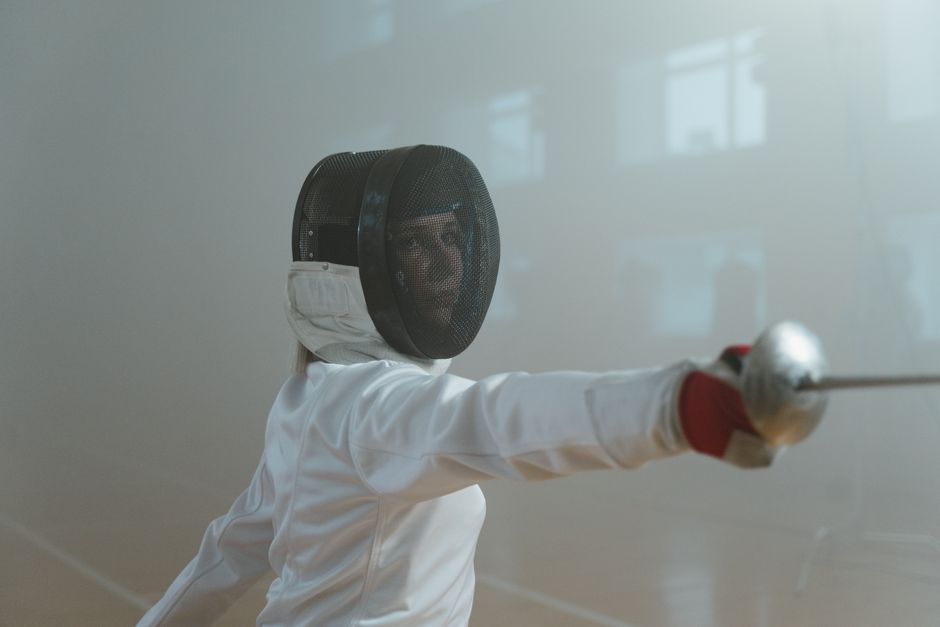
Tuesday night at the club. Before anyone picks up a blade, the coach lines everyone up along the strip: advance, advance, retreat, lunge, recover, again, faster. Twenty minutes in, thighs burn and a few of the ten-year-olds are laughing at how low the coach wants them to sit. That’s the heart of fencing training: footwork you could do in your sleep, legs strong enough to lunge hard at the end of a long day, and a body that stays balanced even though the sport only ever works one side. This page covers the off-season to the week before a tournament, for youth, high school and college fencers, Olympic hopefuls and veterans.
General information, not a personal training plan. If you’re coming back from an injury, have your PT or athletic trainer adapt it. Back to the fencing hub.
What fencing asks of your body
A widely cited review of fencing science found that an international tournament can last 9 to 11 hours, but bouts fill only about 18% of that time, with an actual fighting time of roughly 17 to 48 minutes. The effort inside each bout is short and explosive, drawing on both aerobic and anaerobic energy systems. In a 2024 simulated épée competition, fencers’ heart rates averaged about 87% of age-predicted maximum in pool bouts and about 91% in the first direct-elimination bout. So fencers need three things at once: speed and power for the attack, enough fitness to repeat it all day, and the skill to make decisions while tired.
What separates good from better? A 2025 study of Polish men’s fencers found that the top-ranked group did clearly better on a fencing-specific endurance test, on jump power and on lean mass, but not on a 5-meter sprint. Straight-line speed was similar; repeated, fencing-specific power was the difference.
Footwork: the foundation
Every coach builds from the en garde stance: knees bent, weight centered, front foot pointing at the opponent. Advances, retreats, lunges, recoveries, balestras (a small jump forward) and the flèche (a running attack) are the basic vocabulary; your coach will tell you which moves your weapon’s rules allow. A few principles most coaches share:
- Little and often: 10 to 20 minutes of footwork at the start of most sessions, before the legs are tired, beats one long block.
- Change rhythm: fencing is about timing, so mix slow-slow-fast patterns and follow-the-leader drills where you react to a partner.
- Ladders and lines help quick, light feet, especially for younger fencers. A simple agility ladder such as the SKLZ Quick Ladder fits in a fencing bag.
- Gear on when required: at USA Fencing-sanctioned tournaments, fencers and coaches must wear mask and glove for drills, lessons and warm-ups.
Lunging strength and power
The lunge is a single-leg jump forward that the front leg has to catch. A 2026 study of 45 elite women fencers found that strength and power tests (a mid-thigh pull and several jumps) were linked to lunge speed, though the links differed by weapon: in foil, an advance-lunge was strongly tied to relative maximal strength. The épée fencers had the fastest advance-lunges. The practical message is plain: fencers get faster lunges by getting stronger and more powerful, not only by lunging more.
- Strength (2–3 days a week in the off-season): squats or trap-bar deadlifts, split squats and step-ups on both legs, hip thrusts, calf raises.
- Power: jumps, bounds and short lunge-jumps, kept low in volume and high in quality.
- The lunge “brakes”: slow lowering work for the front leg’s quads, hamstrings and adductors. The Nordic hamstring exercise and the Copenhagen adduction exercise cut hamstring and groin injuries in soccer trials (see our soccer training page). A strap like the NordStick lets you do Nordics at home.
- Kids and teens: the American Academy of Pediatrics supports supervised, well-taught resistance training for children and teens; start with technique and body weight, then add load slowly.
Conditioning for a long tournament day
Fencing fitness is repeated bursts with short rests. In a 2026 study of elite épée fencers, eight sessions of repeated 15-second all-out fencing “sprints” with 15 seconds of easy recovery, over four weeks, made best and average sprint times about 5–7% faster and cut the drop-off in speed across repeats by roughly a quarter to a third. Build your own version from footwork: 10 to 15 seconds of hard advance-lunge-recover patterns, the same time easy, repeated in sets.
An aerobic base matters too, because it helps you recover between bouts on a 10-hour day. Easy running, cycling or rowing once or twice a week in the off-season does that without more lunging. A chest-strap heart rate monitor such as the Polar H10 makes it easy to keep easy days easy and hard intervals hard; our best wearables for fencing page compares options.
Asymmetry and balance work
Fencers always hold the weapon in the same hand and lead with the same leg. Research describes a typical limb asymmetry in fencers that comes from this one-sided practice, and a 2026 survey of USA Fencing members found sword-arm injuries were far more likely on the dominant side. You can’t make fencing symmetrical, but you can balance the rest of your training:
- Do single-leg work on both legs, with a few extra sets for the back leg, which drives every attack.
- Train the non-weapon arm and both sides of the trunk: rows, presses, carries and anti-rotation work (Pallof presses, side planks) on both sides.
- Hips and ankles: mobility for the lunge, plus band work for the hips. A set of loop bands like the Fit Simplify bands is enough for lateral walks and clamshells.
- Balance: single-leg balance, wobble-board and hop-and-stick drills. The National Athletic Trainers’ Association recommends at least 3 months of balance and neuromuscular training for ankle sprain prevention. In a small 2026 study, eight weeks of fencing-specific training improved junior sabre fencers’ balance in the en garde position.
Fit Simplify Resistance Loop Bands
- Set of 5 loop bands
- Five resistance levels
- About $14
NordStick Nordic Hamstring Curl Strap
- Holds heels for Nordic curls
- Quick setup, packs for travel
- About $25
Polar H10
- Chest strap, Bluetooth + ANT+
- Up to 400 h battery
- About $105
A season, in broad strokes
- Off-season: the most strength and aerobic work, technique fixes, and real rest. The American Academy of Pediatrics recommends young athletes take at least 1–2 days off a week from their main sport and 3 months off a year in 1-month blocks.
- Pre-season: shift toward power, repeated-sprint conditioning and more bouting.
- Competition season: keep one or two short strength sessions a week, and lighten the load in the two or three days before a tournament so your legs arrive fresh. Our tournament day page covers the day itself.
- Veterans: the same pieces with more recovery between hard days. Older age was linked with more injuries in a 2025 review of fencing injury studies, so build up slowly.
Warm-up and the mental game
A good warm-up runs from easy movement to dynamic stretches, then footwork at rising speed, then a few hard lunges and some bouting or a lesson. On the mental side, a 2025 survey of Chinese national-level fencers found mental fatigue rated higher in direct elimination than in pools, and linked to timing decisions and attacks. Practicing decisions while tired, for example bouting at the end of a conditioning session, prepares you for that. Our mental training tools guide has books and apps many athletes use.
For injury prevention details, see fencing injuries; for what to do after hard weeks, fencing recovery; and for bands and other kit, best resistance bands for athletes and best speed training equipment.
Fencing training: FAQs
How do I make my lunge faster?
Technique first, then strength and power. Studies of elite fencers link lunge speed to lower-body strength and jump power, so squats, split squats and jumps, done well, support the footwork you practice at the club.
Should fencers lift weights?
Yes, with good coaching. Top-ranked fencers in one study had more jump power and lean mass than lower-ranked fencers. Two or three sessions a week in the off-season and one or two in season fit most fencers.
What kind of cardio is best for fencing?
Mostly short, hard repeats with short rests, like the 15-seconds-on, 15-seconds-off fencing sprints that improved elite épée fencers’ performance in a 2026 study, plus some easy aerobic work so you recover between bouts.
How do I fix the imbalance from fencing?
You won’t remove it, and some asymmetry is part of being a skilled fencer. Balance it in the gym with single-leg work on both sides, extra back-leg strength, both-side trunk work and pulling exercises for the non-weapon arm.
How many days a week should a young fencer train?
It depends on age and goals, but the American Academy of Pediatrics advises at least 1–2 days off a week from the main sport and 3 months off a year in 1-month blocks. Other sports in the off-season are good for young fencers.