This article contains affiliate links: if you buy through them we may earn a commission, at no extra cost to you. Learn more.
First week of preseason. The cones are out, the grass is still wet, and by the third set of shuttle runs half the team is bent over with hands on knees, wondering why the summer felt so short. Every player knows that feeling. Good soccer training is about making that week, and the whole season after it, a little less brutal: building the engine, legs and head the game actually asks for, without breaking down along the way. Here’s what the game demands, and how players at every level prepare for it.
General information for healthy players. Kids, players coming back from injury and anyone with a heart or medical condition should check with a doctor before a new program. For the overview of the sport, see our soccer hub.
What a soccer match asks of your body
Soccer is stop-and-start. Here’s what match studies of top players have measured:
- About 11 km per match for a top-class player, on average, in Jens Bangsbo’s classic match analyses, with big differences by position.
- 150 to 250 brief intense actions per game (sprints, accelerations, tackles, jumps), even though more than 70% of the game is low-intensity movement.
- About 2.4 km of high-intensity running, including roughly 650 m of sprinting, for top-class professionals in one well-known study, and 35–45% less high-intensity running in the last 15 minutes than in the first.
- Position matters: in the Premier League, wide midfielders covered about 3.1 km of high-intensity running per match, central defenders about 1.8 km. The average recovery between very hard runs was 72 seconds.
- The game keeps getting faster: across seven Premier League seasons (2006–07 to 2012–13), high-intensity running distance rose by about 30%.
Youth and recreational games are slower and shorter, but the pattern is the same: lots of jogging and walking, broken up by short bursts that decide the game. So soccer training needs two things: an aerobic base so you recover between bursts, and the speed and strength to make those bursts count.
The soccer year: off-season, preseason, in-season
Off-season: rest first, then build
The off-season starts with a real break. For young players, the American Academy of Pediatrics (AAP) recommends a total of 3 months a year away from their main sport, in 1-month blocks, while staying active in other ways. After the break, it’s the time to build general strength, fix the niggles that lingered through the season, and play other sports.
Preseason: build gradually, especially in heat
Preseason is where the running volume climbs, which is why it’s also where a lot of injuries start. The International Olympic Committee’s consensus on load and injury names poor load management, including rapid jumps in training, as a major injury risk factor. The American Academy of Orthopaedic Surgeons (AAOS) links shin splints to sudden increases in how often, how long or how hard you train. Summer preseason has a second risk: heat. The National Athletic Trainers’ Association (NATA) says athletes should get used to the heat gradually over 7 to 14 days. More on hot days is on our soccer game day page.
In-season: maintain, recover, repeat
Once games start, the job is to keep fitness and strength while staying fresh for match day. A simple rhythm: keep the hardest session well away from the day before a game, keep short strength and prevention work going every week, and protect at least one full rest day. AAP advises young athletes to take at least 1 to 2 days off per week from their main sport.
Soccer conditioning: aerobic base and repeated sprints
Soccer conditioning has two layers:
- Aerobic base: steady runs, tempo runs and longer small-sided games build the engine that lets you recover between efforts. Bangsbo’s work found the average effort in a match is around 70% of a player’s maximum oxygen uptake, so the base matters.
- Repeated high-intensity work: shuttle runs, interval runs and intense small-sided games train you to sprint, recover and sprint again. In the study above, the top-class players did more high-intensity running and sprinting than moderate professionals, and scored better on the Yo-Yo intermittent recovery test, a shuttle test many teams use to measure soccer fitness.
Many players now track this with a heart-rate strap, GPS watch or recovery wearable. If you’re choosing one, our WHOOP vs Oura vs Garmin comparison explains which suits which player.
Strength: the injury-prevention layer
Strength work for soccer isn’t about bulk. It’s about legs and hips that can take sprints, landings and tackles. Three exercises with strong soccer research behind them:
- Nordic hamstring exercise: a 2019 meta-analysis of 8,459 athletes found programs including it reduce hamstring injuries by up to 51%.
- Copenhagen adduction exercise: one exercise, three times a week in preseason and once a week in season, gave semi-professional men’s teams a 41% lower risk of groin problems.
- Squats, lunges, single-leg work and core: the backbone of FIFA 11+ part 2 and most ACL prevention programs, which a summary of meta-analyses found halve ACL injuries overall.
Our soccer injuries page has the full prevention research.
Speed and agility
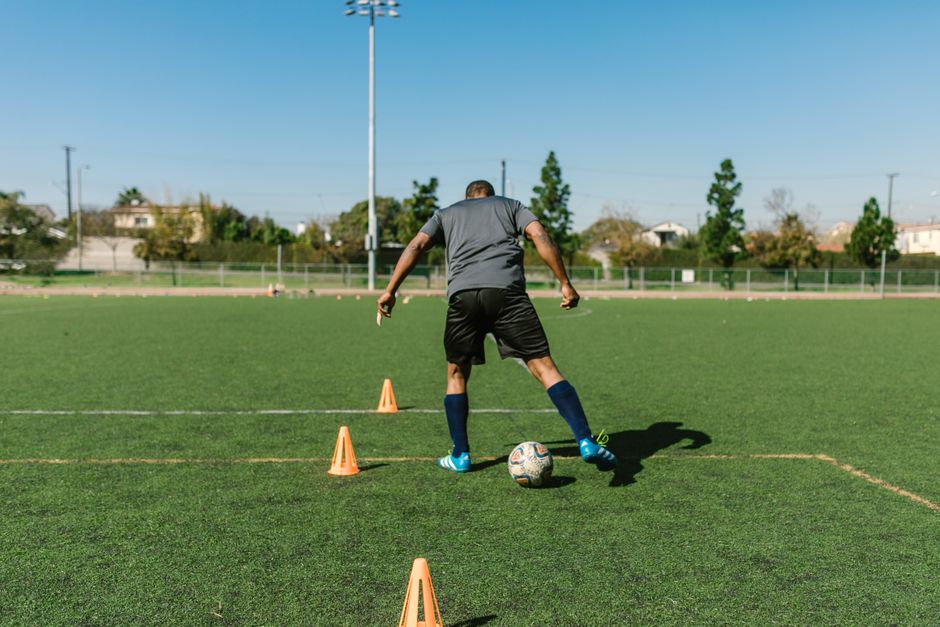
Being first to the ball is often worth more than being the fittest player on the field. Speed work for soccer means short accelerations, top-speed runs, and change of direction with the ball and without it. Keep it fresh: sprints count only when you’re rested enough to go all-out, so they usually come early in a session, after the warm-up. Ladders, mini-hurdles and resisted sprints add variety; our best speed training equipment guide compares the tools teams actually use.
SKLZ Quick Ladder
- 15 ft, 11 flat rungs
- 17 in wide
- Carry bag included
SKLZ Speed Hurdle Pro (set of 6)
- 6, 9 or 12 in heights
- One-button adjust
- Folds into a case
NordStick Nordic Hamstring Curl Strap
- Holds heels for Nordic curls
- 350 lb capacity (listing)
- Quick setup, packs for travel
A SKLZ Quick Ladder and a set of SKLZ Speed Hurdles cover most footwork drills for a team or a backyard; a NordStick strap lets you do Nordic curls without a partner holding your ankles.
Warm-up: FIFA 11+
If your team does one thing from this page, make it this. FIFA 11+ is a roughly 20-minute warm-up with 15 exercises in three parts: running drills, then strength, balance, jumping and agility, then faster running with cutting. It’s designed for players 14 and up, at least twice a week, and there’s an “11+ Kids” version for younger players. A 2017 meta-analysis found FIFA 11+ reduced soccer injuries by 39%; the kids’ version cut injuries by 48% in its main trial. FIFA’s review also reports performance gains such as better balance and agility.
The mental game
Missing a penalty, getting benched, a tough coach: soccer tests your head as much as your legs. The International Olympic Committee’s 2019 consensus statement on mental health in elite athletes says mental health symptoms are common in athletes, can hurt performance, and are linked to a higher risk of injury and slower recovery. Practical habits help: a short pre-game routine, breathing to settle nerves, a “next play” reset after mistakes, and visualizing game situations. If it’s more than nerves (lasting low mood, anxiety, trouble sleeping or eating), talk to someone: a parent, coach, team doctor or a mental health professional. Apps and tools that support this are in our best mental training tools for athletes guide.
Training load and rest days
- Build gradually. Rapid jumps in training and crowded competition calendars are both named as injury risks in the IOC load consensus.
- Watch match load. In UEFA’s injury research, the hamstring injury rate in matches was about 9 times the rate in training. Games are the hardest sessions of the week; plan around them.
- Take real rest days. At least one or two a week for young players (AAP). Adults benefit from the same rhythm.
- Sleep is training. The American Academy of Sleep Medicine recommends 9–12 hours for ages 6–12, 8–10 hours for teens, and at least 7 hours for adults.
Youth vs adult players
Kids and teens. AAP says playing several sports, at least until puberty, lowers the chances of injury, stress and burnout, and that specializing later (late adolescence) may give a better chance of reaching athletic goals. One study found young athletes who played more hours of organized sport per week than their age in years had about twice the odds of a serious overuse injury. Use 11+ Kids, keep sessions fun, and watch for growth-spurt pains like heel or knee pain. More in youth soccer.
Adults and weekend players. The usual problem is the opposite: one hard game a week and nothing in between. Two short strength and conditioning sessions plus FIFA 11+ before games help close the gap between desk week and Sunday sprinting. How you feel the day after a game is useful information, and our soccer recovery page covers what to do with it.
Soccer training: FAQs
How far does a soccer player run in a game?
Top-class players average about 11 km in classic match analyses, with midfielders usually covering the most. Youth and recreational players cover less, depending on age, field size and game length.
What is the best conditioning for soccer?
A mix: an aerobic base (steady and tempo running, longer small-sided games) plus repeated high-intensity work (intervals, shuttles, intense small-sided games), because a match is long stretches of light movement broken by 150–250 short intense actions.
How many days a week should soccer players train?
It depends on level and age, but rest days are part of the plan. AAP recommends at least 1–2 days off per week from the main sport for young athletes, and about 3 months off per year in 1-month blocks.
Should soccer players lift weights?
Yes, with good coaching and sensible progression. Lower-body strength, Nordic hamstring and Copenhagen adduction exercises have strong soccer research behind them for lowering hamstring and groin injury risk.
Is FIFA 11+ only for kids?
No. FIFA 11+ is designed for players 14 and older, including adult amateurs; 11+ Kids is the version for younger players. Both work best done at least twice a week as the team’s normal warm-up.