This article contains affiliate links: if you buy through them we may earn a commission, at no extra cost to you. Learn more.
Six in the morning in late July. The grass is already wet with heat, the coaches are setting out cones, and a hundred players are about to find out how their summer went. Football training is a year-round cycle: lifting in the winter, spring practice, summer conditioning, then the preseason, when most of the danger and most of the work happen at once.

This page walks through that year for every level, from youth and high school to college, the NFL and adults getting back into the game. The biggest part is the preseason heat-acclimatization rules from the National Athletic Trainers’ Association (NATA) and the National Federation of State High School Associations (NFHS), because that’s where football’s most preventable deaths happen. Then strength, speed and what each position really needs. It’s general information; a qualified strength coach and your athletic trainer know your situation.
The football year at a glance
| Phase | Main goal | Watch out for |
|---|---|---|
| Off-season (winter–spring) | Strength, speed, fix weak spots, spring practice | Too much too soon after a break |
| Summer | Conditioning, position work, getting used to heat | The first days of any new program |
| Preseason (camp) | Acclimatize, learn the system, add pads and contact step by step | Heat illness, early concussions |
| In season | Keep strength, stay fresh for games | Fatigue, piling up contact |
Off-season and summer: build, but build slowly
Every level has rules for the off-season. In the NFL, the players’ collective bargaining agreement sets a voluntary nine-week offseason program in three phases: two weeks of strength, conditioning and rehab only; three weeks of on-field drills with no live contact; then four weeks that can include up to ten days of organized team activities (OTAs), still with no live contact. NCAA Division I programs get 15 spring practice sessions, and high school rules vary by state association.
The hidden risk is conditioning, not contact. In college football, non-traumatic deaths (heart, heat stroke, exertional sickling in athletes with sickle cell trait, and muscle breakdown called rhabdomyolysis) outnumbered traumatic ones about 5 to 1 between 2001 and 2017, according to recommendations endorsed by 13 medical organizations. Those recommendations treat the first seven days of any new conditioning period as the riskiest, ask for workouts that build “intentionally, gradually and progressively,” and say exercise should never be used as punishment. NCAA schools must confirm each athlete’s sickle cell trait status before they play.
Linemen need their own plan. The NFHS reports that 97% of football heat stroke deaths involve linemen and that all have happened during conditioning, not games. Its guidance: train linemen for what they actually do (short, explosive bursts, about 10 yards at full speed in a game), drop timed miles and long sprint series, especially in the first two weeks, and lighten workloads for players starting a new program, then build back up over about four weeks.
Preseason heat acclimatization (NATA and NFHS)
The body adapts to heat over about two weeks, so the NATA-led preseason guidelines for high schools spread the first 14 days out like this:
- Days 1–5: no more than one practice a day, up to 3 hours. A walk-through of up to 1 hour is allowed, with at least 3 hours of recovery in between.
- Gear step by step: helmets only on days 1–2; helmets and shoulder pads on days 3–5, when contact with blocking sleds and tackling dummies can start; from day 6, all gear and full contact.
- Days 6–14: a double-practice day must be followed by a single-practice day. Neither practice may exceed 3 hours, 5 hours in total, with at least 3 continuous hours in a cool place between them.
- Rest: after six straight days of practice, one full day off with no conditioning.
The NFHS position statement explains why: most heat deaths happen in the first few days of practice, “prompted by doing too much, too soon,” sometimes with full pads on too early. It adds that an athlete can’t be conditioned in two or three weeks, so summer fitness still matters. Its fundamentals also include starting each practice hydrated, adjusting for heat and humidity (many schools use a Wet Bulb Globe Temperature reading) and keeping an emergency plan with ice-water cooling on site. Each state association writes its own rules, so check yours.
College and pro. NCAA football opens with a five-day acclimatization period for every player, new or returning: one on-field practice a day of up to 3 hours, helmets only on days 1–2, helmets and shoulder pads on days 3–4, and full pads from day 5. Since 2017, Division I has banned preseason two-a-days; teams keep 29 practices before the first game. The NFL agreement also starts camp with a five-day acclimation period, then allows only one padded practice a day (no longer than 2.5 hours on the field) and no more than 16 padded practices in all of training camp.
Strength training for football
Strength protects players in a collision sport and powers every block, tackle and sprint. For young athletes, the American Academy of Pediatrics (AAP) says supervised strength training is safe and useful, with qualified instructors and no more than about 10 players per coach. Its guidance:
- Train 2–3 times a week for 20–30 minutes, with at least 10 minutes of warm-up and cool-down.
- Learn every lift without weight first, then add load slowly: no more than 10% a week.
- 2–3 sets of 8–15 reps for all major muscle groups, core included.
- No one-rep maxes or maximal lifts before the body is fully grown, and stop at once if something hurts.
Older high school, college and adult players lift heavier under a strength coach, usually built around squats, hinges, presses and pulls. Add two things that protect football bodies: the Nordic hamstring exercise, which halved hamstring injuries in a review of 15 studies, and many coaches add neck and upper-back work for players who block and tackle. Many adult players also use creatine, one of the most studied supplements; our creatine guide lists third-party tested options. Teens should talk to a doctor first.
Speed, agility and what each position needs
Football speed is short: get off the ball, hit top speed in a few strides, change direction. GPS data from an NCAA Division I team showed big differences by position: wide receivers and defensive backs covered the most total distance and did the most high-speed running, sprinting and hard accelerations and decelerations of their groups. The researchers concluded that training should be position-specific.
- Receivers and defensive backs: repeated sprints, top speed, cutting and stopping.
- Running backs and linebackers: acceleration, change of direction and strength to break or make tackles.
- Linemen: first-step quickness, power over 5–10 yards and the conditioning to repeat it, with extra care in the heat.
- Quarterbacks and specialists: footwork, shoulder and hip care, and the throwing or kicking load.
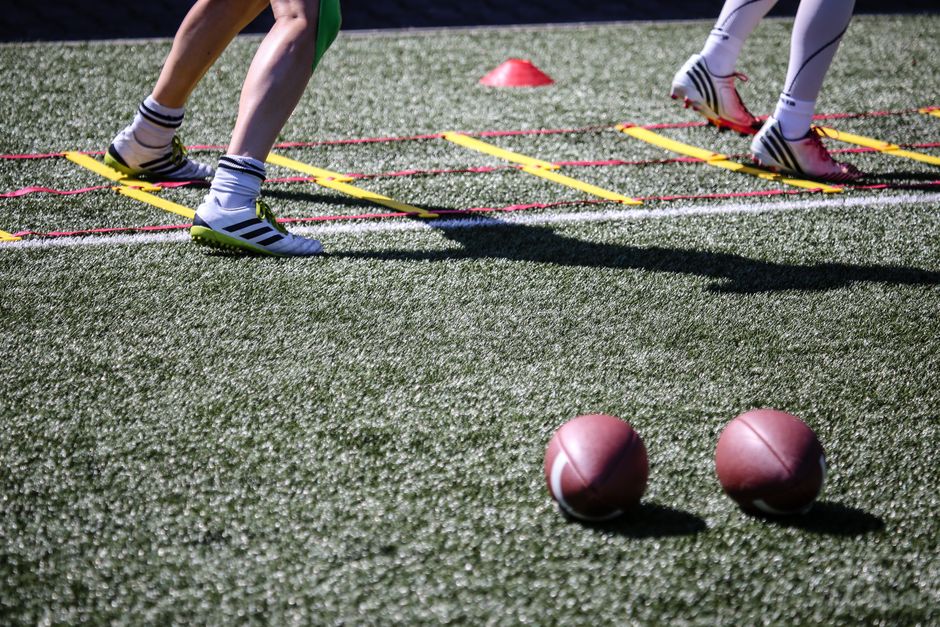
Simple tools go a long way: an agility ladder for foot speed, mini hurdles, and a sled for acceleration (the speed training equipment guide compares them). Many teams track sprint loads with a GPS vest, and players watch sleep and readiness with HRV. The mental game counts too: see mental training tools.
Contact in practice
The NFHS recommends teaching tackling and blocking first with no- or light-contact levels (“air,” “bags” and “control”), then limiting full contact in season to 2–3 practices a week, ideally no more than 30 minutes a day and 60–90 minutes a week. In preseason double sessions, only one should include full contact. Our football injuries page explains why.
Training gear
Four picks for the off-season: the Wilson GST, an official-size leather game ball approved for NFHS and NCAA play; the SKLZ Quick Ladder for footwork; the Rogue Dog Sled for pushes and drags on grass or turf; and Thorne Creatine, our NSF Certified for Sport pick for adults.
Wilson GST Leather Game Football
- Official size, collegiate pattern
- NFHS and NCAA approved
- Leather, composite laces
Rogue Dog Sled 1.2
- Grass, turf or concrete
- 103 lb, made in USA
- Push poles + carabiner
Thorne Creatine
- 5 g creatine monohydrate
- 90 servings, unflavored
- NSF Certified for Sport
More for the football year: the football hub, game day, recovery, and soccer if you play both.
Football training FAQs
How long does heat acclimatization take?
About two weeks. High school guidelines spread preseason over 14 days with gear and practice time added step by step; NCAA and NFL camps open with a five-day acclimatization period.
When can football players wear full pads in preseason?
Under the high school guidelines, helmets only on days 1–2, helmets and shoulder pads on days 3–5, then all gear and full contact from day 6. In the NCAA, full pads are allowed from day 5.
At what age can kids start lifting weights for football?
The AAP says most kids have the balance and control for supervised strength training around 7 or 8, if they can follow directions. Start with body weight and technique, add weight slowly and skip max lifts.
How should linemen condition differently?
With short, explosive work that matches the game, not long runs or long sprint series, and with extra care in the first week of any new program, when heat stroke risk is highest.
How many days a week should a football player lift in season?
Enough to hold on to off-season strength without leaving legs heavy for games: shorter sessions, placed away from game day. For young athletes, the AAP suggests 2–3 sessions a week. A strength coach can fit lifting around games and contact days.