This article contains affiliate links: if you buy through them we may earn a commission, at no extra cost to you. Learn more.
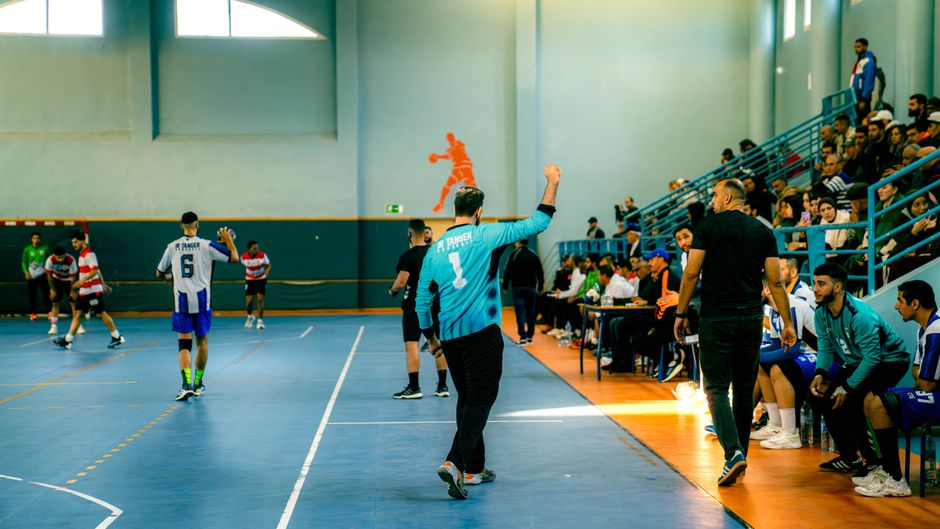
One goal down, ten seconds left, and the referee points to the 7-meter line. The whole gym goes quiet as one shooter faces the goalkeeper, who may not step past a short line 4 meters out until the ball leaves the shooter’s hand. Moments like that are why people fall for handball. The handball rules look busy at first, but the core is simple, and once you know it the game makes sense fast. Here’s how to play handball under the International Handball Federation (IHF) Rules of the Game, the rulebook used from club games to the Olympics, in plain words.
The basics at a glance
| Players | 7 on court per team (6 court players and a goalkeeper), up to 16 on the team. At least 5 must be on court to start. |
|---|---|
| Playing time | 2 × 30 minutes for 16 and older, 2 × 25 at ages 12–16, 2 × 20 at ages 8–12; half-time normally 10 minutes. |
| Court | 40 × 20 meters, with a safety zone around it. |
| Goal | 3 meters wide, 2 meters high, with a net. |
| Key lines | Goal-area line (6 m), free-throw line (9 m, dashed), 7-meter line, goalkeeper’s restraining line (4 m), center line. |
| Scoring | One goal when the whole ball crosses the goal line inside the goal. Most goals wins. |
The team and substitutions
Each team has up to 16 players and up to 5 team officials. Only 7 may be on court at once, and only one of them can be the goalkeeper, who wears a different color from everyone else. Substitutions are “flying”: a substitute can come on at any time, as often as the coach wants, as long as the player going off has already left, and both use their own team’s substitution line near the center of the court. Getting it wrong, or having an extra player on court, costs a 2-minute suspension.
A team may also swap its goalkeeper for a seventh court player to attack with an extra player, leaving its own goal empty. It’s a gamble you’ll see a lot in modern handball: long shots into the empty net are part of the game.
Playing time, time-outs and overtime
The clock stops for referee time-outs, for example after a 2-minute suspension or an injury. Each team gets one 1-minute team time-out per half under the basic rule; competitions may instead allow three per game, with no more than two in one half. If a game must have a winner and is tied, there are two 5-minute overtime halves after a 5-minute break, then a second overtime if needed, and then whatever the competition decides, often a 7-meter shootout with five shooters per team.
The goal area
The goal area, inside the 6-meter line, belongs to the goalkeeper. Court players may not touch the line or step inside it. That’s why handball’s signature shot is the jump: attackers take off outside the line, fly over the area, and release the ball before they land. Landing inside after the ball is gone is fine as long as it doesn’t hurt the opponents. If an attacker steps in with the ball, the defense gets the ball back with a goalkeeper throw. If a defender steps in to gain an advantage, the attack gets a free throw, or a 7-meter throw if that destroyed a clear chance to score.
Inside the area, the goalkeeper may stop the ball with any part of the body and move freely with it. The goalkeeper may also come out and play as a court player, but may not carry the ball out of the area once in control of it.
Steps, three seconds and dribbling
- Three steps: a player may take up to 3 steps with the ball. Catching it in the air and landing on one or both feet doesn’t count as a step.
- Three seconds: a player may hold the ball for up to 3 seconds, even if it’s lying on the floor.
- Dribbling: a player may bounce the ball repeatedly with one hand, or bounce it once and catch it. Once the ball is caught again, the player has 3 more steps and 3 more seconds, but may not dribble again until the ball has touched another player or the goal (the “double dribble” foul).
- Hands, not feet: the ball can be played with hands, arms, head, body, thighs and knees, but not with the foot or leg below the knee, unless an opponent throws it at you.
Defense: what’s allowed
Handball is a contact sport, within limits. Defenders may play the ball out of an opponent’s hand with an open hand, use bent arms to make contact and follow an attacker, and use their torso to block. They may not pull or hit the ball out of an opponent’s hands, push, hold, trip, run or jump into an opponent, or use a dangerous elbow. Fouls aimed mainly at the body are punished progressively, and fouls that endanger an opponent, such as hits to the head or neck or knocking down a player in the air, can bring an immediate 2-minute suspension or a red card. Players in the air can’t protect themselves, and the rules treat that seriously.
Passive play
A team can’t keep the ball without a real attempt to attack or shoot. When the referees see a team stalling, one raises an arm as a forewarning. From then on the attackers have at most 4 passes; if the fifth pass is caught without a shot, the other team gets a free throw. The referees can also whistle for passive play at any moment if the attack doesn’t change after the warning.
Free throws and 7-meter throws
Free throws are the normal restart after a foul or violation, taken from where it happened, but never inside the opponents’ 9-meter line; then it moves to the nearest spot outside it. Defenders must stand at least 3 meters away, and the attackers must stay outside the 9-meter line until the ball is thrown, which is why you see walls of defenders lining the 6-meter area.
7-meter throws are awarded when a clear scoring chance is illegally destroyed anywhere on court, including by a defender stepping into the goal area. The shooter stands behind the 7-meter line, shoots within 3 seconds of the whistle and may not touch the line before letting go. Everyone else stays outside the 9-meter line, and the goalkeeper may not cross the 4-meter restraining line until the ball is released, or the throw is retaken if it didn’t go in.
Yellow cards, 2-minute suspensions, red and blue cards
- Yellow card (warning): the first step for fouls and unsportsmanlike conduct. A player should get no more than one, and a team no more than three; after that, the punishment is at least a 2-minute suspension.
- 2-minute suspension: the referee holds up two fingers. The player sits out 2 minutes of playing time and the team plays a player short; nobody can replace them. A player’s third suspension always means a red card.
- Red card (disqualification): the player is out for the rest of the game, must leave the court and bench, and the team plays a player short for 2 minutes.
- Blue card: shown after a red card when the referees will file a written report, which can mean a further ban from the competition’s authorities.
Equipment rules
Players must wear sports shoes. Anything that could hurt someone is out: helmets, face masks, gloves (goalkeepers included), watches, rings, necklaces, earrings and glasses with rigid frames, and fingernails must be short. Small earrings or flat rings can be taped over. Under the IHF’s protective-equipment regulations, soft knee pads, elbow pads and shoulder guards are allowed in any color, and soft nose protection and clear or single-color mouthguards are allowed. Ankle braces are allowed if any hard parts are fully padded, and anything worn on the lower legs, braces and calf sleeves included, must match the team’s sock color. A player who is bleeding must leave the court until it has stopped and the wound is covered. Our handball gear page turns this into a shopping list.
Ball sizes and resin
| Ball | Who uses it | With resin | Without resin |
|---|---|---|---|
| Size 3 | Men and boys 16+ | 58–60 cm, 425–475 g | 55.5–57.5 cm, 400–425 g |
| Size 2 | Women, girls 14+, boys 12–16 | 54–56 cm, 325–375 g | 51.5–53.5 cm, 300–325 g |
| Size 1 | Girls 8–14, boys 8–12 | 50–52 cm, 290–330 g | 49–51 cm, 290–315 g |
Resin is the sticky wax many players put on their fingers for a better grip. The current IHF rules (July 2025 edition) list two ball categories, one for play with resin and one for play without it, slightly smaller and lighter. Mini-handball balls for the youngest kids aren’t set by the rules. Whether resin is allowed depends on your league and your gym, so ask first. A top match ball like the Molten 5000 (size 3, which the listing calls the official IHF ball, about $82) is hand-stitched with a synthetic-leather cover; a natural-resin wax like the Erima Trimona 2.0 is a common resin, and a resin cleaner keeps balls usable.
How the rules change for kids and beach handball
Kids: beyond shorter halves and smaller balls, national federations may adjust some rules for youth. The IHF’s mini-handball for children up to about 8–9 years uses five players a side, smaller goals and courts, a small, light ball, no deliberate body contact, and a supervisor who teaches the rules instead of a referee. More in our youth handball guide.
Beach handball: barefoot on a 27 × 12 meter sand court, with 3 court players and a goalkeeper per team. A game has two 10-minute periods, each won separately; a tied period is decided by a golden goal, and if each team wins a period, a shoot-out decides it. Creative or spectacular goals, goals from 6-meter throws and goals by the goalkeeper count two points.
Gear that fits the rules
Two rule-friendly picks to start with: a real IHF-approved match ball, and soft padded knee protection like Rehband’s 5 mm knee pads, made for handball and volleyball floors (about $70 a pair). For mouth protection, choose a clear or single-color guard such as the Shock Doctor Gel Max (about $12) in a color that fits the rule.
Molten 5000 Handball (H3A5000)
- Size 3, hand-stitched
- Official IHF ball (listing)
- About $82
Erima Trimona 2.0 Resin
- Natural resin wax
- 250 g tub (500 g also sold)
- About $62
Rehband Handball Knee Pads
- 5 mm padded neoprene
- Soft, no hard parts
- About $70 a pair
Back to the handball hub, or see handball leagues and associations, handball injuries and handball gear. Coming from soccer? Compare with our soccer rules page.
Handball rules questions
How many steps can you take in handball?
Three steps with the ball, and you can hold it for up to three seconds. Landing on one or both feet after catching the ball in the air doesn’t count as a step, and after a dribble you get three new steps.
Can you dribble in handball?
Yes, with one hand, like in basketball, but only once per possession. After you catch the ball you can’t dribble again until it has touched another player or the goal.
What is passive play in handball?
Keeping the ball without really trying to score. After the referee’s raised-arm warning, the attacking team has at most four passes to take a shot, or the other team gets the ball with a free throw.
What happens with a 2-minute suspension?
The player sits out 2 minutes of playing time and the team plays one player short, with no replacement. A player’s third suspension means a red card and disqualification for the rest of the game.
Can handball players wear knee pads and ankle braces?
Yes. Soft knee pads are allowed in any color. Ankle braces are allowed if hard parts are fully padded, and they must match the color of the team’s socks. Helmets, face masks and gloves are not allowed.