This article contains affiliate links: if you buy through them we may earn a commission, at no extra cost to you. Learn more.
Your daughter’s first real game. She scores, the parents cheer, and then the referee’s flag goes up and the goal is gone. “Offside,” says the dad next to you, as if that explains it. If you’ve ever nodded along without knowing why, this page is for you. Here are the soccer rules in plain words: the official Laws of the Game, the field and ball, how substitutions work, offside, fouls and cards, restarts and VAR, and how the rules change for little kids, high school and college.
For the big picture of the sport and its levels, start at our soccer hub. This page goes deep on the rules only.
Who writes the rules: IFAB and the 17 Laws
Soccer’s rules are called the Laws of the Game, and they are written by the International Football Association Board (IFAB), not by any one league. There are 17 Laws, from Law 1 (the field) to Law 17 (the corner kick). They are updated every year, and the new edition starts on 1 July. The 2026/27 edition was used at the 2026 World Cup and is the one in force now. US high schools use NFHS rules and US colleges use NCAA rules. Both are close cousins of the Laws with some real differences, covered below.
The field, the goal and the ball
Law 1 gives a range, not one size. For general competitions, the touchline (the long side) is 90–120 m (100–130 yd) and the goal line is 45–90 m (50–100 yd). International matches are tighter: 100–110 m long and 64–75 m wide. The markings are the same everywhere:
- Goal: 7.32 m (8 yd) between the posts and 2.44 m (8 ft) high.
- Penalty area: reaches 16.5 m (18 yd) out from the goal line. The penalty mark is 11 m (12 yd) from the goal.
- Goal area: the small box, 5.5 m (6 yd) from each post.
- Center circle and penalty arc: both 9.15 m (10 yd), the same distance opponents must give at free kicks.
The adult ball (size 5) is 68–70 cm around, weighs 410–450 g at kickoff and is pumped to 0.6–1.1 atmospheres (8.5–15.6 psi). In official FIFA competitions it must carry a FIFA Quality Programme mark.
Players, substitutions and positions
A team has at most 11 players on the field, and one must be the goalkeeper. A match can’t start or go on if a team has fewer than 7. In official competitions, a team can use up to five substitutes, in no more than three “opportunities” during play, plus at halftime. Competitions may also allow extra permanent concussion substitutes. Since 2026/27, a player being substituted has 10 seconds to leave the field. “Return” substitutions, where a player comes back on, are allowed only in youth, veterans, disability and grassroots soccer.
The Laws name only one position: the goalkeeper, the one player allowed to handle the ball, and only inside their own penalty area. Everything else is up to the coach. A typical team has defenders (center backs and fullbacks), midfielders (holding, central and wide players) and forwards (wingers and strikers). Each role asks something different of the body; see soccer training.
How long is a soccer game? It depends on the level
Under the Laws, a match is two equal halves of 45 minutes. Halftime can be no longer than 15 minutes. The referee adds time lost to substitutions, injuries, time-wasting, cards, VAR checks and celebrations. The fourth official’s board shows a minimum, which the referee can raise but not lower. Other levels change the clock:
| Level | Rules | Game length | Ties |
|---|---|---|---|
| Pro, international, most adult | IFAB Laws | 2 × 45 min + added time | Set by the competition (extra time, penalties, or a draw) |
| College (NCAA) | NCAA rules | 2 × 45 min, clock stops at set times | Regular season: a tie stands. Postseason: 2 × 10 min golden goal, then penalty kicks |
| High school (NFHS) | NFHS rules | 2 × 40 min or 4 × 20 min quarters | Overtime only if the state association allows it, 20 min max |
| Ages 12 and under (U12) | U.S. Soccer small-sided standards | 9v9: 2 × 30 min | Usually no overtime |
| U10 | Small-sided | 7v7: 2 × 25 min | Usually no overtime |
| U8 and younger | Small-sided | 4v4: 4 × 10 min quarters | No scores or standings recorded |
Offside, explained like a human
Law 11 is the one that confuses everyone, but the idea is simple. You can’t hang out behind the defense waiting for a long ball. A player is in an offside position when any part of the head, body or feet is in the opponents’ half and closer to the opponents’ goal line than both the ball and the second-to-last defender. Arms and hands don’t count.
Being in that position is not a foul by itself. It becomes an offence only when a teammate plays or touches the ball and the offside player gets involved, by playing the ball or by interfering with an opponent. There is no offside directly from a goal kick, a throw-in or a corner kick, and none in your own half. The punishment is an indirect free kick for the other team.
Fouls and cards
Law 12 lists the fouls that give a direct free kick (a shot can go straight in): charging, jumping at, kicking, pushing, striking, tackling or tripping an opponent in a way the referee judges careless, reckless or with excessive force. Holding, deliberate handball, impeding with contact, biting or spitting are on the list too. If any of these happens inside the defending team’s own penalty area, it’s a penalty kick. The three levels of force matter:
- Careless: lack of attention in a challenge. A foul, but no card.
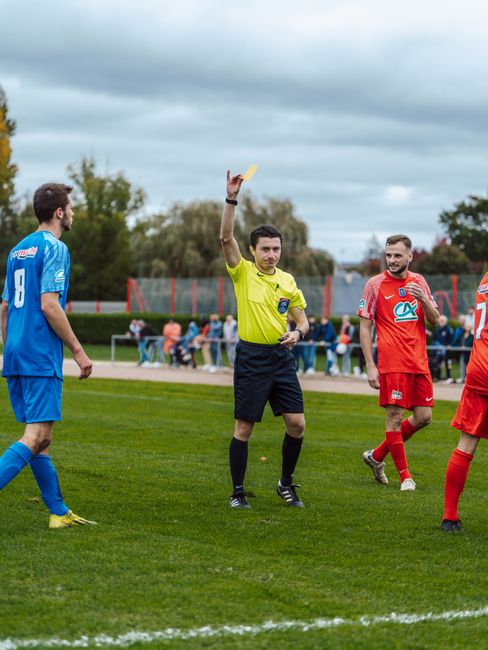
- Reckless: ignores the danger to the opponent. Yellow card (caution).
- Excessive force: goes beyond what’s needed or endangers the opponent. Red card (sending-off).
You also get a yellow card for things like dissent, delaying a restart, not giving the required distance, repeated fouls, diving (simulation) and stopping a promising attack. A red card comes for serious foul play, violent conduct, biting or spitting, offensive language or gestures, denying an obvious goal-scoring opportunity, or a second yellow. A sent-off player can’t be replaced, so the team plays short. Playing dangerously or blocking without contact gives an indirect free kick: someone else must touch the ball before a goal counts.
Restarts: how play starts again
- Kickoff: starts each half and restarts after a goal.
- Throw-in: when the ball goes over the touchline. Both hands, from behind and over the head, part of each foot on or behind the line. Opponents stay 2 m back, and you can’t score straight from a throw.
- Goal kick and corner kick: when the ball crosses the goal line without a goal. A goal kick if the attackers touched it last, a corner if the defenders did.
- Free kicks: opponents must be at least 9.15 m (10 yd) away. When three or more defenders make a wall, attackers must stay 1 m from it.
- Penalty kick: from the 11 m mark, one on one with the goalkeeper.
Time-wasting rules got tougher. Since 2025/26, a goalkeeper who holds the ball in their hands for more than eight seconds gives up a corner kick, with the referee counting the last five seconds down on a raised hand. In 2026/27, the same five-second countdown came in for slow throw-ins and goal kicks. Too slow, and the throw goes to the other team, or the goal kick becomes a corner.
VAR: what the video assistant can and can’t do
The video assistant referee (VAR) doesn’t re-referee the game. Under IFAB’s protocol, it can step in only for a “clear and obvious error” or a “serious missed incident” in a short list of match-changing situations: goal or no goal, penalty or no penalty, direct red cards and mistaken identity. In 2026/27 the list grew a little. VAR can now check a red card that came from a clearly wrong second yellow and, if the competition chooses, a corner kick that was clearly wrongly given. The referee always makes the final call, often after watching the replay at the pitch-side monitor.
How the rules change for kids, high school and college
Youth (small-sided): U.S. Soccer’s Player Development Initiatives shrink the game for players 12 and under. U6–U8 play 4v4 with no goalkeepers on a 25–35 × 15–25 yd field, with a size 3 ball and no offside. U9–U10 play 7v7 with goalkeepers, a size 4 ball and offside. U11–U12 play 9v9, still with a size 4 ball. Full 11v11 with a size 5 ball usually starts around 13. Our youth and high school soccer page covers the formats, heading limits and safety rules in detail.
High school (NFHS): games are shorter, at 2 × 40 minutes, and substitution is far freer. A player who comes off may go back on an unlimited number of times, at set moments like goal kicks, goals and the end of a period. A cautioned player must leave the field and can come back at the next substitution chance. Each state association decides on overtime and postseason tiebreakers. For 2026/27, NFHS also moved the goalkeeper’s limit from six to eight seconds, like the Laws.
College (NCAA): two 45-minute periods with a stopped clock at certain times. Since 2024, the clock also stops for substitutions in the last 15 minutes when the game is tied or the leading team subs. Regular-season games can end in a tie, because the NCAA dropped regular-season overtime in 2022. In conference tournaments and the NCAA tournament, two 10-minute golden-goal periods come first, then penalty kicks. Most college teams get no re-entry in the first half and one in the second. Division I men get no re-entry and six substitution “moments” a game.
Gear for refs, coaches and backyard games
Refereeing a U8 game or running practice? Three things help. The adidas Trionda Pro was the official match ball of the 2026 World Cup. The Fox 40 Classic is a pealess whistle many referees use. The Kwik Goal red and yellow cards are a simple, cheap card set. Prices change often. These are what we saw at the maker or a major retailer in October 2026.
adidas Trionda Pro Match Ball
- Size 5, FIFA Quality Pro
- Thermally bonded, seamless
- About $170 list (often on sale)
Kwik Goal Red and Yellow Cards
- 1 yellow + 1 red card
- Pocket size
- About $3–$9
Shin guards, cleats and the rest are on our soccer gear page. For what to do when a hard foul leaves someone hurt, see soccer injuries. After 90 minutes on your feet, try our recovery shoes guide.
Soccer rules questions
How many players are on a soccer team on the field?
Eleven per side under the Laws of the Game, one of them the goalkeeper. A match can’t continue if a team drops below seven. Youth small-sided games use fewer: 4v4 up to age 8, 7v7 at 9–10 and 9v9 at 11–12.
Can you be offside from a throw-in?
No. Law 11 says there is no offside offence when a player receives the ball directly from a throw-in, a goal kick or a corner kick. You also can’t be offside in your own half.
What’s the difference between a direct and an indirect free kick?
A goal can be scored straight from a direct free kick. From an indirect free kick, the ball must touch another player first. The referee shows an indirect free kick by holding one arm up until the ball has touched another player or gone out of play.
Does a soccer game end in a tie?
Often, yes. League games under the Laws can end in a draw, and NCAA regular-season games end tied after 90 minutes. Knockout games use extra time and/or penalty kicks, and the competition sets which. In high school, overtime depends on your state association.
How many substitutions are allowed in soccer?
In official competitions under the Laws, up to five, in three opportunities plus halftime, and players can’t come back on. Senior international friendlies may use up to eight, or eleven if both teams agree. High school allows unlimited re-entry. College allows limited re-entry, except Division I men, who have none.