This article contains affiliate links: if you buy through them we may earn a commission, at no extra cost to you. Learn more.
The night before a paddle, the gear comes out on the living-room floor: life jackets, a paddle in two pieces, a dry bag with a fleece and a sandwich, sunscreen, a whistle, maybe a helmet and a spray skirt if it’s a river day. In the morning the boat goes on the roof rack and everything else goes in the car. Getting your kayaking gear right is what turns a good day into a safe one, and most of it costs less than people think.

Buying guide · Our Kayaking buying guide compares the gear we'd pick, with prices and sizing:
Prices change often. The prices below are what we saw at the maker or a major retailer in October 2026; check the current price before you buy.
This page goes item by item: the life jacket, the boat, the paddle, whitewater helmets, spray skirts, dry bags, safety extras and clothing, then the recovery gear paddlers use after a long day. For the big picture of the sport, start at our kayaking hub.
Our top kayaking gear picks
Onyx MoveVent Dynamic Paddle Vest
- USCG and Transport Canada approved
- Mesh lower back for high seats
- SOLAS reflective trim
Pelican Argo 100X Recreational Kayak
- 10 ft, 36 lb
- 275 lb max capacity
- Foam flotation blocks
Bending Branches Whisper Kayak Paddle
- 2-piece aluminum shaft
- Polypropylene dihedral blades
- 0° or 60° feathering
NRS Havoc Livery Helmet
- Meets CE EN 1385
- DialFit adjustment
- Replaceable fit pads
Seals Sea Sprite Spray Skirt
- 4 mm neoprene deck
- Adjustable nylon tunnel, suspenders
- Grab loop with whistle
Earth Pak 20L Waterproof Dry Bag
- Roll-top, 500D PVC
- Shoulder strap
- Waterproof phone case included
1. The life jacket (buy this first)
Federal rules require a Coast Guard-approved wearable life jacket for every person in a kayak, the right size and readily accessible, and kids under 13 must wear theirs while underway. The bigger reason is the Coast Guard’s 2024 data: of the 77 kayakers who drowned that year, 60 weren’t wearing one. Buy a jacket you’ll want to keep on. Paddling vests have big arm openings and a short or mesh back so they don’t push against a high seat back.
- Onyx MoveVent Dynamic (about $69): Coast Guard and Transport Canada approved foam vest with a mesh lower back for high-back seats, shoulder adjustments, zippered pockets and SOLAS-grade reflective trim.
- Onyx Kayak Fishing Life Jacket (about $85): Coast Guard approved, with a high-back design, mesh lower back and shoulders, and pockets and tool holders for anglers.
For whitewater, American Whitewater recommends a snug, Coast Guard-approved whitewater-specific vest (Performance Level 70, Type III or V). The Coast Guard doesn’t recommend inflatables for anyone under 16 or for non-swimmers. Kids’ sizes are on our kayaking with kids page.
2. Kayaks by type
| Type | Typical size (ACA) | Best for | Example |
|---|---|---|---|
| Recreational sit-in | 10–15 ft long, 24–30 in wide | Calm lakes and slow rivers, cooler days | Pelican Argo 100X, about $510 |
| Sit-on-top | Similar, no cockpit | Beginners, warm water, swimming stops; easy to climb back on | Pelican Seek 100X, about $485 |
| Touring and sea kayak | 14–20 ft long, 20–25 in wide | Longer trips, open water, speed; bulkheads and spray skirt | Usually bought from a paddling shop after a test paddle |
| Whitewater | 6–9 ft, highly rockered | Rivers Class II and up, with a skirt, helmet and training | Fit matters most; demo before you buy |
| Inflatable | Varies | No roof rack or storage space | Sea Eagle 370 Pro, about $449 |
| Folding | Varies | Apartments, travel, trunk storage | Oru Inlet, about $899 |
- Pelican Argo 100X (about $510): a 10-foot sit-in that weighs 36 pounds, holds up to 275 pounds, has foam flotation blocks and an adjustable padded backrest. An easy-to-carry first boat for calm water.
- Pelican Seek 100X (about $485): a 10-foot sit-on-top with a stable twin-arched hull, removable bars for getting in and out, a textured standing area and covered storage; about 43 pounds.
- Sea Eagle 370 Pro (about $449): a three-person inflatable that weighs 32 pounds, supports up to 650 pounds and comes with two seats, two paddles, skegs and a repair kit. The maker rates it for up to Class III whitewater.
- Oru Inlet (about $899): a 9-foot-8, 20-pound folding kayak that packs into a 42 x 10 x 18 inch box and sets up in under five minutes, made for calm lakes, rivers and bays.
Want to paddle with a partner or a child? Tandem kayaks seat two, and the ACA notes they’re useful on long trips or for paddling with a child; the Sea Eagle above seats up to three. Whatever you buy, never exceed the boat’s listed capacity, gear included; the ACA warns that an overloaded boat sits lower, is harder to control and swamps or capsizes more easily. (Shopping for an open boat instead? See our canoeing gear page.)
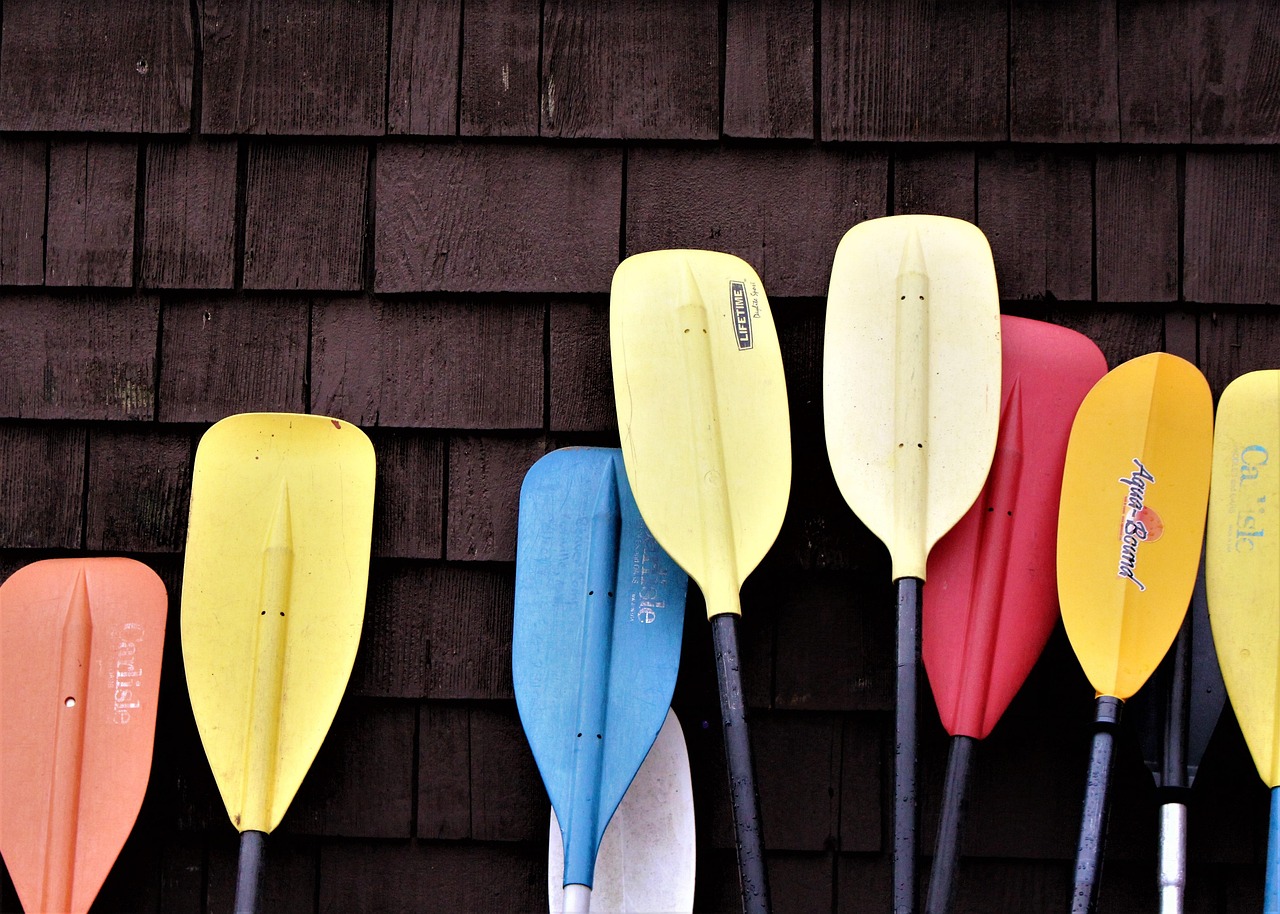
3. Paddles and how to size them
The paddle is what connects your body to the water, and length matters more than most beginners think. The wider your boat and the taller you are, the longer the paddle. Retailer NRS’s sizing guide for low-angle touring and recreational paddles is a good starting point:
| Paddler height | Boat width | Paddle length |
|---|---|---|
| 5’0″–5’10” | 21″–23″ | 220 cm |
| 5’6″–6’2″ | 23″–26″ | 230 cm |
| Over 6’3″ | Over 25″ | 240 cm |
Wider recreational and fishing kayaks often call for longer paddles, so check the maker’s chart for your exact boat. Whitewater paddles are much shorter: NRS suggests about 188–194 cm for paddlers under 5’2″, 191–197 cm for 5’0″–5’8″ and 194–203 cm above 5’6″. Many kayak paddles also let you feather the blades, setting them at an angle to each other (the Whisper below offers 0° or 60°) so the upper blade slices through the wind; try both and use what feels easy on your wrists. Lighter materials (fiberglass, carbon) cost more but tire you less over a long day.
- Bending Branches Whisper (about $80): two-piece aluminum shaft, polypropylene dihedral blades, 0° or 60° feathering; made in Wisconsin.
- Carlisle Day Tripper (about $62, 230 cm): oval aluminum shaft, asymmetrical polypropylene blades, 60° or inline feathering, 37 ounces; also made in 220 and 240 cm.
4. Helmets for whitewater
On rivers and in the surf, wear a helmet made for paddling. American Whitewater notes that whitewater-specific helmets are designed to withstand multiple impacts and stay intact under water. The NRS Havoc Livery (about $58) meets the CE EN 1385 standard for whitewater helmets, with a DialFit adjuster and replaceable pads. A helmet should sit level and low on the forehead and not rock when you shake your head. If you hit your head, the CDC’s rule is “When in doubt, sit them out.”
5. Spray skirts
A spray skirt seals the cockpit of a sit-inside kayak so waves and rapids stay out. Skirts come in sizes for both your waist and your boat’s cockpit, so use the maker’s chart. Nylon skirts suit calm water and warm days; neoprene seals tighter for rough water and rolling. The Seals Sea Sprite (about $180, made in the USA) pairs a 4 mm neoprene deck with a breathable nylon tunnel, adjustable suspenders and a grab loop with a built-in whistle. Practice pulling the release loop until it’s automatic: American Whitewater warns that a skirt can be hard to release if the grab handle isn’t exposed.
6. Dry bags and safety extras
- Dry bag: spare layers, food, a first aid kit and your phone ride in a roll-top dry bag like the Earth Pak 20L (about $25, 500D PVC, shoulder strap and waterproof phone case). Clip it in so it can’t float away.
- Whistle: a pea-less whistle like the Fox 40 Classic (about $7, 115 dB) on your life jacket covers the federal sound-signal rule.
- Throw rope: for rivers, the NRS Compact Rescue Throw Rope (about $70) has high-visibility rope and foam flotation. Learn to use it in a rescue class.
- Paddle float: touring kayakers use one to climb back into a sit-inside kayak in deep water; the NRS Foam Paddle Float (about $50) uses closed-cell foam, so it works without inflating.
- Light, pump and sponge: after dark you need a white light ready to show; a hand pump and sponge empty a sit-inside kayak after a capsize.
7. Dress for the water
Dress for the water temperature, not the air. The ACA’s beginner guide suggests specialized paddling wear when air plus water temperature adds up to less than 120°F, and American Whitewater says a wetsuit or drysuit is essential below 50°F water. Skip cotton; choose synthetic or wool layers that insulate when wet, a wind-and-spray jacket, low-profile water shoes or booties that fit inside the boat, and a hat. In summer, sun is the bigger issue: broad-spectrum, water-resistant SPF 30+ reapplied every two hours, a long-sleeve top and sunglasses on a strap.
8. Recovery gear for paddlers
Paddling loads the shoulders, upper back, forearms and lower back. After a long day many paddlers use a foam roller like the TriggerPoint GRID 1.0 (about $40) on lats and upper back, or a compact massage gun such as the Theragun Mini (about $220, three speeds, three attachments) on forearms and shoulders. Recovery slides like the OOFOS OOahh (about $60) are comfortable after hours in wet shoes. These are for comfort, not treatment; shoulder or wrist pain that lingers needs a sports medicine doctor, physical therapist or athletic trainer. See our best foam rollers and best massage guns guides and our kayaking recovery page.
TriggerPoint GRID 1.0 Foam Roller
- Multi-density surface
- Hollow core keeps its shape
- 13 x 5 in
Theragun Mini
- 3 speeds
- 3 attachments
- Pocket-size, one-button control
OOFOS OOahh Recovery Slide
- OOfoam cushioning
- APMA Seal of Acceptance
- Machine washable
How to choose kayaking gear
- Life jacket before boat. Try it on with the clothes you’ll paddle in and sit in a kayak seat to check the back.
- Match the boat to your water. Rec boats for calm water, touring boats for distance, whitewater boats only with training.
- Weigh the carry. If you can’t lift it onto the car alone, an inflatable or folding kayak may get used more.
- Size the paddle to you and the boat, and spend a little more on a lighter one if you paddle often.
Kayaking gear FAQs
What gear do I need to start kayaking?
A Coast Guard-approved life jacket that fits, a kayak and a paddle of the right length, a whistle, and a dry bag with water, snacks and a spare layer. Add a light if you might be out after sunset.
What size kayak paddle do I need?
It depends on your height and your boat’s width. As a starting point, NRS suggests 220 cm for paddlers 5’0″–5’10” in boats 21″–23″ wide, 230 cm for 5’6″–6’2″ in 23″–26″ boats, and 240 cm for taller paddlers in wider boats. Wider recreational kayaks often need longer paddles.
Is a sit-on-top or sit-in kayak better for beginners?
Both work. The ACA notes sit-on-tops are especially suitable for beginners because if you tip over you simply climb back on. Sit-ins keep you drier and warmer, which helps on cooler days, but you need to practice a wet exit.
Do I need a helmet for kayaking?
Not on calm lakes, but yes on whitewater and in surf, where you can hit rocks or your boat when you flip. Choose a helmet made for paddling, such as one meeting CE EN 1385, and make sure it fits snugly.
Do I need a spray skirt?
On a calm summer lake, usually not. For sea kayaking, whitewater, cold water and rolling, yes. Fit it to both your cockpit and your waist, and practice releasing it until it’s second nature.
Good kayaking gear is gear you’ll use: a life jacket you keep on, a kayak you can carry and a paddle that fits. Next: paddling rules and water safety, kayaking wearables, kayaking with kids, or compare with our sailing gear page.