This article contains affiliate links: if you buy through them we may earn a commission, at no extra cost to you. Learn more.
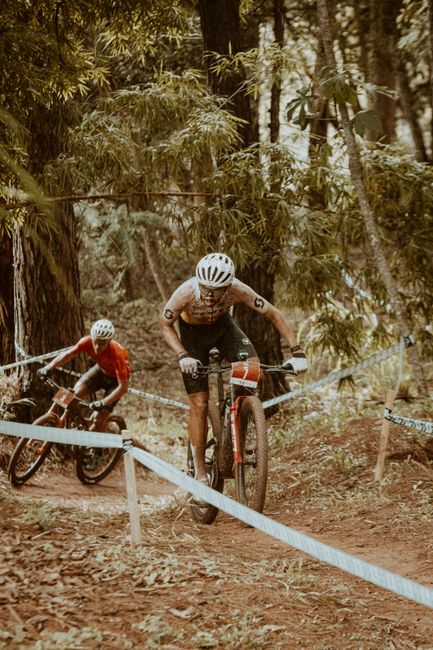
A blue trail on a Saturday morning, the third lap of the day, legs warm and confidence high. The tabletop looks smaller than it did on lap one, so you hit it faster. The front wheel lands short, the bars snap sideways, and you’re over them before you know it. Usually you roll, laugh and ride on. Sometimes you sit up holding your shoulder or wrist, or can’t remember the start of the trail. Mountain biking injuries are mostly crash injuries, and this page covers the ones riders get most, how helmets and pads help, how to plan for a crash far from the trailhead, and when to see a professional. It’s for every rider, from kids on the pump track to pros.
This page is general information, not medical advice. If you’re hurt, see a sports medicine doctor, physical therapist (PT) or certified athletic trainer (AT). For the sport as a whole, start at our mountain biking hub; for road riding, saddle and bike-fit problems, see cycling injuries.
How mountain bikers get hurt
A 2023 systematic review of 17 mountain bike studies (more than 220,000 injured riders) found that most injuries are minor bruises, scrapes and cuts, but that fractures made up anywhere from 1.5% to 43% of injuries, and the arms and shoulders were the most injured area. A 2025 sports-medicine review agreed: the head and upper body are hit most, and serious injuries such as concussions and fractures do happen.
- Over the bars is the classic crash. In a 2025 video study of 534 real mountain bike crashes, 55% were riders thrown forward over the handlebars, often after a poorly landed jump and at speeds above 30 km/h (about 19 mph). Shoulder and arm injuries dominated.
- US emergency rooms: an analysis of national injury data estimated about 109,600 mountain bike injuries seen in US emergency departments from 2013 to 2022, rising over the decade. Falling off the bike was the cause in 63%. Kids had the highest share of head and face injuries.
- High school racing: NICA, which runs interscholastic mountain bike leagues, tracks injuries every season. Over five seasons (2018–2022, 119,098 student-athlete years) about 2.2% of riders per season had an injury event. The most common were wrist/hand (23%), head/brain (23%) and shoulder/collarbone (16%).
- Elite downhill: at the 2023 UCI Downhill World Championships in Fort William, Scotland, 10.4% of 230 riders were injured over five days, with more injuries in training than in racing.
Collarbone, shoulder and wrist
Broken collarbone
Mountain biking’s signature fracture. The American Academy of Orthopaedic Surgeons (AAOS) explains that most collarbone (clavicle) fractures happen in a fall onto the shoulder or an outstretched arm. Signs: strong pain, a shoulder that sags down and forward, a bump over the bone and trouble lifting the arm. Many heal in a sling; some need surgery when the bone ends are far apart. It needs an X-ray.
Shoulder separation (AC joint)
Land right on the point of the shoulder and you can sprain or tear the ligaments where the collarbone meets the shoulder blade. AAOS grades these from mild (a sprain, normal X-ray) to severe (both ligament groups torn, with a visible bump), and says most people, even with severe separations, do well without surgery. A dislocated shoulder is different and needs a doctor right away.
Wrist: don’t brush off the “sprain”
Catching yourself on an outstretched hand can break the scaphoid, a small bone on the thumb side of the wrist. AAOS warns that the pain can be mild enough to pass for a sprain and that the break often doesn’t show on the first X-ray, so doctors may splint the wrist and X-ray it again later. Because of the scaphoid’s unusual blood supply, some breaks heal poorly if missed. Pain in the hollow at the base of the thumb after a fall is a reason to get checked.
Head injuries and helmets
Concussion: recognize it, stop riding
The CDC’s HEADS UP rule works on a trail too: if you suspect a concussion, stop riding for the rest of the day and until a health care provider clears you. Signs: looking dazed, slow answers, clumsiness, not remembering the crash, headache, dizziness, nausea, blurry vision, feeling foggy. Call 911 for the danger signs: one pupil bigger than the other, a worsening headache, slurred speech, weakness or numbness, repeated vomiting, seizures, growing confusion or drowsiness, or passing out. A 2022 downhill review found riders often kept riding despite a concussion. Don’t; walk down with a friend. Return to riding happens in gradual steps, each usually at least 24 hours (2022 Amsterdam consensus), after your provider OKs it.
Helmets, and the full-face evidence
Across all cycling, a 2017 meta-analysis of 55 studies found helmets were linked to about half the odds of head injury and about 69% lower odds of serious head injury. Every bike helmet sold in the US must meet the CPSC standard. For mountain biking, two things go further:
- ASTM F1952 is the standard for downhill mountain bike racing helmets. It was written because downhill crashes are more frequent than road crashes, and it requires more coverage (lower at the back and sides) and harder impact tests than the CPSC standard. It doesn’t require a chin bar, but if a helmet has one, the chin bar is tested too.
- USA Cycling rules require a full-face helmet for downhill and four-cross (4X) races (and dual slalom at nationals), and strongly recommend body armor, elbow and knee pads and full-finger gloves at all gravity events.
- What the research shows on chin bars: a 2023 lab study with a crash-test dummy found a full-face bike helmet reduced brain strain and face forces in lower-face (chin) impacts, but not in mid-face impacts, and slightly raised upper-neck forces. Face injuries are common: a US study estimated nearly 19,000 emergency visits for mountain bike head and neck injuries over 2009–2018, including nose, jaw and eye-socket fractures. Real-world studies proving that full-face helmets prevent injuries in trail riders are still scarce.
The practical answer many riders land on: a trail helmet with good rear coverage for everyday riding, like the Giro Radix MIPS, and a full-face for bike parks, downhill, enduro racing and steep, fast trails. The Fox Proframe RS is a vented full-face built for enduro that Fox lists as ASTM F1952 downhill certified. Replace any helmet after a hard hit: the CPSC standard requires a warning that impact damage may not be visible.
Spinal injuries: rare, serious, and mostly in young men
Data from British Columbia, home of famous downhill and freeride trails, show why riders fear spine injuries. A 13-year review at the province’s spine referral center (1995–2007) counted 107 mountain bikers with spinal fractures or spinal cord injuries; 95% were men, average age 33, three-quarters of injuries were in the neck, 40% involved the spinal cord and 63% needed surgery. A newer study from a Vancouver trauma center (2008–2022) counted 58 riders with spinal cord injury, about four a year, average age 35.5 and 93% men; 27 had complete injuries. The authors of both called for more prevention. Neither study proved what prevents them; the sensible lessons are to ride within your skill, progress to jumps and drops in steps, and ride big features with someone around.
If a rider might have a neck or back injury (neck or back pain, numbness, tingling or weakness in arms or legs, or they’re unconscious): don’t move them, don’t take off their helmet, keep them still and warm, and call for help.
Overuse injuries
Mountain bikers also get the slow-building problems of road riders: knee pain (often saddle height or cleats), low back pain on long seated climbs, numb hands and tired forearms on rough descents. The fixes are mostly setup and strength: a bike fit, levers and grips set for your hands, suspension set for your weight, core and upper-body work (see mountain bike training) and building riding time gradually. Numbness that lasts or pain that returns every ride needs a professional; our cycling injuries page goes deeper.
Prevention that helps
- Ride your level. Check trail ratings, walk features first and pre-ride race courses.
- Learn the skills. The emergency-room study recommended better front-brake coaching for young riders. A skills clinic is cheaper than a cast.
- Wear the gear. Helmet always, full-finger gloves, knee pads for anything rough, full-face and more armor for gravity riding.
- Respect fatigue. When your hands are tired and your eyes are slow, skip “one last run”. Check brakes, tires and bolts before every ride.
Riding alone and your emergency plan
Mountain bike crashes happen where help is slow: no cell signal, no road, hours from a trailhead. The National Park Service’s trail advice fits riders too: tell someone where you’re going and when you’ll be back, check the weather, know your turnaround time, and carry a personal locator beacon or satellite messenger where there’s no cell service. A simple plan:
- Leave your route and return time with someone, and share live location (Garmin LiveTrack, phone apps) when you have signal.
- Turn on crash/incident detection on your bike computer or watch (it needs your phone and signal, and it’s a backup, not a guarantee).
- Out of coverage, carry a satellite messenger such as the Garmin inReach Mini 2 (SOS to a 24/7 response center; needs a subscription).
- Pack first aid, a space blanket, a light, food, water, tools and a charged phone; ride with a buddy on remote loops.
Gadgets for this: mountain bike wearables.
Protective gear many riders use
None of these makes riding risk-free, but many trail riders carry them.
Fox Racing Proframe RS
- ASTM F1952 downhill certified (maker)
- MIPS Integra Split system
- About 820 g in medium (maker)
Giro Radix MIPS
- MIPS rotational layer
- Roc Loc 5.5 fit system
- Adjustable visor
Fox Racing Launch Pro D3O Knee Guard
- D3O impact foam
- Removable hard cap
- CE-certified
Garmin inReach Mini 2
- Two-way satellite messaging
- SOS to 24/7 response center
- Subscription required
When to see a sports medicine doctor, PT or athletic trainer
- Emergency (call 911 or get to an ER): concussion danger signs, any possible neck or back injury, a possible broken bone, a dislocated shoulder, a deep or dirty wound, chest pain or trouble breathing after a crash.
- Within a day or two: a suspected concussion, a shoulder that sags or won’t lift, wrist pain at the base of the thumb, a swollen joint.
- Soon: knee, back or hand problems that keep coming back, numbness that lasts after riding.
A sports medicine physician diagnoses, a physical therapist guides rehab and a certified athletic trainer works with school teams. For getting back on the bike, see mountain bike recovery; for concussion in team sports, soccer injuries.
Mountain biking injuries: FAQs
What is the most common mountain biking injury?
Scrapes, bruises and cuts are the most common overall. Among more serious injuries, the shoulder, collarbone, wrist and hand, and head (concussion) lead. In NICA high school racing, wrist/hand and head injuries each made up about 23% of injuries, and shoulder/collarbone about 16%.
Do I need a full-face helmet for mountain biking?
For downhill and 4X racing, yes: USA Cycling requires one. For trail riding, it’s your call. Many riders wear one in bike parks and on steep, fast trails, and a half-shell for everyday rides.
What does ASTM F1952 mean on a helmet?
It’s the ASTM standard for downhill mountain bike racing helmets. Compared with the basic CPSC bike helmet standard, it requires more coverage and harder impact tests, and it tests the chin bar if the helmet has one.
How long does a broken collarbone keep you off the bike?
It depends on the break and treatment, so your orthopedic doctor sets the timeline. Many heal in a sling; displaced ones may need surgery. The return is gradual.
Is it safe to mountain bike alone?
Many riders do, but plan for a crash: tell someone your route and return time, share live location, turn on incident detection, and carry a satellite messenger or locator beacon where there’s no cell signal.