This article contains affiliate links: if you buy through them we may earn a commission, at no extra cost to you. Learn more.
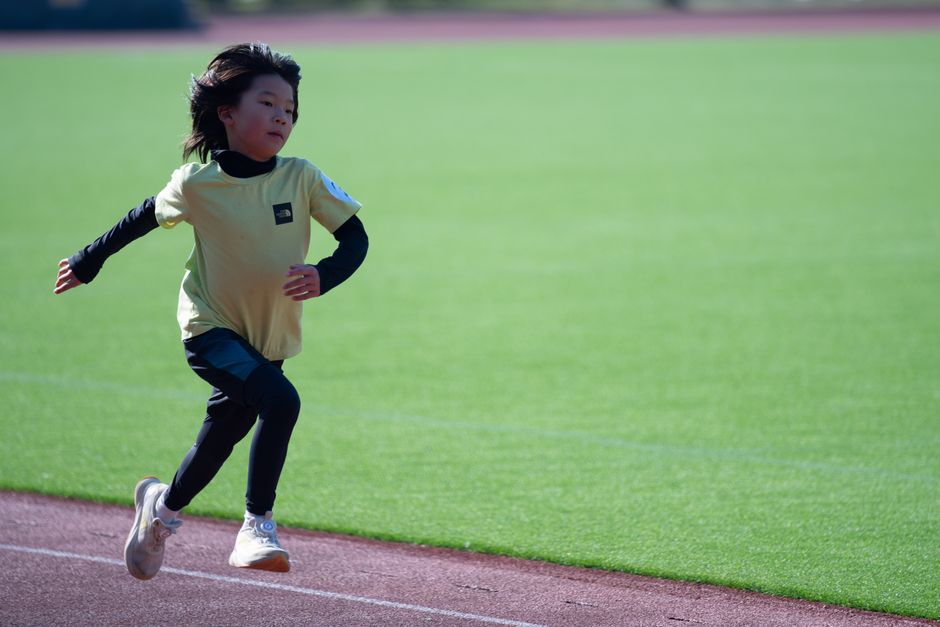
An eight-year-old in borrowed spikes, crouched at the start of her first 100 meters, glancing back at her dad in the stands. A seventh grader who just found out he likes the shot put better than basketball. A sophomore wondering when college coaches will start paying attention. Youth track and field is one of the best places for kids to find their sport, because there’s an event for every body type: the fast kid, the tall kid, the strong kid and the kid who just keeps going. This guide covers events and implement weights by age, starts and spikes, health for growing athletes, and the questions parents ask most, including college recruiting.

For the sport at every level, start at our track and field hub. For kids’ road races and cross country, see kids’ running.
Where kids compete
Before high school, most kids compete in summer club track through two national programs: USATF Junior Olympics and the AAU. Both run local and regional qualifiers up to a national championship, and both group athletes by birth year, not school grade. USATF uses two-year groups (8 and under, 9–10, 11–12, 13–14, 15–16, 17–18). The AAU uses single years from 9 to 14, plus 8 and under, 15–16 and 17–18. Many middle schools also have spring track teams, and high school track is the No. 1 girls’ sport and No. 2 boys’ sport in the US by participation (NFHS, 2024–25).
Events by age
Events open up as kids grow. This is the AAU’s list of authorized events (USATF’s is similar):
| Age division | Running events | Field events |
|---|---|---|
| 8 and under | 100, 200, 400, 800, 1500 m; 4×100 relay | Long jump, shot put, turbo javelin |
| 9 and 10 | 100, 200, 400, 800, 1500 m; 1500 m race walk; 4×100 and 4×400 relays | Long jump, high jump, shot put, turbo javelin; triathlon |
| 11 and 12 | Adds 80 m hurdles and 3000 m; 4×800 relay | Adds the discus; pentathlon |
| 13 and 14 | Adds 100 m hurdles and 200 m hurdles; 3000 m race walk | Adds triple jump, pole vault and the 600 g javelin; pentathlon |
| 15–16 and 17–18 | Adds 110 m hurdles (boys), 400 m hurdles and the 2000 m steeplechase | Full set of jumps and throws; decathlon (boys), heptathlon (girls) |
In middle school, events follow state association rules. For example, Kansas’s recommended 7th–8th grade program has 75 m hurdles at 30 inches, 100 to 1600 m races (3200 m for 8th graders), relays, long jump, high jump, pole vault and shot put.
Implement weights by age
| AAU age division | Shot put | Discus | Javelin |
|---|---|---|---|
| 8 and under | 4 lb | none | Turbo javelin, 300 g |
| 9 and 10 | 6 lb | none | Turbo javelin, 400 g |
| 11 and 12 | 6 lb | 1 kg | Turbo javelin, 400 g |
| 13 and 14, girls | 6 lb | 1 kg | 600 g |
| 13 and 14, boys | 4 kg | 1 kg | 600 g |
| 15–18, girls | 4 kg | 1 kg | 600 g |
| 15–18, boys | 12 lb | 1.6 kg | 800 g |
The 15–18 weights match US high school. USATF differs in places: under its 2026 youth rules, 9–10-year-olds throw a new 250 g “Aero Javelin” while 8-and-unders keep the foam TurboJav, and 13–14 boys run the 100 m hurdles at 36 inches (the AAU uses 33). Internationally, World Athletics’ under-18 implements are a 5 kg shot for boys and 3 kg for girls. The full adult table is on our track and field rules page. At AAU meets, kids may bring their own implements if they meet the weight and size specifications.
Starts, false starts and spikes for kids
- False starts: in AAU and USATF youth meets, athletes 14 and under get a warning on their first false start and are disqualified on the second. From 15 up, and in high school, the first false start disqualifies.
- Starting blocks: optional for 14 and under, required for 15–16 and 17–18 in races up to 400 m.
- Spikes: not required. Many youth meets allow only ¼-inch pyramid spikes (the AAU Junior Olympic Games did in 2026), and flats are fine for beginners. A sprint spike helps once a child is racing regularly; buy for fit, not for growth.
Health for growing track athletes
This is general information, not medical advice. Talk to your pediatrician, a sports medicine doctor or an athletic trainer about any injury.
- Overuse: in high school track, most practice injuries are overuse injuries (71% for girls and 47% for boys in the NFHS’s 2021–22 data). The American Academy of Pediatrics (AAP) suggests one to two days off a week and waiting until about 15 or 16 to focus on one sport. Playing another sport in the off-season is good for young sprinters and jumpers.
- Heel pain (Sever’s disease): the American Academy of Orthopaedic Surgeons (AAOS) says it typically affects active kids aged 9 to 13 in running and jumping sports. It’s an irritated growth area at the back of the heel and needs a check-up and a break from pounding while it hurts.
- Hamstrings: pulled hamstrings are the classic sprinter’s injury. Proper warm-ups and age-appropriate strength work, including the Nordic hamstring curl for older teens, help. A 2019 review found programs with the Nordic curl cut hamstring injuries by up to half.
- Eating enough: the IOC’s 2023 consensus on Relative Energy Deficiency in Sport (REDs) says under-fueling affects both girls and boys and is linked to bone stress injuries. Missed periods are a reason to see a doctor.
- Pole vault and throws: pole vault needs a qualified coach and proper pads every time, because rare but serious injuries come from landing in or near the box. Kids should stay out of throwing sectors and carry implements back, never throw them.
- Heat, lightning and head knocks: summer meets are hot, so bring water and shade, and the National Athletic Trainers’ Association (NATA) recommends easing into heat over 7–14 days. If you hear thunder, go indoors and wait 30 minutes after the last thunder. After a fall or a hit to the head, follow the CDC’s HEADS UP advice: out for the day, and back only after a healthcare provider says so.
- Sleep: the CDC recommends 9–12 hours for ages 6–12 and 8–10 hours for teens.
More on our track and field injuries page.
College recruiting for track athletes
Track recruiting runs on marks and times, so keep a record of your results from meets with reliable timing. The NCAA projected 883 men’s and 973 women’s outdoor track teams for 2025–26, and the NAIA and NJCAA add many more. In NCAA Division I, coaches may begin calls, texts and emails on June 15 after sophomore year, and visits can start August 1 before junior year. Your athlete can email coaches at any age; the limits are on what coaches may start. Since 2025, Division I schools that opted into the House settlement use roster limits instead of scholarship caps, reported as 45 per team in track and field, and many schools stay below that. Register with the NCAA Eligibility Center if your athlete is aiming for Division I or II.
Gear for young athletes
Kids don’t need much. For practice at home or at the park, a soft Turbojav 400 g training javelin (about $42) is the same weight used in AAU meets for ages 9–12, with a soft nose for safety. A Champion Sports rubber practice discus, 1 kg (about $9) is the right weight from age 11 through high school girls. Pack ¼-inch pyramid spikes and a wrench (130-piece kit, about $10) and a big water bottle like the Nalgene 32 oz for long meet days. Prices change often; these are what we saw at a major retailer in October 2026.
Turbojav 400 g Training Javelin
- 400 g, 28 in long
- Soft elastomer nose
- About $42
Champion Sports Rubber Practice Discus, 1 kg
- 1.0 kg rubber
- Smooth edges, indoor-safe
- About $9
1/4-inch Pyramid Track Spikes (130 pcs)
- 130 stainless steel ¼-in spikes
- Wrench + storage box
- About $10
Nalgene Sustain 32 oz Wide Mouth
- 32 oz, wide mouth
- BPA-free Tritan
- Made with 50% plastic-waste material
Spikes by event and more are on our track and field gear page.
Parents’ questions about youth track and field
What age can kids start track and field?
AAU and USATF both have an 8-and-under division with short sprints, the long jump, a light shot and a foam javelin. Ask local clubs what age they start; at that age, keep it playful.
Which events should my child try?
As many as possible. Kids change a lot through puberty, and today’s slow sprinter can be tomorrow’s thrower or 800 m runner. The youth multi-events (triathlon and pentathlon) are a great way to try several at once.
How heavy is the shot put for a 12-year-old?
6 lb in the AAU for both girls and boys aged 9 to 12. At 13–14, girls stay at 6 lb and boys move to 4 kg (about 8.8 lb). High school girls throw 4 kg and boys 12 lb.
Does my child need track spikes?
Not to start. Flats are fine for beginners. If your child races regularly, a sprint or jump spike gives better grip, but many youth meets allow only ¼-inch pyramid spikes, so check before you buy replacement spikes.
When can college track coaches contact my child?
In NCAA Division I, from June 15 after sophomore year, with visits from August 1 before junior year. Before that, coaches can still follow results, and your child can reach out to them.
Back to the track and field hub, or see the rules and youth programs and organizations.