This article contains affiliate links: if you buy through them we may earn a commission, at no extra cost to you. Learn more.
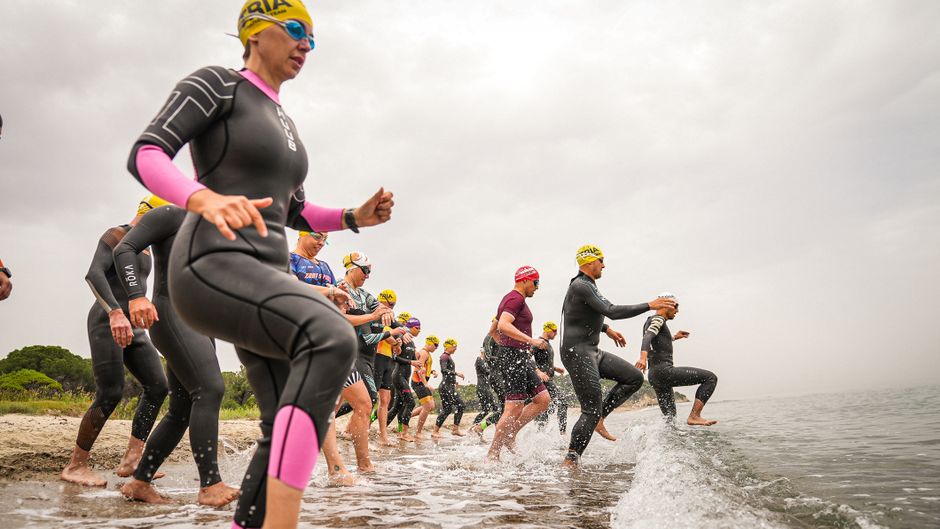
It’s 6:40 on a June morning at a lake sprint triathlon. Three hundred people in matching swim caps stand on the beach, half of them tugging at wetsuit necks, and the announcer reads the number everyone is waiting for: water temperature 68 degrees, wetsuits legal. A woman doing her first race lets out a breath. In cool water a good suit keeps you warm, lifts your hips and calms the nerves, which is why the best triathlon wetsuits are among the most worthwhile gear a triathlete buys. Below are six real suits sold in 2026, full sleeve and sleeveless, plus the USA Triathlon and World Triathlon rules on water temperature and thickness, and how to get the size right.

Prices change often. The prices below are what we saw at the maker or a major retailer in October 2026; check the current price before you buy.
Our top picks
Synergy Endorphin Full Sleeve
- 5 mm core, 3 mm legs, 2 mm arms
- Yamamoto #39 neoprene
- Men's and women's
Synergy Volution 5/2 Full Sleeve
- 5 mm core, 2 mm legs and back
- Internal YKK zipper
- Men's and women's
Zoot Maui
- 5 mm chest and upper legs
- 1.5 mm arms, 2 mm shoulders
- 2-year warranty
XTERRA Vortex Full
- 5 mm front, 3 mm back
- 1.5 mm arms
- X-Flex 2.0 liner
Zone3 Agile
- 2 mm flex-fit shoulders
- Slimline speed cuffs
- Glued and blind-stitched seams
Zoot Maui Sleeveless (Women's)
- 5 mm front chest
- Female-specific panels
- Men's version too
Triathlon wetsuits compared
| Wetsuit | Style | Thickness (maker) | Key feature | About (Oct 2026) |
|---|---|---|---|---|
| Synergy Endorphin | Full sleeve | 5 / 3 / 2 mm | Yamamoto #39, 2-year warranty | $399 |
| Synergy Volution 5/2 | Full sleeve | 5 / 2 mm | Full 5 mm core at a lower price | $259 |
| Zoot Maui | Full sleeve | 5 / 3 / 2 / 1.5 mm | Forgiving fit for new triathletes | $260 |
| XTERRA Vortex | Full sleeve | 5 / 3 / 1.5 mm | Thin arms for a natural stroke | $369 |
| Zone3 Agile | Full sleeve | 2 mm shoulders (rest not stated) | Speed cuffs for quick T1 | $395 |
| Zoot Maui Sleeveless | Sleeveless | 5 / 3 mm | Free shoulders for warmer water | $220 |
The best triathlon wetsuits for 2026
1. Synergy Endorphin Full Sleeve: best overall
The Endorphin is a mid-price race suit and the one we’d point most age-groupers to. Synergy builds it from Yamamoto #39 neoprene with an SCS silicone coating, using the full 5 mm the rules allow in the core buoyancy panel, 3 mm in the lower legs and back and 2 mm in the arms and shoulders. It has an internal YKK zipper, a soft low neck and a 2-year warranty when you register it; the women’s listing also mentions an Astro Thermal liner for colder water. The men’s and women’s Endorphin were both about $399, in a wide range of sizes. There’s also a sleeveless long john version (about $399) for warmer races.
- Good: maximum legal buoyancy where you need it; thin arms; warm for early-season swims.
- Watch out: some sizes were running low; check the size chart before you order.
- Best for: sprint to IRONMAN racers who want one suit for training and race day.
Check the Synergy Endorphin price on Amazon
2. Synergy Volution 5/2 Full Sleeve: best value
If you race a few times a summer and don’t want to spend $400, the Volution 5/2 keeps the part that matters most: a 5 mm core buoyancy panel, with 2 mm in the lower legs and back. Synergy uses silicone-coated neoprene, an internal YKK zipper and the same soft low neck as its pricier suits. Warranty is 1 year with registration. Both the men’s and women’s Volution 5/2 were about $259. Synergy also sells the Volution in a 3/2 mm full suit and in sleeveless and shorty cuts.
- Good: full legal core thickness at a lower price; simple, proven design.
- Watch out: the listing doesn’t state arm thickness; shorter warranty than the Endorphin.
- Best for: first full season, budget-minded racers, a training suit.
Check the Synergy Volution 5/2 price on Amazon
3. Zoot Maui: best for first-timers
Zoot calls the Maui its most accessible full-coverage wetsuit, made to help new triathletes feel supported and relaxed in open water. It puts 5 mm neoprene in the chest and upper legs to lift the hips, 3 mm in the lower back of the legs, 2 mm in the shoulders and 1.5 mm in the arms, with a hydrophobic Neoskin SCS coating, a soft nylon liner and a YKK zipper. Zoot, founded in Kona in 1983, warrants its products for two years against defects. It was about $260 for the men’s suit.
- Good: forgiving fit; body-position help in the legs; 2-year warranty.
- Watch out: the card links the men’s suit; check the women’s Maui separately for your size.
- Best for: first open water races and swimmers whose legs sink.
Check the Zoot Maui price on Amazon
4. XTERRA Vortex Full: best for shoulder freedom
Stiff shoulders are what make swimmers hate wetsuits. XTERRA’s Vortex, an upgrade of its long-selling Volt, uses 5 mm limestone-based neoprene on the front, 3 mm on the back and just 1.5 mm in the arms for a more natural stroke. The X-Flex 2.0 liner is meant to make getting in and out easier, and the low-profile collar and triple-glued, double-stitched seams aim to keep the suit comfortable and holding its shape. The listing showed five sizes from Small to XX-Large, at about $369.
- Good: thin arms; buoyant front; built for training and racing.
- Watch out: fewer sizes than some rivals; men’s listing only.
- Best for: stronger swimmers and anyone who has felt tight in the shoulders in a wetsuit.
Check the XTERRA Vortex price on Amazon
5. Zone3 Agile: best for fast transitions
Zone3 built the Agile for swimmers who want range of motion and a quick exit. It has 2 mm Flex-Fit shoulder panels, core support buoyancy panels on the upper legs, a Speedflo and Smoothskin coating, fully glued and blind-stitched seams for comfort and warmth, and slimline speed cuffs that help it come off fast in T1. A talon-resistant coating helps against fingernail tears. Zone3’s listing doesn’t state the core thickness. It was about $395.
- Good: quick-release cuffs; flexible shoulders; tougher outer coating.
- Watch out: few specs on the listing; check Zone3’s size chart and details before buying.
- Best for: racers who care about every second in transition.
Check the Zone3 Agile price on Amazon
6. Zoot Maui Sleeveless: best sleeveless wetsuit
For races in water that’s legal but warm, a sleeveless suit keeps the buoyancy and loses the heat. The women’s Maui Sleeveless is made for women new to triathlon or open water, with female-specific panels, 5 mm Neoskin in the front chest, 3 mm in the lower back of the legs, the same SCS coating and a YKK stainless steel zipper. Zoot’s advice: if you’re between sizes, choose the smaller size. The women’s and men’s Maui Sleeveless were both about $220.
- Good: free shoulders; cooler in summer races; lowest price here.
- Watch out: colder at the arms in early-season water; less arm buoyancy than a full suit.
- Best for: summer racing in the South, warm lakes, swimmers who hate tight sleeves.
Check the Zoot Maui Sleeveless price on Amazon
Wetsuit rules: water temperature and the 5 mm limit
Every suit above stays within the rules: no more than 5 mm thick anywhere, and nothing over the face, hands or feet (USA Triathlon and World Triathlon both say so; World Triathlon allows a 0.3 mm tolerance). Whether you can wear it depends on the water temperature, measured before the start. For most USA Triathlon age-group races:
| Water temperature | Wetsuit (USAT age group) |
|---|---|
| 60.6°F (15.9°C) and below | Mandatory |
| 60.7–78.0°F | Allowed |
| 78.1–83.9°F | Allowed, but no age-group awards or rankings |
| 84.0°F (28.9°C) and above | Banned |
USAT national championships and World Triathlon qualifiers ban wetsuits at 76.2°F and up, and IRONMAN’s age-group limit is 76.1°F. At World Triathlon events, age-groupers up to the 55–59 category can’t wear one at 22°C (71.6°F) and up for swims of 1,500 m or less, or at 24.6°C (76.3°F) and up for longer swims; from 60–64 on, the limit is 24.6°C at every distance. Wetsuits are mandatory at 15.9°C (60.6°F) and below. Our triathlon gear guide covers swimskins for the warm-water days.
How to choose a wetsuit for open water swimming
- Get a triathlon suit, not a surf suit. Tri suits use slick, thin neoprene in the arms and shoulders so you can swing your arms; a wetsuit for open water swimming should feel very different from one for paddling a board.
- Size by the maker’s chart. Height and weight first, then chest. Charts differ between brands, so don’t assume your size carries over.
- Snug, no gaps. Pull it up from the ankles a bit at a time until the crotch and armpits sit high, with no air pockets in the back. Snug at the neck without choking. Shoulders should feel free when you swing your arms. Use your fingertip pads, not nails, to avoid tears.
- Full sleeve or sleeveless? Full sleeve is warmer and many swimmers find it faster; sleeveless is cooler and freer for warm, legal water. If you buy one suit and race in spring or in northern lakes, go full sleeve.
- Practice before race day. Swim in it at least once in open water, with a buddy, and practice taking it off. A wetsuit floats you, but it’s not a life jacket. Many races and shops rent suits, a smart way to try before you buy.
- Protect the neck. A little anti-chafe balm on the neck stops the rub on long swims; rinse the suit in fresh water and dry it out of the sun.
Start at our triathlon hub, see the full triathlon gear list, read about open water swim safety on our triathlon injuries page (chest pain, dizziness or unusual breathlessness in the swim is a reason to stop and see a doctor), and see our youth triathlon page if your kids race too. Train smarter with our best heart rate monitors, fuel the bike leg with best energy gels, or browse more triathlon articles.
Triathlon wetsuit questions
At what water temperature can I wear a wetsuit in a triathlon?
In most USA Triathlon age-group races, up to 78.0°F with full award eligibility, 78.1–83.9°F without awards, and never at 84°F or warmer. Below 60.7°F it’s mandatory. National championships, IRONMAN and World Triathlon events use lower limits, so check your race’s athlete guide.
How thick can a triathlon wetsuit be?
5 mm at the most, anywhere on the suit, under USA Triathlon, IRONMAN and World Triathlon rules. Most tri suits use 5 mm only in the core and legs and thinner neoprene in the arms and shoulders.
Can I use a surfing wetsuit for a triathlon?
Only if it’s 5 mm or thinner everywhere. Even then, surf suits are usually stiffer and grippier in the shoulders, which makes swimming harder. A tri suit or a rental is a better choice.
How tight should a triathlon wetsuit be?
Tight on land, like a firm hug, with no gaps at the crotch, armpits or lower back, and loose enough to breathe deeply and swing your arms. If you feel short of breath or panicky in it, try the next size or another brand’s cut.
Do I need a wetsuit for my first triathlon?
Not for a pool swim or warm water. For a cool lake, a wetsuit helps with warmth and floating, and it’s required at 60.6°F and below in USAT races. Renting one for your first race is a cheap way to find out what you like.