This article contains affiliate links: if you buy through them we may earn a commission, at no extra cost to you. Learn more.
The isolation room before a lead final, where climbers wait so they can’t see the route before their turn. The beep of the speed timer and two athletes exploding up the wall. A first-timer at the gym front desk, nervous about the belay test. A crag at dawn, where the unwritten rules are as important as the written ones. Climbing has rules at every level, and most of them exist for one reason: to keep people safe. This page covers the climbing rules that matter: competition formats, how grades work, gym rules and belay checks, and the ethics of climbing outdoors.
Competition climbing: boulder, lead and speed
World Climbing (the international federation, called the IFSC until December 2025) and USA Climbing run competitions in three disciplines. The same basics apply from a local youth event to the Olympics, with formats adjusted by level.
Boulder
Climbers face short problems on a low wall, about 4.5 meters at the Olympics, with no rope or harness, over thick mats. Each boulder has marked start holds, usually a “zone” hold partway up, and a finishing hold that must be held with both hands in a stable position (or the climber stands on top). Under the scoring World Climbing introduced in 2025, a top is worth 25 points and a zone 10, with 0.1 points taken off for each failed attempt, so solving a problem quickly matters. Climbers get a set time on each boulder, and in elite finals several climbers can now be on the wall at the same time.
Lead
Climbers get one attempt at a tall route, at least 15 meters in elite events, clipping the rope into quickdraws as they go. In “on-sight” rounds they haven’t seen anyone else climb it: they wait in isolation and get only a short group observation period. USA Climbing’s rulebook caps climbing time at six minutes per attempt, and the Olympics use six minutes too. The highest hold controlled decides the ranking, with a “+” for a climber who makes a real move toward the next hold. Under USA Climbing rules, youth climbers in U15 and younger climb routes on top-rope; U17 and older must lead at regional, divisional and national championships.
Speed
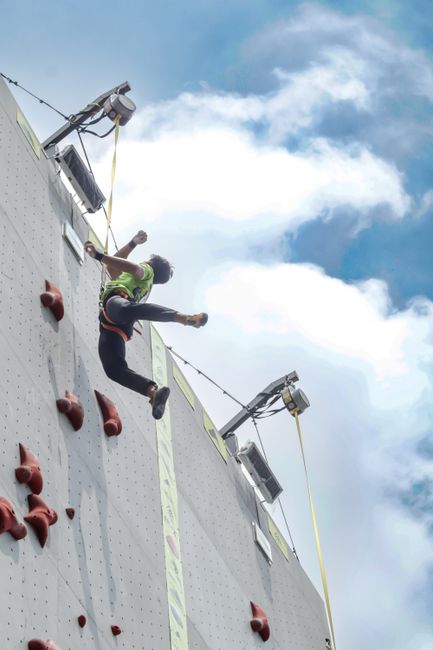
Two climbers race side by side up a 15-meter wall set at a 5-degree overhang, on a standardized route that is identical worldwide, so records can be compared. They’re protected by an automatic belay, and the timer starts when their feet leave the start pad. A climber whose reaction time is under 0.100 seconds, and quicker than the other climber’s, is called for a false start. The fastest men now climb it in under five seconds and the fastest women in about six. In the USA Climbing Youth Series, speed is mainly for U17 and older.
How it works at the Olympics
Tokyo 2020 had one combined event per gender, with every climber doing all three disciplines. Paris 2024 split speed off and combined boulder and lead. LA28, in July 2028, will be the first Games with three separate medal events per gender, decided by the IOC Executive Board in April 2025, with 76 athletes. Competitors must wear climbing shoes (and a harness where relevant), may use chalk and may choose to wear a helmet. More in our leagues and associations guide.
Climbing grades: V-scale and YDS
The V-scale grades boulders. John “Verm” Sherman published it in 1991 in his Hueco Tanks guidebook. It starts at V0 (many gyms use “VB” for the easiest problems) and was at V17 in 2026, with Burden of Dreams in Finland the first boulder to get that grade. It rates only how hard the moves are, not the risk.
The Yosemite Decimal System (YDS) grades roped climbs in the US and Canada. It began with the Sierra Club in the 1950s. Classes 1–4 cover hiking and scrambling; class 5 is technical roped climbing, written 5.0 to 5.9, then 5.10 and up, split further into a, b, c and d (5.10a, 5.10b…). The top is 5.15d, and as of December 2025 only three routes had that grade. Trad routes can also carry a protection rating such as PG-13, R or X, warning that a fall could be long or dangerous.
Gym grades are set by each gym’s route setters, and indoor boulder grades tend to feel softer than the same grade outdoors, at least up to around V10. Treat any grade as a guide, not a promise, and start a few grades below your gym level when you first climb on real rock.
| Style | US grade | Range | Rates |
|---|---|---|---|
| Bouldering | V-scale | VB/V0 to V17 | Difficulty of the moves only |
| Top-rope, lead, sport, trad | YDS class 5 | 5.0 to 5.15d | Hardest move and overall difficulty; trad may add PG-13/R/X |
Gym rules and belay checks
Every gym sets its own rules, but they follow the same pattern. Before you belay, you pass the gym’s belay test, even if another gym already certified you. A typical top-rope test, like Cornell’s, asks you to show a good harness fit, tie in with a figure-eight follow-through, set up the belay device and close the system, use clear belay commands, do a partner check, then belay, catch and lower a climber smoothly. Lead belaying is a separate, harder test. Minimum ages vary: Cornell’s climbing center requires belayers to be 13 to take the top-rope test, and River Rock Climbing requires climbers to be 14 to use its auto-belays without staff help.
- Partner check, every climb: both harness buckles done, the knot finished and tied through both tie-in points, the belay device loaded right, the carabiner locked, and a knot in the rope end.
- Close the system: the American Alpine Club found that more than half of reported lowering accidents over a decade involved the rope end passing through the belay device. A stopper knot prevents it.
- Auto-belays: clip in before you leave the ground, every time; the AAC has documented serious falls from climbers who forgot.
- Bouldering: don’t walk or sit under other climbers, one climber per line at a time, climb down when you can, and land on your feet with knees bent.
- Kids: most gyms require kids to be supervised, and set their own ages for belaying and tying in.
Chalk is part of every gym session. A simple loose chalk such as Black Diamond White Gold (magnesium carbonate, about $16) does the job; some gyms ask for chalk balls or liquid chalk to keep the dust down, so check yours.
Outdoor ethics: Leave No Trace and the Climber’s Pact
Outdoors, the rules come from land managers, local climbing groups and shared ethics. The seven Leave No Trace principles are the base: plan ahead and prepare, travel and camp on durable surfaces, dispose of waste properly, leave what you find, minimize campfire impacts, respect wildlife and be considerate of others. The Access Fund, the national group that works to keep US climbing areas open, adds a Climber’s Pact with climbing-specific promises, including:
- Park and camp in designated areas; stay on trails whenever possible.
- Place gear and pads on durable surfaces; pack out all trash, crash pads and gear.
- Clean up chalk and tick marks; dispose of human waste properly.
- Respect regulations and closures, and learn the local ethics for the places you climb.
- Use, install and replace bolts responsibly; minimize group size and noise.
Safety rules outdoors build on the gym ones: wear a helmet (rock and gear can fall), check the rope length against the route, tie a stopper knot, and learn trad and anchor skills from a certified guide (the AMGA trains and certifies guides in the US) or an experienced mentor. A helmet such as the Black Diamond Half Dome (CE/EN and UIAA certified, about $70) is a solid first choice. More in our climbing gear guide.
Black Diamond Half Dome Helmet
- CE/EN and UIAA certified
- EPS foam, ABS shell
- About $70
Petzl GRIGRI Belay Device
- Assisted braking
- 8.5-11 mm single ropes
- About $100
Rules keep climbing safe; your body keeps it fun. See our climbing hub, the youth climbing guide for parents, our climbing injuries page, and, for comparison, soccer rules.
Climbing rules FAQs
How is competition bouldering scored?
Since 2025, World Climbing uses points: 25 for a top, 10 for a zone, minus 0.1 for each failed attempt on that boulder. The climber with the most points wins.
What does 5.10a mean in climbing?
It’s a Yosemite Decimal System grade: “5” means technical roped climbing, “10” the difficulty level, and “a” the easiest of four subdivisions (a to d) used from 5.10 up. It’s a solid intermediate grade.
What is the hardest climbing grade?
V17 for bouldering (as of 2026) and 5.15d for routes. Only a handful of climbs in the world carry those grades.
Does my belay certification work at other gyms?
Usually not automatically. Each gym checks you on its own standard, often with a quick belay test on your first visit. Lead belaying is a separate test.
Should I brush off my tick marks?
Yes: cleaning up chalk and tick marks is part of the Access Fund’s Climber’s Pact. Brush them off with a soft brush before you leave so the rock stays natural for the next climbers.