This article contains affiliate links: if you buy through them we may earn a commission, at no extra cost to you. Learn more.
The alarm goes off at 4:45 a.m. for 5:30 ice, then school, then an afternoon session and off-ice conditioning, then homework. For a lot of competitive skaters that’s an ordinary Tuesday, and it explains why figure skating recovery matters as much as any jump drill. Skaters land hundreds of times a week on one leg, spend hours in stiff boots and train in cold rinks, often at hours when everyone else is asleep. This page covers what actually helps skaters bounce back, at every level from Learn to Skate to adult competitors: the cool-down, sleep, refueling, rest days, caring for feet and boots, recovery tools, and the multi-day competition.
The cool-down after the ice
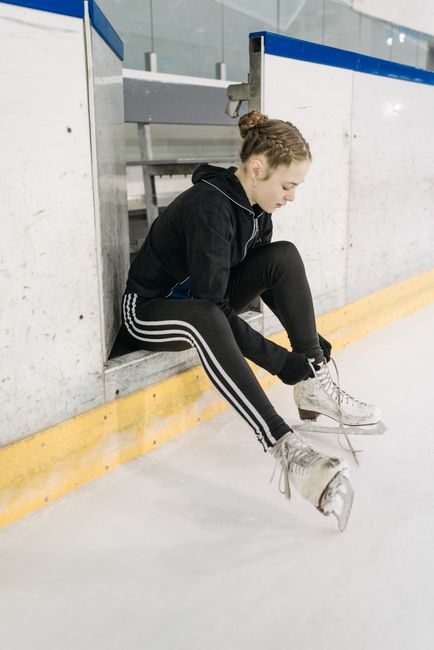
Straight from the ice to the car is the skater’s default. A short cool-down is better: 5 to 10 minutes of easy movement off the ice, then static stretching for the calves, quadriceps, hamstrings, hip flexors and glutes. The American Academy of Pediatrics’ HealthyChildren.org recommends static stretching in the cool-down for skaters. Be realistic about what it does: a 2018 review found that cool-downs do little for next-day soreness or injury risk, but they bring the heart rate down gently, and for skaters the stretching time is where flexibility is kept. Take the boots off as soon as you can after skating and let your feet breathe.
Sleep: the problem with early ice
Sleep is the recovery tool with the strongest case and the one early-morning skating threatens most. The American Academy of Sleep Medicine, with the American Academy of Pediatrics, recommends 9–12 hours a night for children 6 to 12 and 8–10 hours for teens 13 to 18; adults need 7 or more. A 5:30 a.m. session plus school and evening practice makes those numbers hard. In a study of elite female gymnasts, a similar early-specializing, high-volume sport, shorter sleep followed heavier training days and went along with poorer competition results. What helps:
- Work backward from the alarm. A 5 a.m. alarm for a 13-year-old means lights out around 8 or 9 p.m. to reach 8–10 hours.
- Pack the bag the night before so the morning is automatic.
- Screens off 30–60 minutes before bed, a cool, dark room, and steady sleep times on weekends too.
- Nap smart: a short early-afternoon nap can help after early ice, as long as it doesn’t push bedtime later.
- Skip energy drinks. The AAP says caffeinated energy drinks have no place in children’s and teens’ diets.
If early ice and school can’t fit 8 hours of sleep, it’s worth talking with the coach about how many early sessions are really needed. A sleep tracker can make the pattern visible; see figure skating wearables.
Refuel after every session
The 2016 joint position of the American College of Sports Medicine, the Academy of Nutrition and Dietetics and Dietitians of Canada recommends about 15–25 g of protein (or 0.25–0.3 g per kilogram) in the first couple of hours after training, plus carbohydrate to refill energy stores, and drinking to replace what was lost. After early ice that simply means breakfast: eggs and toast, yogurt with granola and fruit, or a smoothie with milk in the car on the way to school. After an evening session, a real dinner. Skipping the post-skate meal is common and costly: in young Swedish skaters, more skipped meals per week went along with more injuries, and the International Olympic Committee links low energy availability to bone stress injuries. More in figure skating nutrition.
Rest days and time off
The American Academy of Pediatrics recommends at least 1–2 days off a week from the main sport and about 3 months off a year, in 1-month blocks, for young athletes. In skating, where the season and summer training camps blur together, that time off often has to be planned on purpose. Signs that recovery isn’t keeping up: performance stalling despite hard work, constant tiredness, heavy legs on every jump, sleep problems, frequent colds, irritability, or a skater who has stopped enjoying the ice. AAP’s pediatricians sum it up: when children stop smiling on the ice, it’s too much. Those signs mean a lighter week and, if they persist, a doctor’s visit.
Feet and boots: skating-specific recovery
- Check your feet after skating for blisters, red pressure spots over the ankle bones and heel, and lace marks. Small sores grow into lace bite, pump bumps and bursitis if the boot keeps rubbing (see figure skating injuries).
- Blister care: keep it clean and covered; see a doctor if it looks infected (spreading redness, warmth, pus).
- Dry the boots and blades: wipe the blades, swap hard guards for soakers, and open the boots up to dry. Wet leather breaks down faster.
- Give feet a break: after hours in stiff boots, many skaters like a soft recovery slide for the walk to the car and around the house.
Recovery tools: what helps, honestly
A large 2018 review of recovery methods found massage the most effective for reducing soreness and the feeling of fatigue. Foam rolling and massage guns are do-it-yourself versions: a 2026 meta-analysis of percussive therapy found some benefit for jump recovery but no clear benefit for strength or soreness. Many skaters like a foam roller on the quads, glutes, calves and the outside of the thigh, and avoid rolling directly on joints or the lower spine. Cold-water immersion (about 10–15 °C for 10–15 minutes) can reduce soreness, but after strength sessions it blunted strength and muscle gains in a 12-week study, so save it for competition weekends rather than every day. Skaters already spend hours in the cold, and nobody needs an ice bath in a chilly rink; anyone with a heart condition should check with a doctor first, and young skaters should ask a pediatrician.
Three tools many skaters like: a TriggerPoint GRID foam roller for the rink-side routine, a Theragun Mini for older skaters who want a portable massage gun, and OOFOS OOahh slides to slip into after taking off the boots. They’re for comfort, not treatment.
TriggerPoint GRID 1.0
- 13 in, hollow core
- Multi-density surface
- About $40
Theragun Mini (3rd Gen)
- 3 speeds, 3 attachments
- Travel case
- About $220
OOFOS OOahh Slide
- Soft OOfoam slide
- APMA Seal of Acceptance
- About $60, machine washable
More in our guides to the best recovery tools for athletes, best massage guns and best recovery shoes, and our athlete recovery routine.
Recovering during a multi-day competition
- Between short program and free skate: eat a proper meal within a couple of hours, drink, do an easy walk and stretch, and get to bed on time. Don’t relive every element at midnight.
- Practice ice the next morning: keep it short and sharp; it’s for feel, not fitness.
- Travel: pack snacks and a water bottle, move every hour on long drives or flights, and keep bedtime close to normal.
- After the event: a day or two of easy activity before hard jumping again. See the competition day playbook for the day itself.
Back to the figure skating hub, or compare with gymnastics recovery and soccer recovery.
Figure skating recovery: FAQs
How much sleep do figure skaters need?
Sleep experts endorsed by the AAP recommend 9–12 hours for ages 6 to 12, 8–10 hours for teens and 7 or more for adults. With early-morning ice, that means an early bedtime, steady sleep times and, if needed, fewer early sessions.
What should a skater eat after practice?
A meal or snack with carbohydrate and about 15–25 g of protein within a couple of hours, such as eggs and toast, yogurt with fruit and granola, or a milk-based smoothie, plus fluids. After early ice, that’s simply a good breakfast.
How many rest days should a figure skater take?
The American Academy of Pediatrics recommends at least 1–2 days off a week from the main sport and about 3 months off a year in 1-month blocks for young athletes. Adults benefit from planned rest days too.
Are ice baths good for figure skaters?
They can ease soreness at a multi-day competition, but regular cold-water immersion after strength sessions may blunt strength gains. Most skaters do fine with sleep, food, stretching and a foam roller. Check with a doctor first if you have a heart condition, and with a pediatrician for kids.
How do I take care of my feet after skating?
Take the boots off promptly, check for blisters and pressure spots, keep blisters clean and covered, and let feet rest in soft footwear. Sores that keep returning in the same spot mean the boot needs a fitter’s attention.