This article contains affiliate links: if you buy through them we may earn a commission, at no extra cost to you. Learn more.
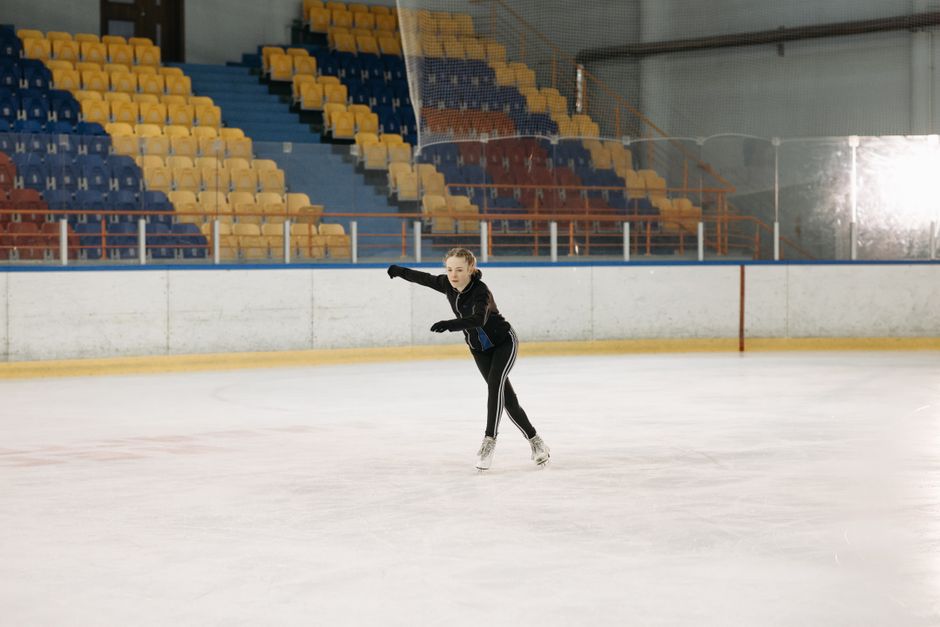
The announcer calls the warm-up group, six skaters step through the gate, and for six minutes the ice is a blur of stroking, test jumps and near misses. Then the rink goes quiet, five skaters leave the ice, and the first one waits in the center for her music. Whether it’s a first local competition in a sparkly dress or the Olympic free skate, competition day in figure skating has the same shape: a long day of waiting in a cold building, a short warm-up, and two to four minutes that count. This page is the playbook: how a competition runs, the off-ice warm-up, staying warm in the rink, what to eat and drink, handling nerves, and what to do if something goes wrong.
How a skating competition runs
Skaters are drawn into a starting order and split into warm-up groups. Under International Skating Union (ISU) rules as of the 2026–27 season, singles skaters warm up for 6 minutes in groups of up to six, pairs for 6 minutes in groups of up to four pairs, and ice dancers for 5 minutes (rhythm and free dance) in groups of up to five couples. The warm-up must come right before that group competes, so the first skater goes straight from warm-up to program, while the last one may wait through five programs. Program lengths at ISU events: 2 minutes 40 seconds for the short program, 4 minutes for the senior free skate and 3½ minutes for juniors. National and local competitions (U.S. Figure Skating, Skate Canada and others) set their own warm-up times and group sizes by level, often shorter for younger skaters, so check the announcement for your event.
Many competitions also offer paid practice ice the day before or the morning of the event. Use it to get used to the rink, the boards and the lighting rather than to cram in extra jumps.
The off-ice warm-up: plan it around your start number
The on-ice warm-up is too short to start from cold, so skaters do an off-ice warm-up first, usually 15 to 30 minutes before their group is called: light jogging or skipping, dynamic mobility (leg swings, lunges, hip circles), activation (band walks, bridges), a few off-ice jumps and rotations, and a run-through of the program in their head. Two timing tips coaches use:
- First to skate? Know exactly what you’ll do in the warm-up and leave a little energy; you’ll go straight from the warm-up into your program.
- Last in the group? You may wait 15 to 20 minutes after the warm-up. Put your jacket on as soon as you step off, keep moving (marching, light jumps, arm swings), and re-warm with a short burst of activity a few minutes before your name is called.
The cold rink: stay warm, breathe easy
Rinks are cold and dry. A classic study of 124 figure skaters noted rink temperatures of about 7 to 10 °C (45 to 50 °F), and skating hard in cold, dry air is a known trigger for exercise-induced bronchoconstriction (EIB), a narrowing of the airways during or after exercise. In that study, 35% of skaters showed EIB after a simulated free skate; another study of 100 competitive skaters found 30%. The American Medical Society for Sports Medicine notes cold air and ice-resurfacing fumes can trigger it, and that vocal cord dysfunction can mimic asthma. If you cough, wheeze or feel tight-chested after programs, see a doctor for testing and a plan, and keep any prescribed inhaler rink-side on competition day.
- Layer up. A warm jacket and warm-up pants over the costume, gloves, and boots or skate covers that keep the feet from chilling between warm-up and program.
- Hand warmers in pockets and gloves help in long waits.
- Wait somewhere warm (the lobby or dressing room) until it’s time to warm up.
- Dry blades: wipe blades after the warm-up and use soakers off the ice and hard guards only for walking, so moisture doesn’t rust them.
Fueling: the pre-competition meal and snacks
The 2016 joint position of the American College of Sports Medicine, the Academy of Nutrition and Dietetics and Dietitians of Canada recommends a pre-event meal with about 1–4 g of carbohydrate per kilogram of body weight, eaten 1–4 hours before, and going easy on fat, protein and fiber to avoid stomach trouble. For a skater that might be oatmeal with banana and honey, toast with jam, a bagel, rice or pasta with a little chicken, and a glass of milk or juice, about 3 hours before the event. Closer in (30–60 minutes before the warm-up), a small, easy snack: a banana, crackers, a granola bar or applesauce. The same paper recommends drinking about 5–10 mL of fluid per kilogram in the 2–4 hours before exercise, aiming for pale yellow urine; for a 45 kg (100 lb) skater that’s roughly 225–450 mL (8–15 oz).
Competition days are long. Pack more food than you think you need, especially if there’s both a short program and a free skate or a long drive. Nerves can kill appetite: small, familiar foods every couple of hours work better than one big meal. Cold rinks dull thirst, so drink by habit, not just by feel. Never try a new food or drink on competition day. And skating with an empty stomach to “look lighter” is a performance and health mistake; see our figure skating nutrition page.
Nerves: make them work for you
Every skater gets nervous; skating is alone on a big sheet of ice with judges watching. In a study of young Swedish competitive skaters, nearly half screened positive for anxiety, so it’s worth taking seriously. The good news: a 2026 meta-analysis of 21 studies found that techniques like pre-performance routines, quiet-eye training, mindfulness and self-talk reduced the drop in performance under pressure, with stronger effects in “closed-skill” sports like skating, where the athlete starts the movement. What it looks like on competition day:
- A fixed routine from the off-ice warm-up to the starting pose: the same stretches, the same music in your headphones, the same cue words.
- Slow breathing while you wait at the boards: a long exhale calms the body.
- Short cue words for each element (“tall”, “snap”, “check”) instead of thinking about scores.
- Parents: keep it simple. “Have fun, I love watching you skate” beats technical advice. Let the coach coach.
For more, see our best mental training tools for athletes guide.
When something goes wrong
- A fall during the program: get up, pick up the music, and keep going. Falls cost points, but finishing the program matters.
- Equipment trouble (a broken lace, a loose costume piece): ISU rules allow limited time to fix certain problems with a deduction, and a costume decoration falling on the ice is itself a deduction. Pack spare laces, safety pins and tape, and check your costume before you go out.
- A hit to the head: if a concussion is suspected, U.S. Figure Skating’s guidance is immediate removal from the ice, with no return until a concussion-trained professional gives written clearance. No competition is worth skating with a possible concussion. See figure skating injuries.
- Trouble breathing after a program: use your prescribed inhaler if you have one and tell the medical staff; get urgent help if it doesn’t settle quickly.
The competition bag
Skates (with soakers and hard guards), spare laces, costume and backup tights, a warm jacket and gloves, the music (with a backup copy if your event requires it), a water bottle, snacks, any medications or inhaler, a small first-aid kit, and something to pass the time. Hand warmers like HotHands make long waits by the boards much more bearable, a big Nalgene 32 oz bottle makes it easy to track how much you’ve drunk, and a sports-psychology book like The Champion’s Mind is good reading for the hotel the night before.
HotHands Hand Warmers, 40 Pairs
- Up to 10 hours of heat
- Air-activated
- About $25 for 40 pairs
Nalgene Sustain 32 oz Wide Mouth
- 32 oz, wide mouth
- BPA-free Tritan
- Made with 50% plastic-waste material
The Champion's Mind (Jim Afremow)
- Paperback
- By a sports psychologist
- About $10–$20
After the event, switch to figure skating recovery, especially at a multi-day competition. Back to the figure skating hub, or see how other athletes handle the big day in our gymnastics meet day and soccer game day guides.
Competition day: FAQs
How long is the warm-up at a figure skating competition?
At ISU events, singles and pairs warm up for 6 minutes (up to six singles skaters or four pairs per group) and ice dancers for 5 minutes in the rhythm and free dance. National and local events set their own times by level, so check your competition’s announcement.
What should a figure skater eat before a competition?
A familiar, carbohydrate-based meal 1–4 hours before (oatmeal, toast, a bagel, rice or pasta), light on fat and fiber, and a small snack like a banana 30–60 minutes before the warm-up. Drink regularly, even though the cold rink dulls thirst.
How do skaters stay warm between the warm-up and their program?
Put a jacket and gloves on as soon as you step off the ice, keep moving with light marching and arm swings, use hand warmers, and do a short burst of activity a few minutes before your name is called.
Why do some skaters cough after their program?
Hard exercise in cold, dry rink air can trigger exercise-induced bronchoconstriction; studies found it in about 30–35% of competitive skaters tested. Coughing, wheezing or chest tightness after skating is worth a doctor’s visit for testing and a plan.
How can I calm my nerves before skating?
Build a routine you use every time, from the off-ice warm-up to the starting pose, with slow breathing and short cue words for each element. Research shows routines and similar techniques help athletes perform under pressure, especially in sports like skating.