This article contains affiliate links: if you buy through them we may earn a commission, at no extra cost to you. Learn more.
The alarm goes off at 4:15. Coffee in a travel mug, the boat already hitched, rods rigged the night before, and a line of trailers at the ramp under the lights. At a bass club tournament or a B.A.S.S. Nation qualifier, boats idle in the dark until the blast-off at first light; on a family day, it’s a cooler of sandwiches and a kid asleep in the truck until the lake comes into view. Whether it’s a quiet morning on a pond, a long wade up a trout stream, an offshore run or a two-day tournament, a good fishing day is mostly won before you launch: the right plan, the right forecast, enough water and food, and sun protection that lasts until the weigh-in.
General information, not medical advice. If you have a heart condition, diabetes or another health condition, or take medicines that affect heat tolerance, ask your doctor about long days in the heat. Prices change often; prices below are what we saw on Amazon in October 2026. Back to the fishing hub.
The night before: plan the day
- License and rules: a valid fishing license for every angler who needs one, and a quick look at the state’s size and bag limits for the water you’ll fish.
- Safety gear check: a Coast Guard-approved life jacket for every person (worn by kids under 13 on a moving boat under federal rules), a throwable device on boats 16 feet and longer, the kill-switch lanyard, a first aid kit, pliers with a wire cutter for hooks, and a charged phone in a waterproof case. If you wear an inflatable, check that the cylinder is full and the indicator is green.
- Tell someone your plan: where you’re launching, where you’ll fish and when you’ll be back.
- Pack the cooler: more water than you think (see below), real food and snacks, and ice for the fish if you keep any.
- Sleep: early starts make for short nights. A sleepy driver at 5 a.m. towing a boat is a risk, and a tired brain makes poor calls on the water.
Weather: read it twice
Weather was the primary contributing factor in 188 recreational boating incidents and 55 deaths in the US Coast Guard’s 2024 report. Check the National Weather Service forecast (and the marine forecast on big lakes and the coast) the night before and again at the ramp: wind and waves, thunderstorms, temperature and heat index, and the water temperature. Small boats and kayaks get into trouble fast when the wind builds in the afternoon.
- Lightning: the National Weather Service says fishing and boating together account for 14% of US lightning deaths, and fishing alone for 40% of the water-related ones, partly because people on the water wait too long. Have a plan for where you’ll go and leave early. “When thunder roars, go indoors.”
- Cold water: spring and fall bring warm air over cold water. The Coast Guard warns that cold shock can make you gasp and hyperventilate for about a minute, and within about 10 minutes you can lose the use of your arms and legs. Dress for the water temperature, and wear your life jacket.
- Fog and darkness: blast-offs at first light and runs home at dusk need lights, a slow speed and a sharp lookout.
Sun: the all-day exposure
A fishing day is often a full day outdoors, with UV coming down from the sky and back up off the water. The CDC notes UV reflects off water and gets through clouds, and is strongest from 10 a.m. to 4 p.m. daylight time. The American Academy of Dermatology recommends a broad-spectrum, water-resistant sunscreen of SPF 30 or more, about one ounce (a shot glass) for the body, put on about 15 minutes before you go out and reapplied every two hours and after sweating or getting wet, plus an SPF 30 lip balm. Set a phone reminder; it’s easy to forget once the bite is on.
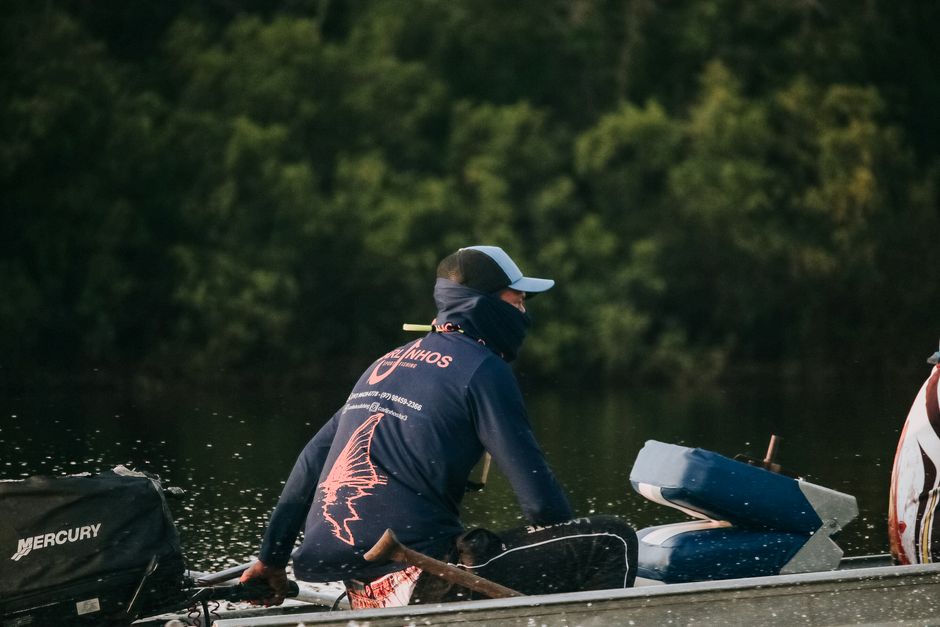
Clothing does the heavy lifting: a long-sleeve sun shirt, long pants, a wide-brimmed hat (or a cap plus a UPF neck gaiter for the ears and neck), sun gloves for the backs of your hands, and sunglasses with 100% UV protection. Polarized lenses cut the glare so you can see fish and structure, but polarization itself doesn’t block UV, so check the label. More on skin and eyes on our fishing injuries page.
Hydration on the water
It’s easy to under-drink on a boat: you’re busy, the breeze hides the sweat, and nobody wants to look for a bathroom. The American College of Sports Medicine (ACSM) suggests drinking about 5 to 10 mL per kilogram of body weight in the 2 to 4 hours before activity (roughly 1.5 to 3 cups for a 70 kg, 155 lb adult), aiming for pale-yellow urine. During the day, the National Athletic Trainers’ Association (NATA) advises keeping fluid losses under about 2% of body weight and, if you don’t know your sweat rate, drinking to thirst. For long, hot days, add sodium from salty snacks or an electrolyte drink.
- Keep a big bottle within reach on the deck, not buried in the cooler, and take sips every time you re-tie or change spots.
- Alcohol and boats don’t mix. The Coast Guard lists alcohol use as the leading known contributing factor in fatal boating incidents, and it also adds to dehydration in the heat.
- Check your urine color at lunch: dark yellow means drink more.
Heat: know the signs
Flat-calm summer afternoons are the dangerous ones. Wet a cooling towel or your hat, use the shade of the console or a Bimini top, and slow down in the hottest hours. The CDC’s warning signs: heat exhaustion means heavy sweating, cold, pale, clammy skin, a fast weak pulse, nausea, cramps, weakness, dizziness or headache: get into shade, loosen clothes, cool down with wet cloths and sip water, and get help if you’re vomiting or getting worse. Heat stroke, with a body temperature of 103°F or higher, hot red skin, confusion or passing out, is an emergency: call 911 (or the Coast Guard) and cool the person immediately, for example with water poured over them.
Food: fuel for a long day
Most anglers live on gas-station coffee and a bag of chips until the weigh-in. You’ll fish better, and think better at 3 p.m., with real fuel. ACSM’s sports nutrition guidance suggests a familiar pre-activity meal 1 to 4 hours before, based on carbohydrate and lower in fat and fiber so it sits well. Then eat a little every couple of hours.
- Before you launch: oatmeal with fruit, a bagel with peanut butter, eggs and toast, or a breakfast burrito.
- In the boat: sandwiches or wraps, bananas, apples, trail mix, pretzels, granola bars, jerky, cheese sticks. Pack them in a dry box; food that’s easy to eat with one hand wins.
- Food safety: keep perishables in a cold cooler away from bait and fish, and clean your hands before eating; the CDC advises not letting raw seafood or its juices touch other food.
Tournament day: how it runs
Bass tournaments, from club events to the Bassmaster Elite Series, follow a similar flow: boat check, a pre-tournament meeting, blast-off in “flights” at first light, fishing until a set check-in time, then the weigh-in. A few rules from the 2025 B.A.S.S. Nation rulebook show how seriously safety is taken:
- Every person in the boat wears a Coast Guard-approved, chest-type life jacket, fastened, any time the big engine is running; the driver wears the kill-switch lanyard.
- Every competitor must complete a boating safety course (or hold a captain’s license) before official practice.
- Officials may delay, shorten or cancel a day for weather.
- The boater’s limit is five bass a day and the non-boater’s three, and officials can cut hours or limits in hot weather to protect the fish; anglers are encouraged to carry extra ice for fish care.
For you, that means: lay out clothing, life jacket, rain gear and food the night before; eat breakfast even when your stomach is jumpy; drink steadily from blast-off, not just when you’re thirsty at noon; reapply sunscreen on a schedule; and don’t race home through a storm to make the check-in. A late penalty is better than a lightning strike or a capsized boat. On a two-day event, the evening between days is recovery time: rehydrate, eat a proper dinner and get to bed. Our fishing recovery page has the details.
Kids on fishing day
Kids burn out faster in sun and heat and lose track of drinking. Keep their life jacket on the whole time on a boat or near deep water, sunglasses on their faces (children made up 41.8% of fishing eye injuries in a recent emergency-room study), sunscreen reapplied, and snacks and water within reach. Short trips that end while they’re still having fun beat long ones.
What we’d pack for a fishing day
Electrolytes for long hot days, a mineral sunscreen that’s water and sweat resistant, a big refillable bottle, and a cooling towel for the afternoon. More choices in our best electrolyte powders guide.
Nuun Sport Electrolyte Tablets
- 300 mg sodium per tablet
- 1 g sugar
- Informed Choice (maker)
Blue Lizard Sport Mineral Sunscreen SPF 30+
- Zinc oxide, UVA/UVB
- Water and sweat resistant
- Fragrance free, 8.75 oz
Nalgene Sustain 32 oz Bottle
- 32 oz, wide mouth
- BPA-free Tritan
- About $16
MISSION Original Cooling Towel
- Cools when wet
- UPF 50 (maker)
- 10 x 33 in
Get ready for the season with our Fishing Fitness plan, and for what to eat across the week see fishing nutrition. Other sports handle long hot days too: compare soccer game day.
Fishing day: FAQs
How much water should I bring fishing?
More than you think, especially in summer. Start the day hydrated (ACSM: about 5 to 10 mL per kg in the 2 to 4 hours before), sip through the day, and bring an electrolyte drink or salty snacks for long hot days. Pale-yellow urine is a good sign.
What should I eat on a fishing trip?
A carbohydrate-based breakfast 1 to 4 hours before, then something every couple of hours: sandwiches, fruit, trail mix, granola bars, jerky. Keep food cold and away from bait and raw fish.
When should I get off the water for a storm?
Before it arrives. The National Weather Service says people on the water often wait too long, and fishing is the top water activity in lightning deaths. Watch the sky and radar, and head in when you first hear thunder or see a storm building.
Do I have to wear a life jacket in a bass tournament?
In B.A.S.S. Nation events, yes: a Coast Guard-approved chest-type life jacket must be worn and fastened any time the combustion engine is running. Other circuits have their own rules; it’s smart to wear one all day.
How often should I reapply sunscreen while fishing?
The American Academy of Dermatology says every two hours, and after sweating or getting wet. Use a water-resistant, broad-spectrum SPF 30 or higher, plus a lip balm with SPF 30, and let clothing and a hat do most of the work.