This article contains affiliate links: if you buy through them we may earn a commission, at no extra cost to you. Learn more.
The arena goes quiet as the last gymnast salutes the judges. Twenty seconds later the scoreboard flashes 14.700, and half the crowd cheers while the other half asks the same question: how did they get that number? At a college meet down the road, a 9.950 on beam brings the whole team off the bench. Same sport, two scoring systems. This page explains the gymnastics rules in plain language: the Code of Points, how the D and E scores work, the apparatus in each discipline, the 10.0 scale used in US youth levels and the NCAA, and the safety rules everyone in the gym follows.

For an overview of the sport at every level, start at our gymnastics hub.
The Code of Points
Every gymnastics discipline has a rulebook called the Code of Points, written by World Gymnastics (the International Gymnastics Federation, or FIG, which took the World Gymnastics name in December 2025). The codes are rewritten every Olympic cycle; the current ones cover 2025 to 2028. They list every recognized skill with a difficulty value, the requirements a routine must meet, the deductions judges take and the rules for attire, timing and behavior. National federations such as USA Gymnastics use the FIG codes for elite competition and write their own rules for the levels below.
D and E scores: how elite gymnastics is scored
Since 2006, elite scores have been “open-ended”: there’s no perfect 10. Each routine gets two scores from two judging panels.
- D score (Difficulty): the D panel adds up the values of the counting skills, plus composition requirements and connection bonuses. In women’s artistic, the eight highest-valued elements including the dismount count on bars, beam and floor, and composition requirements are worth up to 2.00 points. In men’s artistic, the best seven elements plus the dismount count (eight on floor), with points for covering each element group. Skills are rated by letter, from A (0.1) upward. There’s no upper limit.
- E score (Execution): starts at 10.00. Judges deduct small (0.10), medium (0.30), large (0.50) and very large (1.00) faults for bent arms or knees, leg separations, wobbles, steps and poor landings, and in women’s artistic for artistry too. A fall costs 1.00. With five E judges, the highest and lowest deductions are dropped and the middle three averaged.
- Final score = D + E − penalties. Neutral penalties come off the total for things like stepping out of bounds on floor, going over time or attire violations.
The FIG’s own women’s example: a routine with a difficulty value of 3.10, 2.00 in composition requirements and 0.60 in connections has a D score of 5.70. With 1.00 in execution and artistry deductions, the E score is 9.00, for a final score of 14.70.
Apparatus by discipline
Women’s artistic: four apparatus
- Vault: a sprint, a springboard and a push off the vault table. Each vault has a set difficulty value.
- Uneven bars: swings, releases, turns and a dismount between two bars. After a fall, the gymnast has 30 seconds to remount.
- Balance beam: 5 meters long, 10 centimeters wide and 125 centimeters high. Routines can last up to 90 seconds, with 10 seconds to remount after a fall.
- Floor exercise: tumbling, leaps and dance to music on a 12 × 12 meter sprung floor, up to 90 seconds.
Men’s artistic: six apparatus
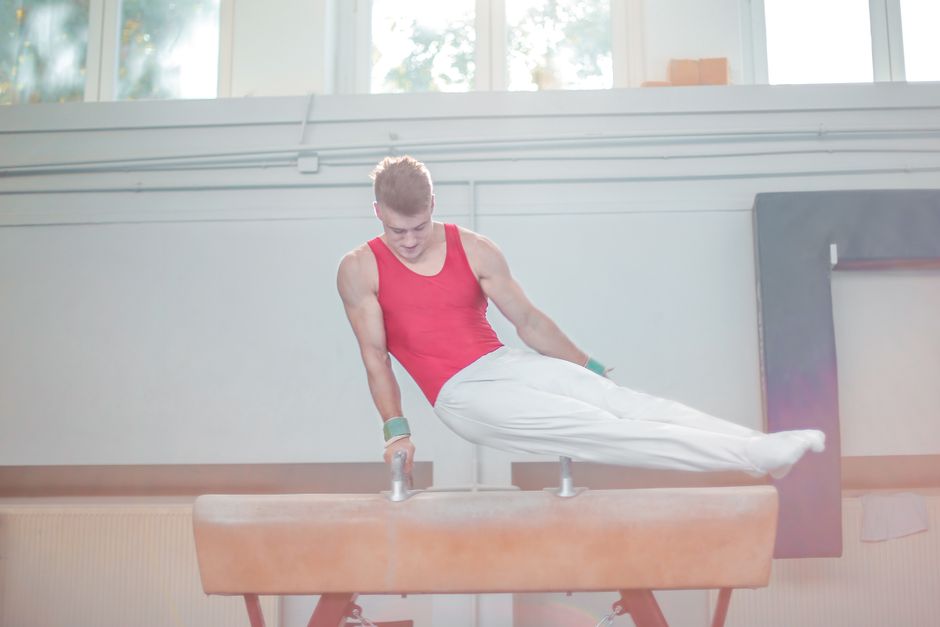
In competition order: floor exercise (up to 70 seconds), pommel horse, still rings, vault, parallel bars and horizontal bar (high bar). Men’s routines lean on upper-body strength, from ring holds to the swings and circles of pommel horse.
Rhythmic gymnastics
Senior and junior individual gymnasts usually perform four routines, with hoop, ball, clubs and ribbon; the rope can still be used in national and some international competitions. Individual routines last 1:15 to 1:30, and group routines, performed by five gymnasts, 2:15 to 2:30. Scores combine a Difficulty score with Artistry and Execution scores, each judged by its own panel.
Trampoline, double mini and tumbling
- Trampoline: each routine has ten elements. The score adds execution, difficulty, time of flight (how long the gymnast is in the air) and horizontal displacement (how well they stay in the center of the bed), minus penalties. Synchronized pairs are also scored on how together they are.
- Double mini-trampoline: a run, then two skills: one on the trampoline and a dismount to the mat.
- Tumbling: eight elements in a row down a sprung track.
Acrobatic gymnastics
Acro is a partner sport: women’s pairs, men’s pairs, mixed pairs, women’s groups of three and men’s groups of four. Units perform balance routines (held pyramids and static holds), dynamic routines (throws, flips and catches) and combined routines with both, set to music.
US youth levels: the 10.0 scale
Most young gymnasts in the US never see an open-ended score. In USA Gymnastics’ women’s Development Program, Levels 1–5 are compulsory (everyone performs the same set routines) and Levels 6–10 are optional (gymnasts build their own routines to meet requirements). The Xcel program, with divisions from Bronze to Sapphire, is optional at every division, with four special requirements worth 0.50 each on bars, beam and floor. Scores are out of 10.0, and an all-around score adds the four events, so a 34.00 all-around means an average of 8.5 per event.
Moving up depends on age and scores. For example, a gymnast must have reached her 7th birthday and score 34.00 all-around at Level 4 to move to Level 5, and must be at least 9 to compete Level 10. Men’s, rhythmic, trampoline and tumbling and acro programs have their own level systems. Our youth gymnastics guide explains the paths.
NCAA scoring: the perfect 10
NCAA women’s gymnastics kept the 10.0 scale, which is why college meets still produce perfect 10s. Routines start at 9.5, and gymnasts add 0.5 or more in bonus through difficulty and connections to reach a 10.0 start value. Six gymnasts compete on each of the four events and the top five scores count, so a perfect team score is 200. Regular-season meets usually use two judges per event, with four at championships, where the high and low are dropped.
NCAA men’s gymnastics doesn’t use the 200-point scale. Men’s college routines on the six events are scored with open-ended difficulty, much like elite gymnastics, so team totals are far higher: Stanford won the 2026 men’s title with 329.825.
Attire, grips and chalk rules
- Women wear a non-transparent leotard or unitard; jewelry is not allowed apart from small stud earrings.
- Men wear a singlet on every apparatus, long gymnastics pants and socks on pommel horse, rings, parallel bars and high bar, and shorts or long pants on floor and vault. Compression sleeves aren’t allowed in competition.
- Handguards (grips), bandages and wrist wraps are allowed if they’re securely fastened and in good repair. If a grip tears and causes a fall, a women’s gymnast can show it to the judge and ask to repeat the routine.
- Chalk (magnesium) may be used on the bars and for small markings on the beam; marking the floor or damaging apparatus is penalized.
Two staples for any gymnastics bag: a block of chalk such as Cannon Sports gym chalk (eight 2 oz blocks of magnesium carbonate) and, for optional-level gymnasts whose coach has fitted them, bar grips like the US Glove Elite uneven bar grips. Our gymnastics gear guide explains sizing.
Cannon Sports Gym Chalk Blocks
- 1 lb, eight 2 oz blocks
- Magnesium carbonate
- About $18
US Glove Elite Uneven Bar Grips
- Leather, hollow dowel
- Hook-and-loop strap
- Optional to elite levels
Tiger Paw Gymnastics Wrist Supports
- Sold in pairs
- Adjustable, sized by body weight
- Made in USA
Safety rules in the gym
The FIG codes require extra 10 cm soft landing mats on top of the basic landing mats for dismounts and vault, and gyms add their own: one gymnast on an apparatus at a time, no new skills without a coach, spotting and progressions for anything inverted. On trampolines, the American Academy of Pediatrics says competitive and structured training settings need supervision and safety rules, and it strongly discourages home trampoline use. If a gymnast hits their head, the CDC’s HEADS UP rule applies: out for the day and until a healthcare provider clears them. More on our gymnastics injuries page and training page.
Gymnastics rules questions
Why don’t Olympic gymnasts get perfect 10s anymore?
Since 2006, elite scores add an open-ended Difficulty score to an Execution score out of 10.00, so totals are often in the 13s to 15s. A perfect execution would be 10.00 on the E score alone.
How much is a fall in gymnastics?
One full point off the Execution score under the FIG codes, and connections that end in a fall don’t earn bonus. In NCAA and US youth levels, a fall is also a large deduction on the 10.0 scale.
How long is a beam or floor routine?
Up to 90 seconds for women’s beam and floor and up to 70 seconds for men’s floor under the FIG codes. Rhythmic individual routines last 1:15 to 1:30.
How does NCAA gymnastics scoring work?
Women’s routines start at 9.5 and earn bonus to reach a 10.0 start value. Six compete per event, the best five count, and a perfect team score is 200.
Are grips and wrist supports allowed in competition?
Yes. The FIG codes allow handguards, bandages and wrist wraps if they’re securely fastened and in good repair, and recommend skin-colored bandages. Check your level’s rules for anything else.