This article contains affiliate links: if you buy through them we may earn a commission, at no extra cost to you. Learn more.
Saturday morning, 8 a.m., and the gym already smells like chalk. The little ones are doing forward rolls down a wedge mat, the Level 8s are on their second set of rope climbs, and a college gymnast home for break is grinding through handstand holds against the wall. Every one of them is doing the same thing at a different scale: building the strength, flexibility and control that make skills look easy. This page covers gymnastics training for every level, from strength and flexibility to conditioning, safe skill progressions, and the rest and load limits that matter most for young athletes.
General information, not a personal program. Young gymnasts should train under a qualified coach, and anyone with pain should see a sports medicine doctor, PT or athletic trainer. Back to the gymnastics hub.
What gymnastics asks of the body
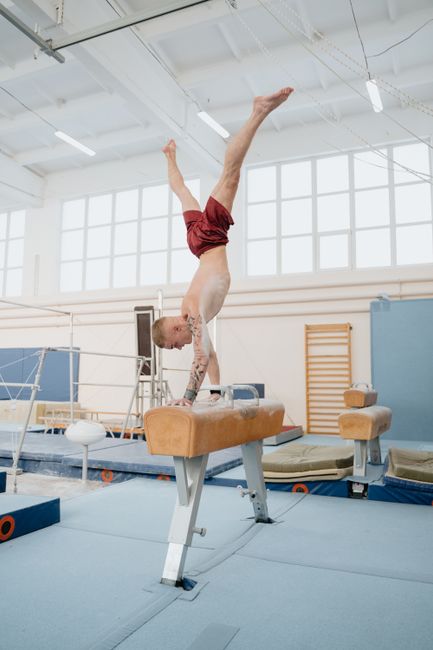
Gymnastics is short, explosive and precise. A routine is over quickly, but it demands power for take-offs, strength relative to body weight for holds and swings, flexibility for splits and bridges, and the body awareness to land on two feet after flipping and twisting. Women’s artistic gymnastics has four events (vault, uneven bars, balance beam and floor); men’s has six (floor, pommel horse, still rings, vault, parallel bars and high bar). Rhythmic gymnastics, trampoline and tumbling, and acrobatic gymnastics each add their own twist. A good training plan covers all of it without piling up so many repetitions that the wrists, back and heels pay the price.
Strength: the base under every skill
Gymnasts are among the strongest athletes pound for pound, and most of that strength comes from body-weight work: handstands, pull-ups, rope climbs, leg lifts, presses and hollow and arch holds. Some parents still worry that strength training is unsafe for kids. The National Strength and Conditioning Association’s position on youth resistance training, and a 2014 international consensus endorsed by sports-medicine and pediatric groups, say the opposite: resistance training can be safe and beneficial for children and teens when it is appropriately designed and supervised. For gymnasts, three areas deserve special attention:
- Trunk and hips. A 2026 review of low back pain in competitive gymnasts found core stability training over 8 to 12 weeks reduced pain. Hollow holds, side planks, back extensions with control and hip strength all count.
- Shoulders and wrists. The arms carry the body on vault, bars and tumbling. Scapular push-ups, band work for the rotator cuff, and gradual wrist strengthening help the upper body handle that load.
- Lower legs. Calf raises (including slow, single-leg ones) and landing drills prepare the Achilles and ankles for take-offs and landings, the site of many college injuries.
Flexibility: active beats forced
Gymnastics needs big ranges of motion in the hips, shoulders and spine. The healthiest flexibility is range you can control: active splits, leg holds and shoulder openers where your own muscles work at the end of the range. Forced stretching is a different story. USA Gymnastics’ Safe Sport Policy discourages adults lying or sitting on top of an athlete during stretching, and lists “painful stances or positions” as physical misconduct. Stretch after a warm-up, never into sharp pain, and remember that many young gymnasts with back pain are already very flexible in the spine: for them, strength around the trunk matters more than more bend.
Conditioning that fits the sport
Gymnastics conditioning is mostly short and intense: jump circuits, sprint-and-hurdle drills down the vault runway, timed rope climbs, and full routines or “routine plus” sets that build the stamina to land the last pass as well as the first. Long, slow runs are not essential, though a little aerobic work helps recovery between turns and during long practices. Keep plyometrics (jumps and bounds) progressive and on forgiving surfaces, and count landings the way a pitcher counts pitches: they add up. USA Gymnastics recommends a “10 percent rule” for conditioning: no more than about a 10% increase a week in training time or repetitions (20 push-ups this week, 22 next week, not 50). Its Safe Sport Policy also says conditioning used as punishment, against medical advice, or that causes fear and undue stress is physical misconduct, and any activity that causes vomiting, heat illness or acute pain must stop immediately.
Safe skill progressions
Every skill in gymnastics has a ladder: drills on a low surface, then with mats and spotting, then on the real apparatus. A back handspring might start on a barrel or wedge, move to a spotted handspring on a soft surface, then to the floor. Skipping rungs is how injuries happen. A few principles hold at every level:
- Master the prerequisites first: handstand, bridge, strong landings and tight body shapes before flips and twists.
- Use mats and spotting from a trained coach. USA Gymnastics requires professional members to complete safety and risk management certification, a fundamentals of instruction course, concussion education and U.S. Center for SafeSport training, plus background screening. It’s fair to ask your gym about its coaches’ credentials.
- Fewer, better repetitions. Fatigue at the end of practice is when form breaks down. New or scary skills belong early in the session.
- Fear is information. Mental blocks are common in gymnastics. Going back down the ladder for a while is normal, not failure.
At home, keep it simple and low: a folding mat for handstands, bridges and conditioning, and a floor-level beam for balance and dance elements. Flips and new skills belong in the gym with a coach. Popular home picks include the BalanceFrom 10 x 4 ft folding mat (2 inches thick, 4 panels), the Z Athletic folding low beam (2 inches off the ground, 4-inch top) and a THERABAND resistance band kit for shoulder and wrist prehab.
BalanceFrom 4-Panel Folding Gymnastics Mat
- 10 x 4 ft, 2 in thick
- Folds to 4 x 4 ft, 15 lb
- About $103
Z Athletic Folding Low Balance Beam
- 9 ft long, 2 in tall (listing)
- 4 in competition-width top
- Folds in half, 4 lb
THERABAND Beginner Kit
- Yellow, red, green flat bands
- Clinic-standard color system
- About $19
Compare more bands in our best resistance bands for athletes guide.
Rest and load for young gymnasts
Gymnastics is famous for early specialization and long hours; a review in the American Journal of Sports Medicine notes it has the highest participation hours of all youth sports. That’s exactly why load matters. In the research on adolescent gymnasts, wrist pain rose with weekly training hours, years in the sport and training intensity, and low back pain rose with training volume. The American Academy of Pediatrics recommends:
- At least 1–2 days off a week from the main sport.
- A total of 3 months off a year from the main sport, in 1-month blocks (other activities are fine).
- Extra caution around the growth spurt, when growth plates are most vulnerable and wrist pain peaks (ages 10–14 in the gymnastics studies).
One study of young athletes found those who trained more hours per week than their age in years had about twice the odds of a serious overuse injury, a handy check for families. Sleep is part of load, too: in elite female gymnasts, heavier training days were followed by shorter sleep, and shorter sleep and higher load were linked with worse performance rankings. Our gymnastics recovery page covers sleep in detail.
Honesty about prevention programs: a 2025 trial in rhythmic gymnasts found that adding targeted knee, back and hip exercises did not, on its own, reduce overuse injuries, and the authors pointed to load management and planning as the next step. Strength work helps gymnasts in many ways, but it can’t cancel out too many hours.
The mental side
Gymnasts rehearse routines in their heads constantly, and a 2026 systematic review of imagery in gymnasts found several studies with better judged performance from imagery-based methods, though the overall quality of the research was mixed. Simple habits help: visualize a skill before each turn, use a short cue word, and treat mistakes as information. Our meet day page has more on nerves.
Adults, college and the elite path
Adult gymnasts (yes, adult classes are a thing) can use the same ladder with more strength work and more patience, since tendons adapt slowly. College gymnasts train around a winter-spring competition season with athletic trainers on staff, and their injury data point to the ankle, Achilles and trunk. Elite gymnasts train under national-team programs with medical staff. At every level, a planned lighter period after the competitive season gives the body time to recover. Want to compare with a team sport? See soccer training.
Gymnastics training: FAQs
How many hours a week should a young gymnast train?
There’s no single right number, and it depends on level and age. Research links more weekly hours to more wrist and back pain, and one study found that training more hours per week than your age raised overuse injury odds. The AAP recommends 1–2 days off a week and 3 months off a year from the main sport.
Is strength training safe for young gymnasts?
Yes, when it’s well designed and supervised, according to the NSCA and a 2014 international consensus on youth resistance training. Most gymnastics strength work uses body weight, and good technique matters more than load.
How can my child practice gymnastics safely at home?
Stick to basics on a proper mat: handstands, bridges, cartwheels, conditioning and floor-beam balance. Leave flips and new skills for the gym, where there are coaches, spotting and deeper matting.
How do gymnasts get so flexible?
Years of regular stretching after warm-ups, plus active flexibility work where the muscles hold the end range. Painful, forced stretching is not part of good coaching; USA Gymnastics’ Safe Sport Policy treats painful stances or positions as misconduct.
What conditioning do gymnasts do?
Mostly short, intense work: body-weight strength circuits, rope climbs, jumps and sprints, plus routine-based sets that build stamina for full routines. Trunk, shoulder and calf strength get special attention because of the sport’s common injuries.