This article contains affiliate links: if you buy through them we may earn a commission, at no extra cost to you. Learn more.
Saturday morning, kids’ judo. A twelve-year-old gets swept off his feet with a big outer reap, tucks his chin, slaps the mat with his arm and pops back up grinning. That breakfall is the single most important thing he’ll learn this year. Martial arts are great for fitness and confidence at any age, but each art has its own injuries: falls in judo, knees and necks in Brazilian jiu-jitsu (BJJ), feet and head kicks in taekwondo. Here is what the research shows, what lowers the risk, and when to stop and get checked.
This page is general information, not medical advice. If you’re hurt, see a sports medicine doctor, physical therapist (PT) or certified athletic trainer (AT). For the bigger picture, start at our martial arts hub. Striking-heavy injuries (hands, cuts, knockouts) are covered on our MMA injuries and boxing injuries pages.
How often martial artists get hurt
The American Academy of Pediatrics (AAP) reviewed martial arts injuries in a 2016 clinical report. Its big-picture message: non-contact forms carry a relatively low risk; sparring and contact competition carry a higher one. Most injuries are bruises, sprains and strains, though fractures make up 10% or more in several studies, and concussions do happen. In one study cited by the AAP, athletes under 18 who trained more than 3 hours a week had a higher injury risk, and it doubled with every 2 extra hours.
Falls and breakfalls (ukemi)
The AAP notes that in judo you’re more likely to be hurt while being thrown, and that falling is a common way children break bones. The most serious falls are the ones where the back of the head hits the mat. A Japanese study of judo’s catastrophic injuries from 2003 to 2010 found 30 head injuries; 27 of them happened to players under 20, mostly while being thrown, and 94% were bleeding between the brain and skull (acute subdural hematoma). Fifteen of those players died.
Good breakfalls are the answer the research keeps coming back to. A 2022 systematic review of breakfall biomechanics found that a proper ukemi kept head impact measures below injury thresholds, unlike falls with direct contact to the back of the head,, and one study in it linked fatigue to worse breakfalls. In a club:
- Breakfalls before throws. Beginners and kids should drill rolling and side, back and front falls until they’re automatic, chin tucked to the chest.
- Throw with control. The thrower holds the partner’s sleeve so they land on their back and side, not their head.
- Watch the end of class. Tired bodies fall worse; hard throwing rounds belong early, not at the end of a long night.
- Any head knock gets checked. Headache, vomiting or confusion after a fall needs a doctor, the same day.
Judo: shoulders, collarbones and elbows
The AAP notes shoulder, hand and finger injuries are common in judo. France’s judo federation tracked 421,670 competition fights over 21 seasons: injuries happened in 1.1% of judoka, and the most common were sprains (54.3%), fractures (15.6%) and dislocations (12.5%). Women had more knee sprains and elbow dislocations; men had more shoulder dislocations. Young adults (18–20) had more AC joint sprains, and children aged 10–14 had more collarbone fractures than adults.
Two mechanisms to know. A shoulder separation (AC joint) usually comes from falling directly onto the point of the shoulder, says the American Academy of Orthopaedic Surgeons (AAOS). An elbow dislocation usually comes from falling on an outstretched hand. That’s why coaches yell “don’t post your arm”. Joint locks also hold the joint in full extension, where it absorbs force poorly (AAP): tap early, and let go the moment your partner taps.
BJJ: knees, shoulders, elbows and necks
In a 2025 survey of 881 BJJ practitioners worldwide, the injury rate was 5.5 per 1,000 training hours and 55.9 per 1,000 competition matches. The knees (25%) and shoulders (13%) were hurt most. Most injuries (89%) happened in training, and most of those (79%) during live sparring (“rolling”). At Hawaii tournaments, the elbow was hurt most, usually by armbars.
Heel hooks deserve special respect. A 2026 study of International Brazilian Jiu-Jitsu Federation (IBJJF) competitors found 26.5 knee injuries per 1,000 matches in competitors exposed to the heel hook, against 2.2 in those who weren’t. That’s why the IBJJF reserves heel hooks and knee reaping for adult brown and black belts in no-gi, and bans moves such as slams, spinal locks without a choke and bending fingers backwards. Learn leg locks slowly with a coach, and tap to the position, not the pain.
Necks. Chokes, cranks, stacking and bad landings all load the neck. In IJF cadet judo, a cadet who loses consciousness in a choke cannot continue. AAOS describes “burners” or “stingers”: a burning or electric-shock feeling down one arm after a hit to the neck or shoulder. See a doctor if it lasts, keeps coming back or affects both arms. Numbness or weakness in both arms or legs, or severe neck pain, is an emergency: don’t move the athlete, call 911.
US emergency-department visits for pediatric BJJ injuries rose steadily from 2012 to 2021, mostly sprains, strains and fractures. Our BJJ recovery guide covers what to do after hard rolls.
Taekwondo and karate: feet, knees and head kicks
Taekwondo is about 80% kicking, says the AAP, so lower-body injuries, especially to the foot, dominate. At the 2017 World Taekwondo Championships (971 athletes), there were 13.5 injuries per 100 athletes. Almost half were in the legs (46.6%), the knee most often; face injuries made up 24.4%, and fingers 6.1%. If a kick lands on an elbow and you can’t walk normally afterwards, get the foot checked.
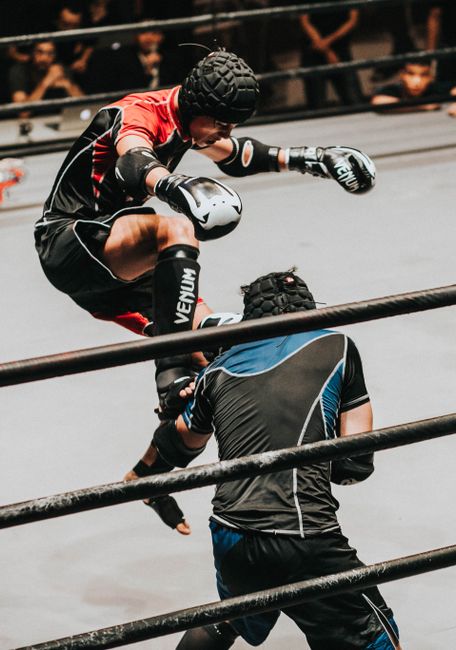
Head kicks and concussion. Under USA Taekwondo’s 2026 rules (which follow World Taekwondo), a kick to the head scores 3 points and a turning kick to the head 6. The AAP reports concussion rates in adult taekwondo of 4.6 to 50.2 per 1,000 athlete-exposures, potentially up to four times higher than in American football. Video studies of World Championships concussions (3.21 per 1,000 games, 2017–2019) found most came from a roundhouse kick to the face, often when the athlete didn’t block. The AAP urges teaching blocking and supports removing head blows for children; USA Taekwondo bars head contact for groups covered by its modified safety rules.
Karate. Much US karate is non-contact, and the AAP cites a youth injury risk of 5.6 per 100 athletes over a year. Under World Karate Federation (WKF) rules, techniques to the head may only make light “skin touch” contact, and under-14s must wear a helmet and body protector. At four World Karate Championships, 1.4% of athletes had a time-loss injury, most often fractures, dislocations and concussions.
Concussion: recognize it and remove the athlete
Head kicks, throws, slams and takedowns can all cause a concussion. The CDC’s HEADS UP program is clear: if you think someone may have a concussion, take them off the mat for the rest of the day, and they don’t return until a health care provider clears them. Signs include looking dazed, headache, dizziness, nausea, blurry vision and feeling foggy. Call 911 for the danger signs: one pupil larger than the other, a headache that gets worse, slurred speech, weakness or numbness, repeated vomiting, seizures, growing confusion or loss of consciousness. In judo, the International Judo Federation (IJF) bars athletes with a suspected concussion from competing for 7 days and requires a doctor’s clearance.
One honest note on gear: the AAP found no evidence that headgear or mouthguards prevent concussions in martial arts, and warns that headgear may give a false sense of security. Mouthguards do protect teeth, and many rules require them. Wear the gear, and still spar like you aren’t.
Skin infections on the mats
Ringworm, impetigo, staph including MRSA, and herpes spread fast in grappling rooms; ringworm outbreaks are well documented in wrestlers and judoka. In a survey of US BJJ athletes, skin infections were the most common condition diagnosed by a doctor. The National Athletic Trainers’ Association (NATA) recommends showering after every practice, never sharing towels, bar soap or gear, and laundering training clothes every day. Mats need cleaning before every session, and IBJJF gi inspectors check skin before matches. A new rash, a ring-shaped patch or a cluster of blisters means no live training until a doctor has looked at it. More detail is on our wrestling injuries page.
Fingers: the grappler’s daily injury
Gi grips are hard on fingers. In a survey of US BJJ athletes, the hand and fingers were the most common injury location, and in another, 78.6% of athletes reported finger or hand injuries. AAOS describes “jersey finger”: a finger (usually the ring finger) gets caught in a jersey and yanked, pulling the tendon off the bone, so the fingertip won’t bend. That one needs a doctor soon; it doesn’t heal on its own. A finger that looks crooked, can’t move fully or swells badly may be broken. Rules help: the IBJJF bans bending fingers backwards, and judo, BJJ and karate all require short nails. Let go when a partner rips free, and ask your athletic trainer about buddy-taping a sore finger.
Gear many martial artists keep in the bag
No gear prevents injuries by itself. A mouthguard is required in taekwondo and karate competition and protects teeth in any sparring; many athletes use the Shock Doctor Gel Max. Grapplers who can’t shower right away often carry Defense Soap body wipes until they can. And for knees that live on the mat, a soft pad like the Cliff Keen Impact knee pad is a common pick (IJF rules allow soft pads with no rigid parts under the judogi).
Shock Doctor Gel Max Mouthguard
- Boil-and-bite gel-fit liner
- Youth and adult sizes
- About $12
Defense Soap Body Wipes (2 x 40)
- Tea tree and eucalyptus oils
- No-rinse, extra-wet cloths
- 80 wipes
Cliff Keen Impact Bubble Knee Pad
- Compression-molded bubble pad
- Full range of motion
- Machine washable
When to see a sports medicine doctor, PT or athletic trainer
- Right away (emergency): any concussion danger sign, any loss of consciousness, numbness or weakness in both arms or legs, a joint that looks out of place, or a possible broken bone.
- Within a day or two: a suspected concussion, a pop and swelling in the knee, an elbow or shoulder that “went out”, a fingertip that won’t bend, or a foot you can’t walk on normally.
- Soon: a new rash or skin sore (before you train again), pain that keeps coming back, stingers that repeat, or a child who limps or protects an arm after class.
Return is a process: pain-free movement, then drilling, then light sparring, then full rounds, signed off by whoever is treating you. Build back the strength you lost on our martial arts training page, and look after the basics on martial arts recovery.
Martial arts injuries: FAQs
Which martial art has the most injuries?
It depends far more on how much you spar and compete than on the art’s name. The AAP says non-contact training has a relatively low risk and sparring and competition a higher one. One study cited by the AAP found three times the injury risk in taekwondo as in karate, and taekwondo carries the biggest concussion concern because head kicks score.
What is the most common BJJ injury?
Knees, shoulders, elbows and fingers come up again and again. In a 2025 survey of 881 practitioners, knees (25%) and shoulders (13%) were hurt most, and most injuries happened during live rolling in training. Finger and hand injuries are the most common in several US surveys.
Does headgear prevent concussions in taekwondo or karate?
There’s no evidence it does, according to the AAP. It may help with cuts and bruises, but the best protection is good blocking, controlled sparring and removing anyone with symptoms.
How do I avoid getting hurt by heel hooks?
Learn them from a coach first, spar them only with experienced partners, and tap as soon as you’re caught: the knee can tear before you feel pain.