This article contains affiliate links: if you buy through them we may earn a commission, at no extra cost to you. Learn more.
7:45 a.m., a ski hill in late spring. Your wave is lined up in the start corral, steam rising off a few hundred people in tight shirts and trail shoes, an announcer working the crowd before he sends you off. Somewhere up that slope is a sandbag carry, and somewhere below it a pond you’ll be swimming through. Whether it’s your first Spartan Sprint or Tough Mudder with friends, a Beast in summer heat, an elite heat with prize money, or a kids’ race your eight-year-old won’t stop talking about, race day goes better when the small things are decided in advance: what you eat, what you drink, how you handle the mud and the cold water, and how you warm up afterwards. Here’s the plan.
General information, not medical advice. If you have a heart condition, diabetes or another health issue, ask your doctor how to handle a long, hard race. The whole sport is on our obstacle course racing hub.
Race morning: eat, drink, arrive early
- Breakfast 1–4 hours before your wave. The joint position of the American College of Sports Medicine (ACSM), the Academy of Nutrition and Dietetics and Dietitians of Canada suggests a carb-based meal in that window, familiar and fairly low in fat and fiber: oatmeal and a banana, a bagel with peanut butter, toast and eggs.
- Drink early, not just at the start line. The same statement suggests about 5–10 mL per kg of body weight in the 2–4 hours before (roughly 350–700 mL, or 12–24 oz, for a 70 kg / 154 lb racer), so your urine is pale by the time you line up.
- Arrive with time to spare. Parking shuttles, check-in, bag drop and porta-potty lines at big events take longer than you think. Spartan asks Beast racers to be ready for five or more hours on their feet, so don’t burn energy stressing in traffic.
- Warm up with 5–10 minutes of easy jogging, leg swings, a few squats and arm circles. Hanging obstacles come early on some courses.
What to wear
Close-fitting synthetic or wool layers that drain and don’t hold water; cotton soaks up mud and stays cold and heavy. Trail shoes with deep lugs, laced snugly and double-knotted (or with lace locks) so the mud doesn’t steal them. Thin synthetic or wool socks. Anti-chafe balm on the inner thighs, underarms, feet and anywhere straps rub. In a cool-weather race, a thin long-sleeve top you don’t mind ruining. Leave jewelry, rings and loose earbuds at home; rings and rigs don’t mix. Cover any small cuts with a waterproof bandage before the start, as the CDC advises for contact with soil and water.
Fueling during the race
How much you need depends on how long you’ll be out there, not the race name. The ACSM-led position statement gives these guides for carbohydrate during endurance exercise:
| Your time on course | Carbs during | Typical OCR example |
|---|---|---|
| Under 45 minutes | Not needed | Fast 5K racer |
| 45–75 minutes | Small amounts, even a sports drink mouth rinse | Most Sprint finishers |
| 1–2.5 hours | 30–60 g per hour | Super, slower Sprint |
| Over 2.5–3 hours | Up to 90 g per hour (mixed carb sources) | Beast, Ultra |
One gel is usually 20–25 g of carbs; a bottle of sports drink adds more. In OCR, eating has one extra rule: don’t eat with muddy hands. Outbreaks after mud races have been linked to swallowing mud and muddy water, and a review of obstacle events specifically advises avoiding food and drink contaminated with mud. Keep gels in a closed pocket, tear them with your teeth at the top, and rinse your hands at a water station if you can. Practice your race fuel in training; race day is no time to find out a gel doesn’t sit well.
Hydration
The National Athletic Trainers’ Association (NATA) suggests trying not to lose more than about 2% of your body weight in sweat, and never drinking so much that you gain weight, which raises the risk of low blood sodium (hyponatremia). If you don’t know your sweat rate, drink to thirst. Salty sweaters (white streaks on dark clothes) and anyone racing more than a couple of hours in the heat should use a sports drink or electrolyte mix with sodium, not just water. For a Sprint, the course water stations are usually enough. For a Beast or Ultra, many racers carry a small hydration vest so they can drink between stations. Find out before race day whether your event allows vests and where the water points are.
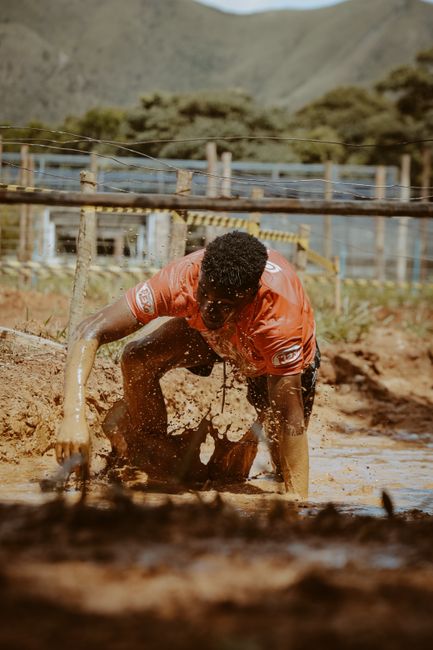
Mud and water obstacles
- Keep your mouth shut. In a CDC investigation of a 2012 Nevada race, 89% of racers who got sick with Campylobacter had swallowed muddy water, against 30% of those who stayed healthy. Spit, don’t swallow.
- Protect your eyes. Wipe mud away from your eyes with a clean-ish forearm, not muddy fingers, and rinse at a water station if they sting.
- Walk into water you can’t see the bottom of. Don’t dive or jump into murky pits unless the course marshals direct it.
- Ask for help if you’re not a confident swimmer. Raise your arm and shout; water obstacles have staff and safety lines for a reason.
Cold water and ice obstacles
The National Weather Service treats any water at 70°F or colder as cold water, and spring and fall races often have ponds well below that. Some races add ice: Tough Mudder’s Arctic Enema is an ice pit the race describes as 34 degrees. The first reaction is cold shock: an involuntary gasp and fast breathing that peaks within roughly the first 30 seconds and settles over a few minutes. So go in feet first, keep your face up, breathe out slowly, and move through without stopping. The NWS also warns that within about 10 minutes in cold water you can lose muscle control in your hands, which is exactly what you need for the next obstacle. If you have a heart condition, ask your doctor before doing ice obstacles; they’re a big, sudden stress on the heart.
Staying warm (during and after)
Wet, muddy and windy is a fast way to get cold, even on a mild day, and slower racers spend the longest out there. The CDC lists shivering, exhaustion, confusion, fumbling hands, memory loss, slurred speech and drowsiness as signs of hypothermia. On course: keep moving, eat and drink on schedule (a body without fuel can’t make heat), and team up with friends at long cold sections. If someone in your group is confused or can’t stop shivering, get them to the medical team.
At the finish, warm up before anything else. Rinse off, get out of wet clothes as soon as you can (a changing poncho or big towel helps in an open field), put on dry warm layers and a hat, and have a warm, non-alcoholic drink and some food. The CDC advises warming the center of the body first. Pack your bag the night before with a full dry outfit, sandals or old shoes, a towel, a trash bag for muddy kit, and wipes or soap for your hands. Proper showering and wound care are on our OCR recovery page.
Hot races
Summer races on exposed ski slopes can be brutal. NATA recommends 7–14 days of gradually getting used to training in the heat before a hot event. During the race, slow down on climbs, use water obstacles to cool off (keep your mouth closed), drink to a plan and take sodium. Heavy sweating, dizziness, headache, nausea and weakness are reasons to slow down, find shade and drink. Confusion, odd behavior or collapse in the heat is an emergency: get the medical team immediately; the rule for heat stroke is to cool the person first, then transport.
Pacing and obstacles
- Start slower than you want. Narrow trails bottleneck early; there’s no point sprinting to a queue.
- Shake out your hands and wipe them on your shorts (or grab a handful of dry dirt where allowed) before hanging obstacles.
- Know the penalty rules. At Spartan races a failed obstacle means 30 burpees; take them steadily rather than risking a bad fall. Elite and age-group heats can have different obstacle rules from open waves; check your event.
- Skip what you need to. Electrified obstacles are optional at Tough Mudder; skip them if you have any heart condition, pacemaker, seizure history or are pregnant. More in OCR injuries.
Race-day kit many racers swear by
An anti-chafe stick like Body Glide Original for feet, thighs and underarms; an electrolyte mix like Skratch Labs Hydration in your bottle (about 400 mg sodium per serving, the maker says); gels like Maurten Gel 100 (25 g carbs each) for long races; and for a Beast or Ultra, a light vest such as the Salomon ADV Skin 5. Our guides to electrolyte powders, energy gels and running hydration vests compare more options.
Body Glide Original Anti-Chafe Balm
- 1.5 oz stick
- Feet, thighs, underarms
- About $11
Skratch Labs Hydration Sport Drink Mix
- About 400 mg sodium per serving
- 20 servings
- About $24
Salomon ADV Skin 5 Set
- 5 L trail running vest
- Soft flasks up front
- Close, bounce-free fit
Want to see your splits on each obstacle afterwards? Several Garmin watches have an Obstacle Racing mode; see best wearables for OCR. For how another sport handles game day, see soccer game day.
OCR race day questions
What should I eat before an obstacle course race?
A familiar, carb-based breakfast 1–4 hours before your start, fairly low in fat and fiber, such as oatmeal with a banana or a bagel with peanut butter, plus some fluid in the hours before.
Do I need gels during a Spartan Sprint?
Usually not if you finish in under about 75 minutes; a good breakfast and sips at water stations are enough. If you’ll be out longer, 30–60 g of carbs an hour follows the ACSM guidance.
What should I wear to a mud run?
Tight-fitting synthetic layers (no cotton), trail shoes with deep lugs laced tight, thin synthetic or wool socks and anti-chafe balm. Bring a full dry change of clothes, a towel and a bag for your muddy kit.
How do I stay warm after a cold mud race?
Rinse off, get out of wet clothes quickly, put on dry layers and a hat, and have warm food and a warm non-alcoholic drink. Shivering that won’t stop or confusion are signs of hypothermia and need the medical team.
Is it safe to do the ice bath obstacle?
For most healthy people, yes, if you go in feet first, keep your head up and breathe slowly through the cold-shock gasp. If you have a heart condition, ask your doctor first; you can always skip it.