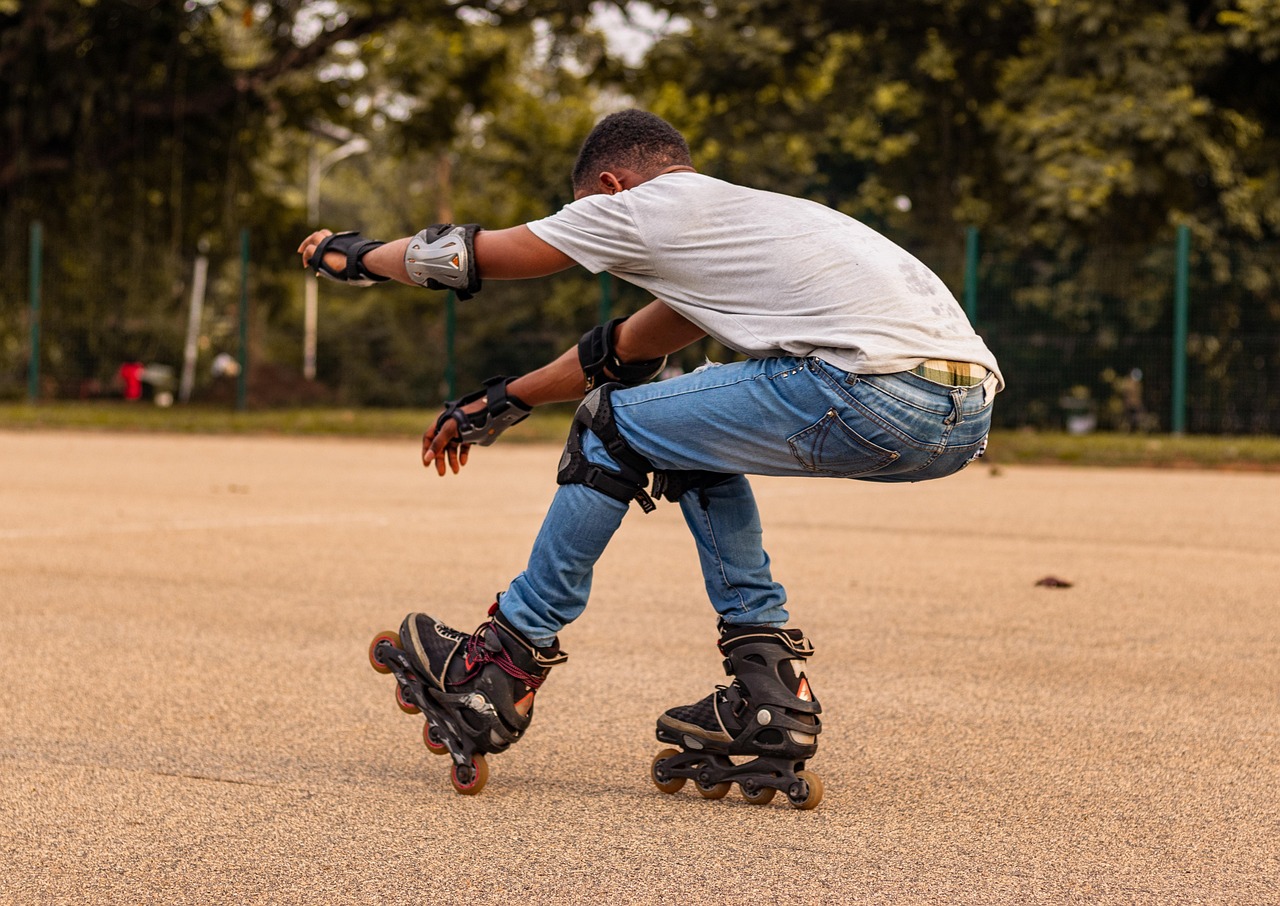
This article contains affiliate links: if you buy through them we may earn a commission, at no extra cost to you. Learn more.
The lights dim, the DJ calls a reverse skate, and the whole rink turns around and rolls clockwise for a song. A beginner clings to the wall on the inside lane while faster skaters swing wide around the outside. Nobody handed out a rulebook, but everyone seems to know it. Roller skating rules come in two kinds: the everyday ones that keep a crowded rink or a busy bike path safe, and the competition rules that decide a figure-skating program or a sprint finish on a banked track. This page covers both, in plain words.
For the bigger picture, start at our roller skating hub. If you’re after jams, jammers and penalties, roller derby has its own roller derby rules page.
Rink etiquette
Rinks post their own rules, but they look a lot alike. From a typical rink’s safety rules:
- Skate counterclockwise, the regular direction, unless the DJ or floor guard calls a reverse skate.
- Faster skaters on the outside, slower skaters and beginners on the inside.
- Never skate faster than you can control. Running into people is the sign to slow down.
- Don’t cut across traffic; move toward the center gradually, on a diagonal.
- No food or drinks on the floor (a spill can drop a skater) and no horseplay or carrying people.
- If you fall, get up quickly and move to the inside or the wall. Ask a floor guard for help.
- Listen to the floor guards and the DJ. They call the special sessions and help skaters who fall.
Practicing spins, jumps or jam moves? Do them only where and when your rink allows it, away from the main traffic lane. Jam skating grew up at skate nights and skate parties, and its styles keep changing, so the best way to learn a rink’s customs is to watch the regulars for a few songs first.
Trail and street safety rules
Outdoors, you share the path with walkers, runners, cyclists and dogs. The American Academy of Pediatrics (AAP) sets out the basics for skaters:
- Learn to turn, control your speed and stop before you head out.
- Skate on the right side of sidewalks, bike paths and trails, and pass on the left. A quick “on your left” helps.
- Avoid streets in crowded areas and obey traffic rules.
- Never hold on to a moving car or bike, and keep it to one person per set of skates.
- Watch the surface: water, sand, gravel and cracks stop wheels fast.
The American Academy of Orthopaedic Surgeons (AAOS) adds a few of its own: put your protective gear on before your skates, avoid wet or icy surfaces, potholes, glass and crowded walkways, warm up first, and drink plenty of fluids in hot, humid weather. Local laws on skating in streets and on sidewalks vary, so check your city’s rules. Take water on longer trail skates, like the Nalgene 32 oz bottle.
Pro-Tec Classic Certified Helmet
- CPSC bike, ASTM F1447 and F1492 (maker)
- XS 52-54 to XL 60-62 cm
- About $63
Triple Eight Saver Series 3-Pack
- Knee, elbow pads and wrist guards
- Junior to Large
- About $50
Competition rules: who writes them
In the US, USA Roller Sports (USARS) writes the rules for sanctioned artistic and speed competitions, and skaters at any USARS-sanctioned event need a current USARS membership card. Internationally, World Skate writes the rulebooks for world championships and the World Skate Games. The USARS season runs roughly from December to the following July, from local inter-club meets and invitationals up to regional championships and nationals. More on both bodies on our associations and competitions page.
Artistic roller skating rules
Artistic skating is judged, like ice figure skating. USARS describes these events:
- Figures: each skater retraces set patterns of take-offs, edges and turns on circles painted on the floor. Accuracy and control are everything.
- Singles (free skating): a program to music with jumps, spins and footwork.
- Pairs: two skaters doing side-by-side spins, jumps and footwork plus overhead lifts.
- Solo dance: prescribed patterns and rhythms, judged on timing, posture, accuracy of the steps and musical expression. It’s the only individual event where men and women compete against each other.
- Team dance: couples skate an original dance with four required elements, plus a free dance.
- Precision team: 8 to 24 skaters moving as one unit, with required elements: a circle, a line, a wheel, intersecting lines, a block, and three different handholds.
- Show team: like precision but built around a theme, with up to four precision elements and optional props.
How it’s scored. USARS judges look at two things: technical merit (how hard the content is and how cleanly it’s done) and manner of performance (how well it’s skated to the music). At World Skate events, the RollArt judging system is used for free skating, solo and couple dance, pairs, inline and precision, while figures and show are judged under a separate system. Each competition publishes its own rulebook with the required elements and program lengths for every age and level, so skaters and coaches read the current edition before each season.
Speed skating rules on wheels
Roller speed skating is raced on quads and inlines, on tracks and on roads. These are the basics from World Skate’s 2025 Speed Rulebook:
- Courses: a standard track is 175 to 200 meters, measured on the inside edge, with banked curves. Road circuits are closed loops, and some road races run point to point.
- Official distances: 100, 200, 300, 500, 1,000, 3,000, 5,000, 10,000, 15,000 and 20,000 meters on track and road. The marathon (42.195 km) is raced only on the road.
- Short-distance races: time trials (a 200 m dual time trial, a 300 m time trial, a team time trial) and sprints (100 m, 500 m, one lap, 1,000 m).
- Points races: sprints for points at set laps, with a bigger score on the last lap. Most points wins. No point sprints in the first 1,000 meters (except in the 5,000 m points race).
- Elimination races: the last one or two skaters across the line at set points are eliminated, with no eliminations in the first 1,000 meters. A bell rings one lap before each elimination sprint.
World championship program. The speed world championships are held every year for juniors and seniors, men and women. On the track: a 200 m dual time trial, the 500 m and 1,000 m sprints, a 5,000 m points race, a 10,000 m elimination race and a 3,000 m relay. On the road: a 100 m sprint, a one-lap sprint, a 10,000 m points race and a 15,000 m elimination race, plus the marathon.
Equipment rules. Skates may have up to five wheels in a line, or two pairs side by side, and can’t be longer than 50 centimeters. Brakes are forbidden. Wheels can be up to 110 mm across (125 mm in the marathon); skaters up to age 12 are limited to 90 mm and those up to age 14 to 100 mm. The helmet must be hard gear with international certification, fastened on the head the whole time a skater is on the course; a skater who takes it off or unfastens it is disqualified.
Age categories. World Skate’s speed rules recognize juniors (ages 15 to 18), seniors (19 and up) and masters (30 to 39, 40 to 49, 50 to 59, and 60 and over), with age counted as of December 31 of the competition year. The minimum age for a world championship is 15. In the US, USARS speed events range from 100 m to 3,000 m for individuals, plus two-person and four-person relays, with age divisions from young children up. Ice racers can compare our speed skating rules.
Big three-wheel inlines like the Rollerblade Macroblade 110 3WD (110 mm/85A wheels, about $210) are a common step toward road racing and long-distance skating. Outside a race, learn a reliable stop before you go fast on them.
Rollerblade Macroblade 110 3WD
- 3 x 110 mm/85A wheels
- 290 mm aluminum frame
- About $210
Triple Eight Dual Certified Helmet
- CPSC bike + ASTM F1492
- EPS liner, adjustable fit
- About $46
After a fall or a crash
Whatever the setting, the same health rule applies. If you or a skater near you hits their head and seems dazed, confused or slow, or has a headache, dizziness or blurry vision, stop skating for the day and see a healthcare provider, as the CDC’s HEADS UP program advises. A wrist that’s swollen or painful after a fall needs a check too. More on our roller skating injuries page, the gear page and our competition day page. Skateboarders can compare our skatepark rules and etiquette.
Roller skating rules FAQs
Which way do you skate at a roller rink?
Counterclockwise, with faster skaters on the outside and slower ones on the inside, unless the rink calls a reverse skate.
Can you roller skate on the street?
Local laws vary. The AAP’s advice is to avoid streets in crowded areas, obey traffic rules, skate on the right side of paths and never hold on to a moving car or bike.
How is artistic roller skating judged?
USARS judges score technical merit (difficulty and execution) and manner of performance (artistry and use of the music). World Skate uses the RollArt system for most artistic events.
How long is a roller speed skating track?
Under World Skate rules, a standard track is 175 to 200 meters with banked curves. Road circuits are longer loops, and the marathon is raced only on the road.
Do speed skates have brakes?
Not in racing: World Skate’s rules forbid brakes on race skates. Fitness and trail inlines usually come with a heel brake, which is worth keeping outside a race.
Is a helmet required in roller speed skating?
Yes. World Skate requires a certified hard helmet, fastened for the whole time a skater is on the course; removing or unfastening it means disqualification.