This article contains affiliate links: if you buy through them we may earn a commission, at no extra cost to you. Learn more.
The final heat of a street contest. Two runs are done, the scoreboard is tight, and a skater stands at the top of a handrail with one trick attempt left. Miss it and she drops off the podium; land it clean and it’s over. Meanwhile, at a neighborhood park across town, a dozen skaters share one bowl without a single judge, just an unwritten rule that everybody gets a turn. Skateboarding rules come in two kinds: the contest rules that decide medals, and the etiquette and safety rules that keep a session fun. This page covers both.
For the big picture, start at our skateboarding hub.
Who writes the rules
World Skate, the international federation, writes the competition rules and judging criteria for its street and park events, including the Olympic qualifiers and the Olympic Games. Pro series such as Street League Skateboarding (SLS) and the X Games run their own formats. Local contests usually borrow from these. Outside contests, the “rules” are the skatepark’s posted rules, local laws and the etiquette skaters have passed down for decades.
How skateboarding contests are judged
Under World Skate rules, five judges score every run or trick from 0.00 to 100.00. The highest and lowest scores are dropped and the remaining three are averaged. Judges rank each performance against the others in the same round, not against a skater’s reputation. World Skate’s criteria for a run are:
- Difficulty: how hard the tricks are, including the obstacle they’re done on. The most important criterion.
- Variety: a wider range of hard tricks scores better.
- Execution and landing: style, speed, distance, energy and height, from takeoff to a clean landing.
- Use of the course: creative, difficult lines that use the key obstacles while keeping speed.
- Consistency: landing tricks without falling for the whole run.
- Flow: linking tricks smoothly; stepping off the board between tricks in street can count against it.
- Repetition of the same trick or obstacle in a run is penalized.
Single trick attempts are judged on difficulty, execution and obstacle selection. World Skate’s scale gives a feel for the numbers: above 90 means a “master” level of the criteria, 80–90 expert, 70–80 advanced, 50–70 standard. A bail (a missed trick) scores zero.
Street competition format
Street contests usually have a qualifier, a semifinal and a final, on a course of stairs, rails, ledges, banks and gaps. World Skate allows several formats:
- Run format: two or three runs of 45–60 seconds; the best run counts. Often used in qualifiers.
- 2/5/3 (runs + tricks): two 45-second runs, then five single trick attempts. The best run plus the two best tricks are added, for a maximum of 300. This was the Paris 2024 Olympic format.
- 2/3/2 and 3/3/2: two or three runs, then three trick attempts; the best run plus the best trick count.
Ties go to the skater with the higher best run, then the higher best trick. Skaters have five seconds to start after the signal, and the street clock doesn’t stop once a run begins. A “scoring refusal” lets a skater have a landed trick thrown out so they can try it again cleaner later without a repetition penalty.
Park competition format
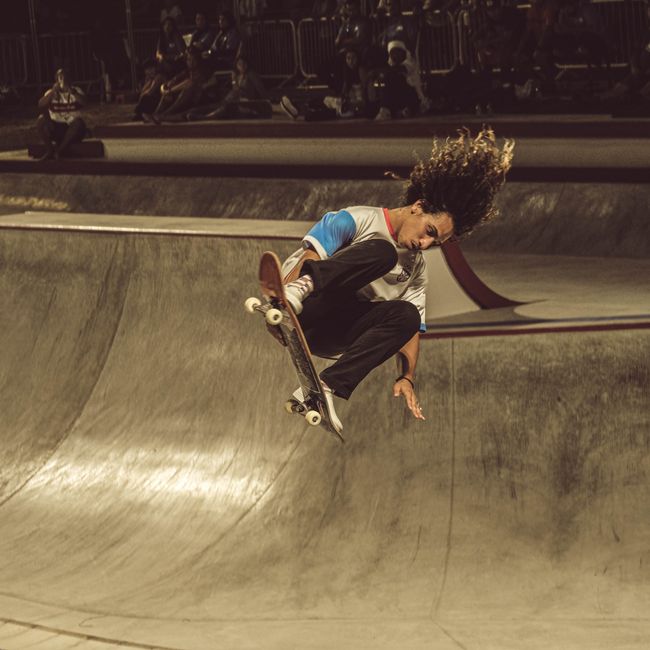
Park is always runs. Skaters get two to four runs of 30 to 50 seconds through the bowls, depending on the field and the course, and only the best run counts. Some events run “until the fall,” stopping the clock when a skater falls. Two optional rules show up in bigger events: the First Wall Rebate lets a skater who bails on the very first trick restart the run right away, and the Golden Run gives the top five after the regular runs one extra run, in reverse order, for a last shot at the podium.
Vert, SLS and X Games formats
Vert is skated on a big halfpipe with vertical walls, back and forth, with airs and lip tricks. It isn’t an Olympic event, but the X Games still run vert contests and vert best-trick contests. SLS runs its own street format: knockout rounds on day one, then a final and a best-trick jam, at stops around the world ending with the Super Crown. Our leagues and associations page covers each series.
Safety rules in competition
- Helmets: World Skate requires a helmet in practice and competition for every park skater and for street skaters under 18. It needs a one-piece hard shell, impact-absorbing padding and a buckled chin strap; World Skate suggests standards such as CPSC 16 CFR 1203 and ASTM F1447.
- Minimum age for World Skate events: 12 in 2026, 13 in 2027 and 14 from 2028 on. For the LA 2028 Olympics, skaters must be born on or before December 31, 2014.
- Concussion: a skater with a suspected concussion must stop and can’t return for 14 days, and needs medical clearance first, whatever they or their coach say.
- Awareness: skaters must watch their surroundings to avoid collisions; headphones aren’t recommended and can be banned.
- Practice: in park practice, skaters go one at a time; sneaking in or blocking someone’s drop-in breaks the rules and can cost practice time or a disqualification.
A dual-certified helmet covers contests and everyday skating. The Triple Eight Dual Certified helmet is certified to the CPSC bike standard and ASTM F1492 for skateboarding, with two sets of fit pads for fit (about $55 to $80 on Amazon in October 2026, depending on size and color). Pair it with the Triple Eight Saver Series 3-Pack of knee pads, elbow pads and wrist guards (about $50), and bring a Nalgene 32 oz bottle for long sessions.
Triple Eight Dual Certified Helmet
- CPSC bike + ASTM F1492
- EPS liner, adjustable fit
- About $46
Triple Eight Saver Series 3-Pack
- Knee, elbow pads and wrist guards
- Junior to Large
- About $50
Nalgene Sustain 32 oz Wide Mouth
- 32 oz, wide mouth
- BPA-free Tritan
- 50% recycled-waste material
Skatepark rules
Read the sign at the gate: hours, whether bikes and scooters share the park, and what gear is required. Some states write gear into law. In California, for example, the Health and Safety Code says a skatepark operator shall not let anyone ride unless they wear a helmet, elbow pads and knee pads, and unsupervised public parks must post a notice saying so. Even where it isn’t the rule, the American Academy of Pediatrics (AAP) and the American Academy of Orthopaedic Surgeons (AAOS) recommend a helmet, wrist guards and knee and elbow pads.
Skatepark etiquette
These are the unwritten rules that most skaters learn at their first busy session. They’re about fairness and avoiding collisions, which cause many skatepark injuries.
- Take turns. Watch the flow of the park and wait your turn. In a bowl or on a ramp, one skater at a time.
- Don’t snake. Dropping in or cutting into a line when it’s someone else’s turn is the cardinal sin; it’s even a rule violation in World Skate practice sessions.
- Keep landings and run-outs clear. Don’t sit, stand or leave your board on obstacles or where people land.
- Look before you go, and keep an eye on little kids and beginners, who don’t always read the flow yet.
- Control your board. Yell “board!” if it shoots away toward someone.
- Respect the park: pick up trash, no glass, and skate within your level. Beginners can learn in quieter corners or at quieter times.
Rules for skating on streets and sidewalks
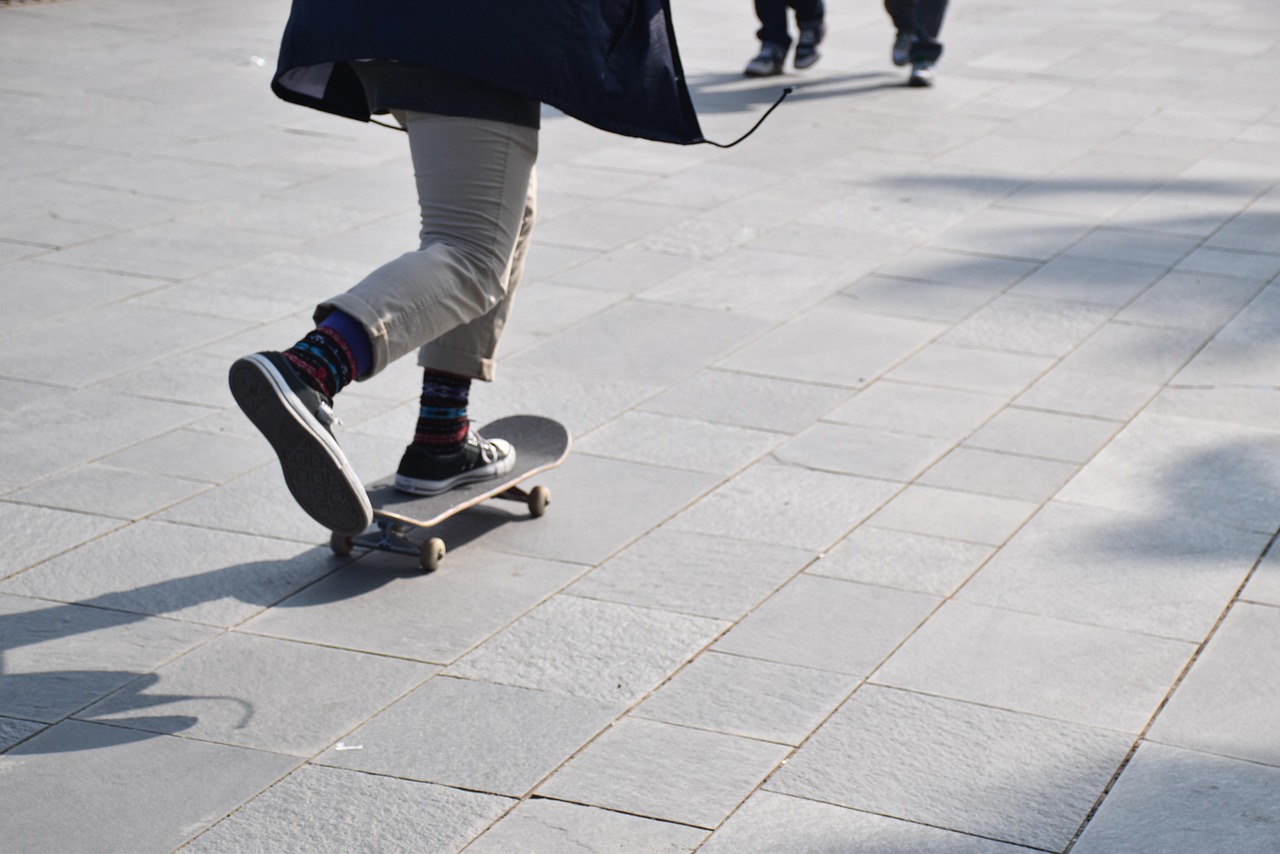
The AAP notes that most young skateboarders are injured on public roads, sidewalks and parking lots, and its rules of the road are simple: skate on the right side of sidewalks, bike paths and trails and pass on the left; avoid skating in the street in crowded areas; obey traffic rules; watch for water, potholes, cracks, rocks and debris; never “skitch” (hold on to a moving vehicle); and never put more than one person on a board. The AAOS adds: no skating in wet or icy weather or after dark. Local laws vary, and some cities ban skating in certain streets or business districts, so check yours.
For kids’ rules and parents’ questions, see our youth skateboarding guide. For choosing a helmet and pads, see our skateboarding gear page. Curious how another sport handles it? Compare soccer’s rules or cycling’s road rules.
Skateboarding rules FAQs
How does Olympic street skateboarding scoring work?
In the 2/5/3 final format, skaters do two 45-second runs and five single trick attempts. Their best run and two best tricks, each scored 0–100 by five judges (high and low dropped), are added up for a maximum of 300.
How long is a park skateboarding run?
Under World Skate rules, 30 to 50 seconds, with two to four runs per round depending on the event. Only the best run counts.
Do pro skateboarders have to wear helmets?
In World Skate events, every park skater must wear one, and so must street skaters under 18. Adult street skaters may choose. A 2021 study of pro contest video found fewer than 5% of competitive skaters wore helmets, which is one reason researchers have called for more work on head protection.
What does “snaking” mean at a skatepark?
Cutting in front of someone or dropping in when it’s another skater’s turn. It’s rude, and it causes collisions. Wait for the skater ahead of you to finish their line.
Are pads required at skateparks?
It depends on where you are. California law, for example, requires a helmet, elbow pads and knee pads at skateparks, and many parks post their own rules. The AAP and AAOS recommend a helmet, wrist guards and knee and elbow pads everywhere.