This article contains affiliate links: if you buy through them we may earn a commission, at no extra cost to you. Learn more.
A Tuesday-night criterium in an office park, the bell ringing for the last lap and forty riders elbow to elbow through the final corner. A Saturday group ride rolling two by two out of town, someone up front pointing at a pothole and calling “car back.” A mountain biker easing off on a narrow trail to let a climber pass. Cycling has two sets of cycling rules: the rules of racing and the rules of the road and trail. This page covers both in plain words, plus the group-ride etiquette nobody writes down but everybody expects.
For the big picture, start at our cycling hub. Traffic laws differ from state to state and city to city, so check yours; this page is general information, not legal advice.
Racing rules: the basics
In the US, most amateur racing runs under USA Cycling rules; international and pro races run under the UCI (Union Cycliste Internationale). A few rules apply almost everywhere:
- Helmets, always. USA Cycling requires a securely fastened helmet that meets its standards at all times at a permitted event, including club rides. NICA requires one any time a student-athlete is on a bike, except when warming up on a stationary trainer.
- Categories. In road, track and cyclo-cross you start as Category 5 (Novice) and work up to Category 1; mountain bike has three categories. Junior races are often grouped by age instead, with riders against peers in a two-year age band.
- The centerline rule. When a road race uses roads open to traffic, riders must stay right of the center line. Crossing it to move up can get you relegated or disqualified.
- Your number. USA Cycling tells first-timers that pinning the bib correctly matters: all four corners, then more pins between them, on the side the officials ask for.
Road racing
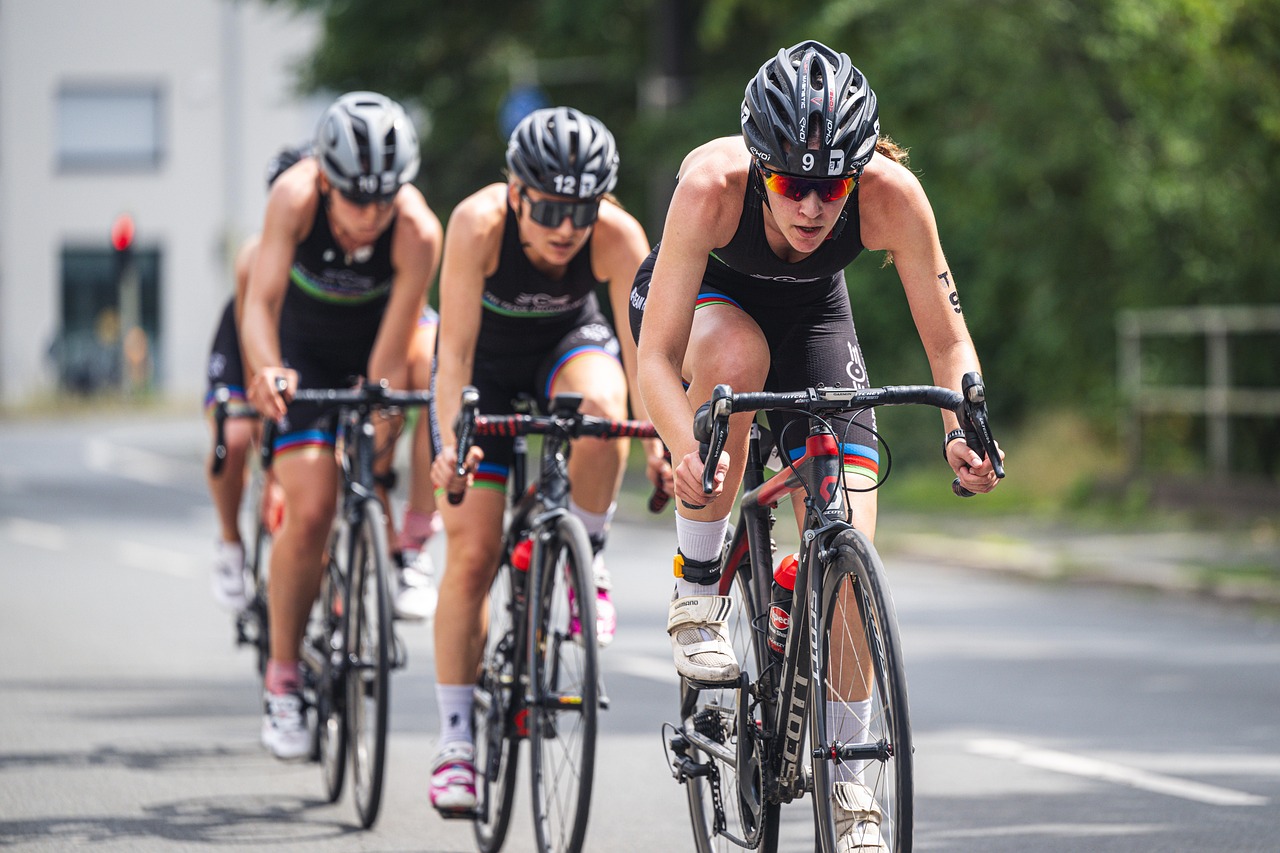
Drafting is legal and is the whole game: riders save energy in the slipstream of others, so teams work together and break away in groups. The main formats are the road race (mass start, first across the line wins), the criterium (many laps of a short closed circuit), the time trial (alone against the clock) and the stage race, where times from every day add up to the general classification. At the Tour de France, the yellow jersey goes to the overall leader, green to the points (sprint) leader, polka dots to the best climber and white to the best rider under 26.
Two UCI safety rules are worth knowing. Under the three-kilometer rule, riders caught in a crash, puncture or mechanical problem in the last 3 km of a stage get the same time as the group they were in; since 2025 a crash has to involve more than one rider to count, and organizers may extend the zone on risky finishes. And from 2025, the UCI’s yellow card system penalizes dangerous behavior: two cards mean a 7-day suspension.
Track, mountain bike, cyclo-cross, gravel and BMX
- Track: fixed-gear bikes with no brakes on a banked velodrome. Sprint events (sprint, keirin, team sprint) last a few laps; endurance events (team pursuit, omnium, madison) are about pace and tactics.
- Mountain bike: Olympic cross-country races are laps of a 4–10 km circuit and last about 90 minutes for elites; short track races last 20–25 minutes.
- Cyclo-cross: senior races last roughly 40 minutes to an hour on a short lap. Barriers can be at most 40 cm high, and riders may swap bikes in the pit.
- Gravel: mass-start races on mixed roads, often long and largely self-supported. UCI Gravel World Series events qualify the top 25% of each age group for the world championships.
- BMX racing: up to eight riders start together from a gate in qualifying rounds called motos. Kids and adults race by age and skill.
In collegiate racing, USA Cycling bans aero equipment such as disc wheels and tri-bars in road, cyclo-cross and mountain bike events, but allows it at track nationals. More about who runs each level is on our leagues and associations page.
Road safety rules for riders
NHTSA counted 1,166 bicyclists killed in traffic crashes in 2023, 28% of them at intersections. Its first reminders: wear a properly fitted helmet every ride, and remember that bicyclists are considered vehicle operators, with the same duty to obey signs, signals and lane markings, riding in the same direction as traffic. The League of American Bicyclists boils road riding down to five rules:
- Follow the law. Same rights and responsibilities as drivers: obey traffic signals and stop signs, and ride with traffic.
- Be predictable. Ride in a straight line, don’t swerve between parked cars, signal turns, and check behind you before you turn or change lanes.
- Be conspicuous. Ride where people can see you, wear bright clothing, and use a white front light, a red rear light and reflectors when visibility is poor.
- Think ahead. Watch for turning cars, opening car doors, debris and potholes.
- Ride ready. Check tires, brakes, chain and quick-release levers, carry basic tools, and wear a helmet.
Lights, passing distance and stop signs
Lights: AAOS says headlights and taillights should be visible from 500 feet. Many riders now run a flashing light by day too; in a Danish trial of about 3,850 cyclists, riders with permanent running lights had 19% fewer injury accidents. A radar tail light like the Garmin Varia RTL515 adds a warning when cars approach from behind (up to 153 yards away, the maker says; about $150 to $200), and a combo set like the Cygolite Metro Plus 800 and Hotshot Pro 150 covers front and rear (about $130 on Amazon in October 2026).
Passing distance: as of the National Conference of State Legislatures’ last update, 35 states and Washington, DC, require drivers to leave at least 3 feet when passing a bicyclist. New Jersey and Pennsylvania require 4 feet, and South Dakota requires 6 feet on roads over 35 mph. NHTSA asks every driver to give at least 3 feet.
Stop signs: in most states, a bicyclist must stop at a stop sign like any driver. A growing number of states, starting with Idaho in 1982, have “stop-as-yield” laws that let riders slow, yield and roll through when it’s clear. Know your state’s law before you count on it.
Helmet laws also vary: some states and cities require helmets only for children, some for everyone, some not at all. Whatever the law, NHTSA, AAOS and the AAP all say to wear one on every ride. For kids’ rules, including the AAP’s advice that children under 10 ride on sidewalks or paths, see youth cycling.
Garmin Varia RTL515 Radar Tail Light
- Radar alerts up to 153 yd
- Up to 16 h in day flash
- Pairs with Garmin and phones
Cygolite Metro Plus 800 + Hotshot Pro 150
- 800-lumen headlight
- 150-lumen taillight
- USB rechargeable
Giro Register MIPS Helmet
- MIPS rotational liner
- Universal adult fit (54-61 cm)
- Meets CPSC standard
Group-ride etiquette
A group ride is the best way to get faster and the easiest way to cause a crash. The League of American Bicyclists’ advice comes down to two things: keep a straight line, and tell everyone what you’re about to do. In practice:
- Hold your line. No sudden swerves or braking; the rider behind you is inches away.
- Call and point. “Car back,” “car up,” “slowing,” “stopping” and “on your left” are standard calls. Point down at potholes and debris so riders behind can see them.
- Don’t overlap wheels. If the rider in front moves sideways, an overlapped front wheel goes down.
- Single file when it’s needed. AAOS advises riding single file with others, and some roads and local laws require it. Follow the ride leader.
- Know the ride. Ask before you start whether it’s “no-drop” (the group waits for everyone) and what pace to expect. Keep aero bars for solo riding.
- Stop at red lights together and don’t run stops to stay with the group.
Trail rules for mountain bikers
Since 1988 the International Mountain Bicycling Association (IMBA) has published its Rules of the Trail: ride open trails only (federal wilderness areas are closed to bikes), leave no trace (stay off muddy trails that you’d rut), control your bicycle, yield appropriately (announce yourself, slow down to pass, and riders going downhill yield to those climbing unless a trail is signed one-way), never scare animals, and plan ahead with tools, water and a sense of your own limits.
Rules are only part of riding safely. Our cycling injuries page covers crashes and concussion, and cycling gear covers helmets, lights and fit. Also play a team sport? Compare with our soccer rules page.
Cycling rules questions
Do cyclists have to follow traffic laws?
Yes. NHTSA notes that bicyclists are considered vehicle operators and must obey the same signs, signals and lane markings as drivers, riding in the same direction as traffic. Some states add bike-specific rules, such as stop-as-yield, so check your state.
How much room must a car give a cyclist?
In most states with a specific number, at least 3 feet. New Jersey and Pennsylvania require 4 feet, and South Dakota 6 feet on roads with speed limits over 35 mph. NHTSA recommends at least 3 feet everywhere.
Is drafting allowed in bike races?
Yes, in road racing, criteriums, gravel and most mass-start events it’s a core tactic. In a time trial, by contrast, each rider starts alone and races against the clock.
What is the three-kilometer rule?
A UCI road rule: riders delayed by a crash involving several riders, a puncture or a mechanical problem in the last 3 km of a stage get the same time as the group they were riding in. Organizers can extend the distance on risky finishes.
Who has the right of way on a mountain bike trail?
Under IMBA’s Rules of the Trail, riders going downhill yield to riders climbing, unless the trail is signed one-way or downhill-only. Announce yourself early, slow down to pass, and give animals extra room.