This article contains affiliate links: if you buy through them we may earn a commission, at no extra cost to you. Learn more.
Your first rugby game as a spectator can feel like chaos: a pile of bodies, a whistle, a scrum, and suddenly someone is sprinting 60 yards to score while the crowd roars. It makes sense fast once you know a handful of ideas: pass backwards, tackle low, stay on your feet, and respect the offside line. This guide explains the rugby rules for union, the 15-a-side game most Americans play, from World Rugby’s 2026 Laws of the Game: scoring, the tackle and the new lower tackle height, rucks, mauls, scrums and lineouts, what changes in sevens and youth rugby, and a short guide to rugby league.
The basics: players, field and time
- Players: 15 a side. Eight forwards (two props and a hooker in the front row, two locks, two flankers and a number 8) and seven backs (scrum-half, fly-half, two centres, two wings and a fullback). International teams may name up to eight replacements.
- Field: the field of play is 94–100 meters long and 68–70 meters wide, with an in-goal area of 6–22 meters behind each try line and H-shaped goalposts on the line.
- Time: up to 80 minutes, two halves of no more than 40 minutes plus time lost, with a half-time break of up to 15 minutes. Under-19 games are 70 minutes (two 35-minute halves), and youth age grades play shorter games.
- Ball: oval, four panels, 410–460 grams, inflated to 9.5–10 psi. Smaller balls may be used for young players.
Scoring in rugby union
| Score | Points | How |
|---|---|---|
| Try | 5 | An attacker is first to ground the ball in the opponents’ in-goal area. |
| Conversion | 2 | A kick at goal after a try, taken in line with where the try was scored. |
| Penalty try | 7 | Awarded when foul play stops a probable try; no conversion is needed. |
| Penalty goal | 3 | A kick at goal from a penalty. |
| Dropped goal | 3 | A drop kick over the crossbar in open play. |
Moving the ball: passing, knock-ons and offside
You can run with the ball, kick it, or pass it, but a pass must not go forward. A throw forward or an accidental knock-on (the ball goes forward off your hands or arms) gives the other team a scrum; a deliberate knock-on is a penalty. In open play, a player in front of a teammate who last played the ball is offside and must not take part until put onside. At rucks, mauls, scrums and lineouts, each team has an offside line, and players not involved must stay behind it.
The tackle and tackle height
A tackle happens when the ball carrier is held and brought to the ground (lying, sitting or with at least one knee down) by one or more opponents. Then everyone has a job, and most penalties in rugby come from getting it wrong:
- The tackler must release the ball carrier at once, get up or roll away, and be on their feet before playing the ball.
- The tackled player must immediately make the ball available: pass it, release it or place it, but not forward, and must not lie on it.
- Arriving players must stay on their feet and come in from their own side (“through the gate”).
Dangerous tackles are foul play: early, late, or tackling a player without the ball, and any tackle above the line of the shoulders, even one that starts lower. A high tackle that hits the head can bring a yellow or red card.
The new community tackle height: from July 1, 2026, World Rugby law lets each national union lower the legal tackle height in community rugby to either the waist or the base of the sternum. The change follows two years of trials in 10 unions, with more than 150,000 tackles studied, which showed fewer upright tackles, the kind most likely to cause head impacts. USA Rugby’s 2026-27 guidelines use the sternum line for community rugby (club, college, high school and youth), while Major League Rugby and Women’s Elite Rugby keep the shoulder line. Many youth programs go lower still, for example tackles only below the armpits at U10 and U12. Our youth rugby page explains how kids learn to tackle safely.
Rucks and mauls
A ruck forms when at least one player from each team is on their feet, in contact, over the ball on the ground (usually right after a tackle). Players must join from behind their offside line, bind onto a player, and keep their heads and shoulders no lower than their hips. Nobody may handle the ball in the ruck; teams win it by driving opponents off it or by heeling it back. When the ball is clearly won, the referee calls “use it” and the team must play it.
A maul is the standing version: a ball carrier and at least one player from each team, bound together on their feet. It must keep moving toward a try line; players join from behind, binding on the last player. Pulling a maul down is illegal because it puts players at risk.
The scrum
A scrum restarts play after small infringements such as a knock-on or forward pass. Eight players from each team bind in a 3-4-1 shape: two props and a hooker in front, two locks behind, and the flankers and number 8 at the back. The referee controls the engagement with three calls: “crouch”, “bind” (each prop grips the opposing prop’s jersey) and “set”. Under the 2026 laws, the hooker keeps one foot forward as a “brake foot” until “set”, to steady the scrum before the hit. The scrum-half then throws the ball in straight down the middle and the hookers strike for it.
Front-row players must be trained for those positions; if a team doesn’t have enough, the referee orders uncontested scrums (no pushing). Under-19 laws add safety limits: a team may not push the scrum more than 1.5 meters, may not wheel it intentionally, and must play the ball once it’s controlled at the back.
The lineout
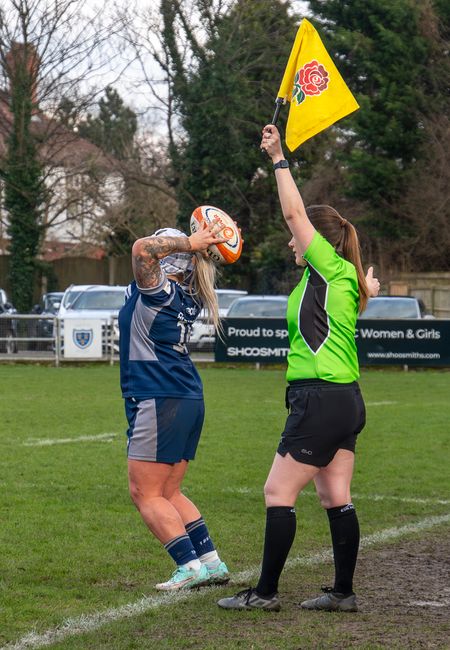
When the ball goes into touch (out of bounds), play restarts with a lineout: at least two players from each team line up between the 5-meter and 15-meter lines, and the thrower (usually the hooker) must throw the ball in straight between the lines so it travels at least 5 meters. Teammates may lift a jumper to catch it, and once the ball is caught the forwards often form a driving maul. A crooked throw gives the other team the choice of a lineout or a scrum.
Penalties, free-kicks and cards
Serious offences (offside, playing the ball off your feet, foul play) give a penalty: the team can kick at goal for three points, kick to touch and throw in at the lineout, take a scrum, or tap and run. Technical offences give a free-kick, which can’t be kicked at goal. A yellow card means 10 minutes in the sin bin; a second yellow means a red. A red card means the player is sent off. In elite rugby only, a player sent off for an action that wasn’t intentional or highly dangerous can be replaced after 20 minutes.
Rugby sevens: what changes
| Union (15s) | Sevens | |
|---|---|---|
| Players | 15, up to 8 replacements | 7, up to 5 replacements |
| Game length | 80 minutes (2 × 40) | 14 minutes (2 × 7); finals 20 (2 × 10) |
| Half-time | Up to 15 minutes | Up to 2 minutes |
| Conversions | Place kick or drop kick, 60 seconds | Drop kick only, 30 seconds |
| Restart after a score | The other team kicks off | The scoring team kicks off |
| Yellow card | 10 minutes | 2 minutes |
| Extra time | Only in knockout games | Periods of up to 5 minutes; first score wins |
With the same full-size field and half the players, sevens is all about speed and space. Teams often play several games in a day, so heat, fueling and recovery matter more than in 15s (see the rugby hub).
Rugby league in brief
Rugby league is a separate code with its own International Rugby League laws. The big differences: 13 players a side; a try is worth 4 points, a conversion or penalty goal 2 and a drop goal 1; and there are no contested rucks. After each tackle, the tackled player gets up and rolls the ball back with a foot in a “play-the-ball”, and a team gets six tackles per set before the ball changes hands (which is why teams usually kick on the last tackle). Games are 80 minutes with a 10-minute half-time.
Gear the rules care about
Law 4 allows soft extras such as a mouthguard, a scrum cap, shoulder pads, fingerless mitts and supports, all within World Rugby Regulation 12 (padding no thicker than 1 cm). It bans anything hard, sharp or with buckles, plus gloves, jewelry and shorts with sewn-in padding. USA Rugby says every player should wear a mouthguard every time they play contact rugby. A good practice ball and a mouthguard are the start; the Gilbert G-TR4000 (about $30) is a popular size 5 training ball, and the OPRO Gold (about $20) is a self-fit mouthguard with no strap. The full list is in our rugby gear guide.
Gilbert G-TR4000 Training Rugby Ball (Size 5)
- Size 5
- Hand-stitched, 3-ply
- Inflate to 9.5 psi
OPRO Gold Level Mouthguard
- Self-fit, no strap
- Adult and kids' sizes
- About $20
Back to the rugby hub, or see rugby leagues and associations, rugby injuries and rugby gear. Comparing sports? Our football rules guide covers the other oval-ball game.
Rugby rules FAQs
Why can’t you pass forward in rugby?
It’s the core law of the game: the ball must be carried or kicked forward, never passed forward. A forward pass or an accidental knock-on gives the other team a scrum.
How high can you tackle in rugby?
The law has always banned tackles above the line of the shoulders. Since July 1, 2026, unions may set a lower limit for community rugby, and USA Rugby uses the sternum line in 2026-27; MLR and WER use the shoulder line. Youth programs often require tackles below the armpits.
What’s the difference between a ruck and a maul?
In a ruck the ball is on the ground and players can’t use their hands; in a maul the ball is held by a standing player, with at least one player from each team bound on.
How long is a rugby sevens game?
Fourteen minutes: two 7-minute halves with up to 2 minutes at half-time. Finals can be two 10-minute halves.
What does a yellow card mean in rugby?
The player is sent to the sin bin for 10 minutes in 15s (2 minutes in sevens) and the team plays a player short. A second yellow in the same game becomes a red card.