This article contains affiliate links: if you buy through them we may earn a commission, at no extra cost to you. Learn more.
It’s a bluebird powder day. You were in the lift line at 8:30, you’ve done six laps without stopping, and lunch feels like a waste of good snow. Then, around 1 p.m., your legs go soft, your hands are freezing and you catch an edge on a run you’ve ridden a hundred times. That afternoon slump is usually fuel, fluid and cold, not skill. A snowboarding day is long, stop-and-start work in the cold, often at altitude and under strong sun. This page covers how to eat, drink and dress for it, whether you’re a weekend rider, a high school or college racer, or a pro waiting at the top of a slopestyle course.
General guidance for healthy riders. If you have diabetes, a heart or lung condition or special diet needs, follow your doctor’s or a registered dietitian’s plan. For the bigger picture, see our snowboarding hub.
Breakfast and the morning
The joint position statement on nutrition and athletic performance from the American College of Sports Medicine (ACSM), the Academy of Nutrition and Dietetics and Dietitians of Canada is the reference most sports dietitians use. For a long day on the hill it suggests:
- Eat 1–4 hours before you ride: 1–4 g of carbohydrate per kg of body weight. For a 70 kg (154 lb) rider eating two hours before, that might be oatmeal with fruit, toast with honey, or eggs with potatoes and juice.
- Keep it familiar and not too heavy in fat, fiber or protein if your stomach is sensitive.
- Drink before you go: about 5–10 mL of fluid per kg of body weight in the 2–4 hours before, aiming for pale yellow urine. For 70 kg that’s roughly 350–700 mL (12–24 oz).
Fueling on the hill
ACSM’s guidance for stop-and-start activity lasting one to two and a half hours is about 30–60 g of carbohydrate per hour. A snowboarding day runs longer than that, with lift rides, hikes and breaks mixed in, so the practical goal is simple: eat something every hour or two and don’t skip lunch.
- Pocket food: bars, chews, dried fruit, a banana, a sandwich, trail mix. Keep bars in an inside pocket; many get hard in the cold.
- Eat on the chair if you don’t want to stop.
- Lunch with carbs and some protein, such as soup and bread, chili, a wrap or pasta, gives you a warm-up and a refuel at once.
Food also helps you stay warm. ACSM warns that low blood sugar can prevent you from shivering, which is one of your body’s main ways of making heat in the cold.
Hydration in the cold and at altitude
You may not feel thirsty, but you’re still losing water. Fluid leaves through sweat under your layers, and in the cold your body also loses more water through breathing and urine, while thirst is blunted. That’s the picture in ACSM’s 2021 expert consensus statement on cold-weather exercise. The National Athletic Trainers’ Association’s general target for athletes is to avoid losing more than about 2% of body weight to sweat.
- Drink at every break and with meals; a small bottle in a jacket pocket or a hydration pack with an insulated hose keeps water from freezing.
- Add electrolytes on long days, if you sweat a lot, or if you’re hiking for laps: a mix like Skratch Labs Hydration adds carbs and sodium, while Nuun Sport tablets add sodium with almost no sugar. A warm drink at lunch counts too.
- Check your urine color at the lodge: pale is good, dark means drink more.
Altitude
Many resorts sit high enough to matter. The CDC’s Yellow Book says about 25% of visitors sleeping above 8,000 ft (2,450 m) in Colorado get acute mountain sickness. Headache is the main symptom, usually with poor appetite, dizziness, fatigue, nausea or sometimes vomiting. The CDC advises avoiding alcohol for the first 48 hours at high altitude and doing only mild exercise for the first 48 hours. If symptoms get worse instead of better, going down is the answer. If you’ve just flown in from sea level, take an easier first day, eat and drink well, and save the big day for later in the trip.
Dressing for the cold
ACSM recommends three layers: a base layer that wicks sweat away from the skin, an insulating layer, and an outer layer that blocks wind and water. A common mistake, it notes, is dressing for standing still and then overheating once you start moving, which leaves you damp and colder during the next rest. For snowboarding that means opening vents on a hike or a hard run, and closing up before a windy chairlift ride.
- Cover the spots that freeze first. The CDC lists the nose, ears, toes, cheeks, chin and fingers, and recommends a hat, mittens or gloves and a scarf or face mask.
- Carry a spare pair of gloves or liners. Wet gloves after a fall are one of the fastest ways to cold fingers.
- Know the warning signs. Frostbite starts with redness or pain, then skin turns white or grayish-yellow and numb (CDC). Shivering, fumbling hands, confusion or slurred speech can mean hypothermia. Get indoors and warm up.
- Watch the wind chill. ACSM says frostbite can happen in 30 minutes or less once the wind chill is below −27 °C (−17 °F). On days like that, take more breaks inside.
For more on cold injuries, see our snowboarding injuries page.
Sun on snow
A cold day doesn’t mean a weak sun. The Skin Cancer Foundation notes that snow and ice can reflect up to 80% of UV rays, so they hit you twice, from above and below, and that UV exposure increases 4–5% with every 1,000 feet of elevation.
- Sunscreen on every exposed patch, including ears, under the chin and the back of the neck. The American Academy of Dermatology (AAD) recommends a broad-spectrum, water-resistant SPF 30 or higher; the Skin Cancer Foundation suggests SPF 50 or higher for outdoor activities.
- Reapply every two hours and after sweating, which is easy to forget with a face covered by a buff and goggles.
- Lips burn too: AAD recommends a lip balm with SPF 30 or higher.
- Wear UV-blocking goggles or sunglasses. The Skin Cancer Foundation lists them as part of winter sun protection.
Competition and long days
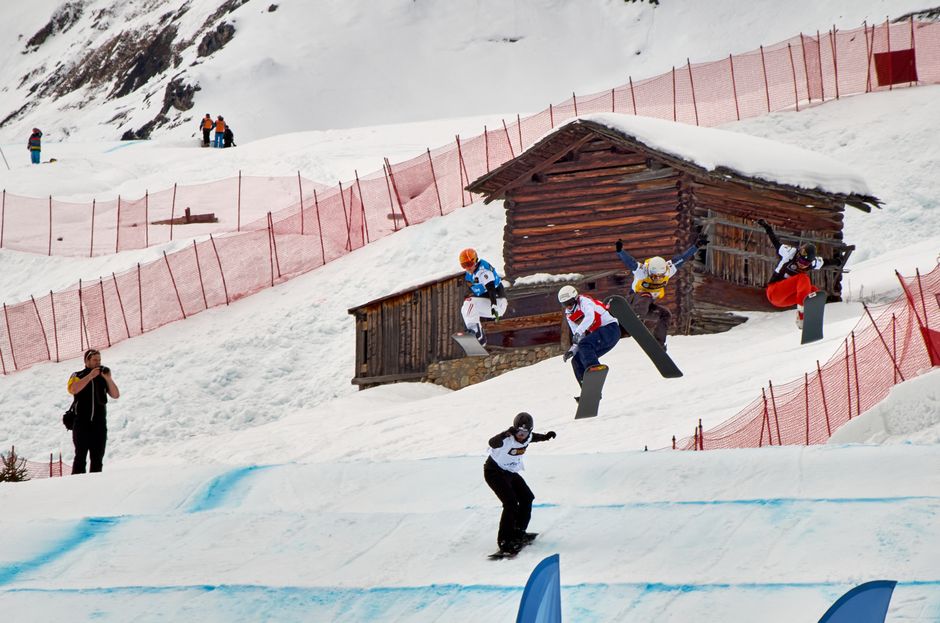
Racers, slopestyle and halfpipe riders spend a lot of time standing at the top between runs. Keep a puffy jacket on until it’s your turn, keep snacks and a drink in your bag, and do a few squats and leg swings to stay warm before you drop in. For everyone else: the last run of the day is when legs are tired and light is flat. The American Academy of Orthopaedic Surgeons (AAOS) advises skipping difficult runs when you’re tired at the end of the day.
What riders keep in their pockets
A small kit covers most of the day: sunscreen and SPF lip balm, a couple of snacks, an electrolyte packet or tablets, and a spare pair of liners. Many riders use a mineral sunscreen like Blue Lizard Sport SPF 30+, and a bottle like the Nalgene 32 oz for the car or the lodge. Compare more mixes in our best electrolyte powder guide.
Blue Lizard Sport Mineral Sunscreen SPF 30+
- Zinc oxide, broad spectrum
- Water and sweat resistant
- Fragrance free
Nuun Sport Tablets
- 300 mg sodium per tablet
- 1 g sugar
- Informed Choice
Skratch Labs Hydration Sport Drink Mix
- 400 mg sodium per serving
- About 20 g carbs per serving
- 20 servings, about $24
Nalgene Sustain 32 oz Wide Mouth
- 32 oz, wide mouth
- BPA-free Tritan
- About $16
After the lifts close, the next job is recovery: see our snowboarding recovery and snowboarding nutrition pages. Soccer players have a game day page of their own.
Snow day: FAQs
What should I eat before snowboarding?
A familiar breakfast with plenty of carbohydrate 1–4 hours before you ride, such as oatmeal, toast, eggs and fruit. ACSM’s guide is 1–4 g of carbohydrate per kg of body weight, depending on how early you eat.
Do you need to drink water when snowboarding in the cold?
Yes. You lose fluid through sweat and breathing, and the cold blunts your thirst, according to ACSM’s cold-weather consensus. Drink at every break and with meals, and check that your urine stays pale.
Can you get sunburned snowboarding?
Easily. Snow can reflect up to 80% of UV rays, and UV rises with altitude, says the Skin Cancer Foundation. Use broad-spectrum sunscreen and SPF lip balm, reapply every two hours, and wear UV-blocking goggles.
How do I avoid altitude sickness on a snowboard trip?
The CDC advises mild exercise and no alcohol for the first 48 hours at high altitude. Headache with nausea, dizziness or fatigue can be altitude sickness; if it gets worse, go down and see a doctor.
How do I keep my hands warm while snowboarding?
Keep gloves dry (carry spare liners), eat and drink regularly so your body can make heat, close up your layers before the chairlift, and go inside when fingers go numb or turn pale. Those can be early signs of frostbite.