This article contains affiliate links: if you buy through them we may earn a commission, at no extra cost to you. Learn more.
First run of the morning, a fresh layer of corduroy, and a beginner on a rental board catches the downhill edge. The board stops, the rider doesn’t, and both hands go out. Every snowboarder knows that moment, from a kid’s first lesson to an Olympic halfpipe rider. Most days end with nothing worse than tired legs, but snowboarding has its own set of injuries, different from skiing’s. Here they are in plain language, with what the research says about prevention and the signs that mean “stop and get it checked”.
This page is general information, not medical advice. If you’re hurt, see a sports medicine doctor, physical therapist (PT) or certified athletic trainer (AT), or the ski patrol on the mountain. For the bigger picture of the sport, start at our snowboarding hub. Skiers have their own page: skiing injuries.
How snowboarding injuries differ from skiing
Both feet are locked to one board, so a snowboarder can’t step out of a fall, and there are no poles. That changes where the force goes. In an 18-season study at a Vermont resort, wrist injuries made up 27.6% of all snowboarding injuries but only 2.8% of skiing injuries, while ACL sprains were 17.2% of skiing injuries and just 1.7% of snowboarding injuries. The same study found the highest injury rate among young, inexperienced riders.
The most common snowboarding injuries
Wrist fractures and sprains
The classic snowboarding injury: a fall backward or forward onto an outstretched hand. Reviews of shoulder and arm injuries put the upper body at roughly half of all snowboarding injuries, and the broken wrist (distal radius) is the most common fracture in the sport. A wrist that is swollen, deformed or too painful to grip needs an X-ray, even if you can still move it.
Wrist guards: what the evidence says
This is one of the best-studied pieces of protective gear in any sport. A systematic review of six studies (including randomized trials) found that snowboarders wearing wrist guards had a much lower risk of wrist injury (relative risk 0.23), wrist fracture (0.29) and wrist sprain (0.17) than riders without them. In plain terms, about three-quarters fewer wrist injuries. A later review found no agreement on which design works best. Most have a stiff splint along the back and/or palm of the wrist and go under or over your glove. They matter most in your first seasons and in the park.
Shoulder and collarbone injuries
Falls onto the shoulder or an outstretched arm, and landings gone wrong off jumps, load the shoulder. In reviews, shoulder injuries make up 8–16% of all snowboarding injuries; the common ones are rotator cuff strains, dislocations, AC joint separations (“separated shoulder”) and collarbone (clavicle) fractures. The collarbone is the second most common fracture in snowboarding after the wrist. A shoulder that looks out of place, a bump over the collarbone, or an arm you can’t lift needs a doctor the same day.
Snowboarder’s ankle (lateral talar process fracture)
This one has the sport’s name on it. A study of 3,213 snowboarding injuries at 12 Colorado resorts found that fractures of the lateral process of the talus, a small piece of bone on the outside of the ankle, were 15% of all ankle injuries and 34% of ankle fractures. The danger is that it feels like an ordinary sprain. The authors warned that many of these fractures don’t show on plain X-rays and need a CT scan, and that pain on the front-outside of the ankle in a snowboarder should raise suspicion. Missed fractures can heal badly, so if an “ankle sprain” from riding isn’t clearly improving, ask the doctor about this fracture by name.
Head injuries and helmets
Catching an edge on hard snow, collisions and falls on jumps can all cause a head injury. A meta-analysis of 12 studies found that skiers and snowboarders wearing a helmet had 35% lower odds of a head injury (odds ratio 0.65), and lower still in studies of children under 13 (0.41). Helmets were not linked to more neck injuries. A trauma surgeons’ evidence review recommends helmets for all recreational riders and found no sign they make riders take more risks. The American Academy of Pediatrics (AAP) says helmets clearly lower the risk of head injury, with some of the strongest evidence in snow sports. Choose a snow-sport helmet, not a bike helmet; look for ASTM F2040 or CE EN 1077 certification, like the Smith Mission MIPS.
Concussion: recognize it and stop riding
The CDC’s HEADS UP program is clear: if you think someone may have a concussion, they stop for the day and don’t ride again until a health care provider clears them. Watch for a rider who seems dazed or confused, or has a headache, dizziness, nausea or blurry vision. Call 911 or get ski patrol and go to the emergency department for any of the CDC’s danger signs: one pupil larger than the other, a headache that gets worse and doesn’t go away, slurred speech, weakness or numbness, repeated vomiting, seizures, increasing confusion, or loss of consciousness with growing drowsiness. The 2022 Amsterdam consensus on concussion in sport describes relative rest for 24–48 hours, then a gradual return, each step usually at least 24 hours, with clearance from a licensed provider.
Tailbone and back
Falls backward onto the heelside edge land riders on their backside, and tailbone pain (coccydynia) is common among beginners. A 2026 review of tailbone pain says first-line care is simple: education, taking pressure off the area when sitting (a cushion), simple pain relievers and physical therapy, with imaging reserved for real trauma or warning signs. Harder falls are a different matter: in Sweden’s national fracture register, spine and pelvis fractures were about eight times more common in snowboarders than in skateboarders. Padded impact shorts are popular for tailbone falls. A 2025 Swiss trauma-center study found back protectors did not prevent spinal injuries. Back pain with numbness, tingling, weakness or loss of bladder or bowel control is an emergency.
Terrain-park injuries
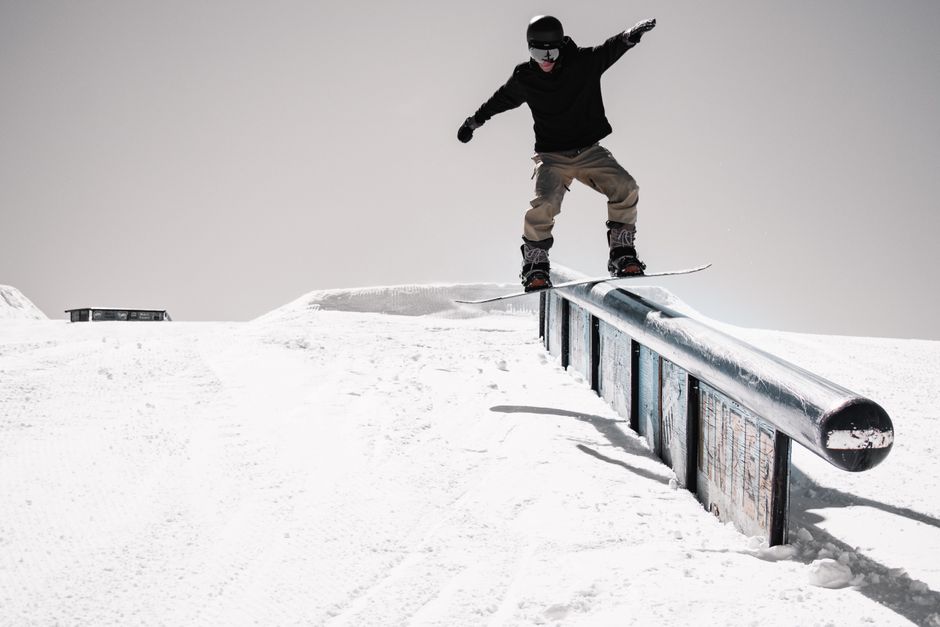
Jumps, rails and boxes are where much of modern snowboarding happens, and where falls from height happen too. In the Vermont study, 21.8% of snowboarding injuries happened in the terrain park, compared with 6.5% of ski injuries. A decade of data from western Canadian resorts counted 12,602 terrain-park injuries; 73% were snowboarders and 86.5% were under 25. The Vermont researchers did not find park riders overrepresented among the injured, so the park just needs a plan. Common park-safety advice boils down to: scope a feature before you hit it, start small and work up, ride within your ability, and respect others in the park.
Tree wells and deep snow
On powder days the danger isn’t only avalanches. A tree well is the loose, deep snow around the base of an evergreen; a rider who falls in head-first can get stuck and suffocate. A 2010 medical review counted more than 70 documented deaths from this kind of snow immersion in two decades, with death probably occurring within 15 to 30 minutes. In experiments in which volunteers were placed in a tree well, 90% could not get themselves out. Resorts’ deep-snow advice is consistent:
- Ride with a partner and keep them in sight. Most people who died in tree wells had partners who were not in visual contact.
- Stay close enough to pull or dig them out, and keep your distance from tree trunks on deep days.
- If you go in, resorts advise trying to grab a branch or trunk, and make an air pocket around your face while your partner digs.
- Carry a whistle and phone; in deep-snow areas many riders also carry a shovel, probe and avalanche transceiver (see our snowboarding wearables page).
Cold, frostbite and hypothermia
The CDC lists frostbite signs as redness or pain first, then skin that turns white or grayish-yellow, feels firm or waxy, and goes numb. Hypothermia shows up as shivering, exhaustion, confusion, fumbling hands, memory loss, slurred speech and drowsiness. The American College of Sports Medicine (ACSM) says frostbite of exposed skin can happen in 30 minutes or less when the wind chill drops below −27 °C (−17 °F),. Dress in layers, cover your face, ears and fingers, swap wet gloves, and get indoors when you see the signs. Body temperature below 95 °F (35 °C) is an emergency. More on staying warm and fueled is on our snow day page.
Prevention: what the studies found
- Take lessons and learn to fall. The American Academy of Orthopaedic Surgeons (AAOS) says learning how to fall correctly and safely can reduce the risk of injury, and urges lessons for new and experienced riders. A 2024 meta-analysis of snow and ice sports found injury-prevention programs halved injuries overall, with education and training programs alone also cutting injuries by about half.
- Wear the gear. Wrist guards and a snow-sport helmet have the strongest evidence; in the same meta-analysis, protective equipment lowered injury risk by about a third.
- Get fit before the season and warm up. AAOS recommends 3–5 minutes of light cardio before the first runs. See our snowboarding training page.
- Know the code. Snowboarders follow the same Responsibility Code as skiers; it’s covered on our skiing rules page.
Gear many riders use for injury prevention
Gear is not a substitute for lessons or rehab, but two pieces have real evidence behind them: a pair of wrist guards like the Demon United Flexmeter Double Sided Wrist Guards and a certified snow helmet like the Smith Mission MIPS. After a sprain, ask your PT about a lace-up brace like the ASO EVO for rehab days.
Demon United Flexmeter Double Sided Wrist Guards
- D3O impact protection
- Double-sided splint
- Sold in S, M, L
Smith Mission MIPS Snow Helmet
- MIPS + Koroyd
- ASTM F2040 and CE EN 1077
- Dial fit, about $140
ASO EVO Ankle Stabilizer
- Lace-up with figure-8 straps
- Fits left or right foot
- Low profile
When to see a sports medicine doctor, PT or athletic trainer
- Right away (call ski patrol or 911): any concussion danger sign, a possible broken bone, a joint that looks out of place, neck or back pain with numbness or weakness, or signs of hypothermia.
- Same day or next: a wrist that is swollen or painful to grip, a suspected concussion, a shoulder you can’t lift, or an ankle you can’t walk on.
- Soon: an “ankle sprain” that isn’t improving after a week or so (ask about a lateral talar process fracture), tailbone pain that lasts for weeks, or pain that keeps coming back.
A sports medicine physician diagnoses and decides on X-rays or CT; a physical therapist guides rehab and your return to riding; on the mountain, ski patrol is your first responder. For what to do on the days after, see our snowboarding recovery page. Soccer players have their own version of this page: soccer injuries.
Snowboarding injuries: FAQs
What is the most common snowboarding injury?
Wrist injuries. In an 18-season resort study they made up 27.6% of all snowboarding injuries, ten times their share in skiing.
Do wrist guards really work for snowboarding?
The research says yes. A systematic review found riders with wrist guards had about three-quarters fewer wrist injuries and lower risk of wrist fractures and sprains. There’s no agreement on the single best design, so pick one that fits comfortably with your gloves.
What is snowboarder’s ankle?
A fracture of the lateral process of the talus, a small bone on the outside of the ankle. It’s often mistaken for a sprain and may not show on a regular X-ray. If ankle pain on the outside front of your ankle isn’t getting better, ask your doctor about it by name.
Should I wear a helmet for snowboarding?
Yes. A meta-analysis found 35% lower odds of head injury with a helmet, and trauma surgeons and the AAP both support helmets for all skiers and snowboarders. Use a snow-sport helmet certified to ASTM F2040 or CE EN 1077.