This article contains affiliate links: if you buy through them we may earn a commission, at no extra cost to you. Learn more.
Saturday at a busy resort: a ski-school class snaking down the green run, a teenager carving fast arcs past them, a dad stopped in the middle of the trail to fix a binding, and a crowd at the bottom of the lift. Everyone gets home safe because everyone follows the same few rules. This page covers skiing rules in two parts: the skier responsibility code that every skier and snowboarder at a U.S. ski area is expected to follow, and the rules of alpine ski racing, from slalom gates to how the Olympic team combined works.
Your Responsibility Code: the skier code
The National Ski Areas Association (NSAA) first developed Your Responsibility Code in 1962, and you’ll see it on trail maps, lift towers and signs at U.S. ski areas. In 2022 it grew from seven points to ten, adding points on lifts, impairment and what to do after a collision. It applies to skiers, snowboarders and everyone else on the slopes. NSAA opens it with a plain warning: winter sports involve risk of serious injury or death, and your knowledge, decisions and actions contribute to your safety. The ten points, with what they mean in practice:
- Always stay in control. You must be able to stop or avoid people or objects. Speed and loss of control were among the most common factors in the fatal accidents NSAA tracked in 2024/25.
- People ahead or downhill of you have the right-of-way. You must avoid them. The skier below can’t see you coming; it’s on you to give them room.
- Stop only where you are visible from above and do not restrict traffic. Not below a roll, not in a narrow spot, and to the side of the trail.
- Look uphill and avoid others before starting downhill or entering a trail. The same habit as checking your mirrors before pulling out.
- You must prevent runaway equipment. A loose ski sliding down a slope is dangerous; ski brakes on bindings are there to stop it.
- Read and obey all signs, warnings and hazard markings.
- Keep off closed trails and out of closed areas. Trails are closed for a reason: avalanche work, grooming, thin cover or race training.
- You must know how and be able to load, ride and unload lifts safely. If you’re unsure, ask the lift attendant for help.
- Do not use lifts or terrain when impaired by alcohol or drugs.
- If you are involved in a collision or incident, share your contact information. Stay, help, call ski patrol if anyone is hurt, and exchange details.
Treat it as more than etiquette: it’s the shared deal that keeps a crowded mountain safe. Snowboarders follow the same code; see our snowboarding section for their side of the hill.
Trail signs
U.S. ski areas use the same symbols: a green circle (easier), blue square (more difficult), black diamond (most difficult), double-black diamond (most difficult, use extra caution) and an orange oval for freestyle terrain. NSAA explains that ratings are consistent within a resort but relative between resorts, so check the trail map before you ride a lift and know what’s waiting at the top. If a run looks beyond you, NSAA’s advice is to take a lesson rather than try it.
Terrain parks: Park SMART
For jumps, rails and boxes, NSAA, Burton, the instructors’ association PSIA-AASI and the National Ski Patrol promote Park SMART: start small and build your skills, make a plan for every feature every time, always look before you drop, respect the features and other users, and take it easy, knowing your limits and landing on your feet. The short version: “Don’t go if you don’t know.”
Trees and deep snow
Collisions with trees were the leading cause of skier and snowboarder deaths at U.S. ski areas in 2024/25, nearly half of them, and snow immersion incidents, including tree wells, were about a tenth. Off the groomed runs, NSAA’s rule is simple: always ski with a partner within viewing distance. More on staying safe on our skiing injuries page.
Gear helps you follow the code: a helmet, goggles that let you see in flat light, and warm hands so you can still work your bindings at 3 p.m. These are the basics we’d start with:
Smith Mission MIPS Helmet
- ASTM F2040 + EN 1077 (maker)
- MIPS liner, dial fit
- About $85 to $120
Smith Squad Goggles (ChromaPop)
- Cylindrical ChromaPop lens
- Anti-fog coating
- About $120
HotHands Hand Warmers, 40 Pairs
- Up to 10 hours of heat
- Air-activated
- About $25 for 40 pairs
Alpine ski racing rules: the basics
Alpine racing is run under the rules of FIS, the International Ski and Snowboard Federation, and in the US by U.S. Ski & Snowboard for club and national races. Racers start one at a time and race the clock through a course of gates. The events fall into two groups:
| Event | Type | Runs | What it’s like |
|---|---|---|---|
| Downhill | Speed | 1 | Longest course, fewest gates, highest speeds |
| Super-G | Speed | 1 | Downhill speed with more turning |
| Giant slalom | Technical | 2 | Wider, rounder turns; two runs, times added |
| Slalom | Technical | 2 | Shortest course, most and tightest turns; two runs, times added |
| Team combined | Both | 2 (one each) | One teammate races downhill, the other slalom; times added |
Gates, faults and timing
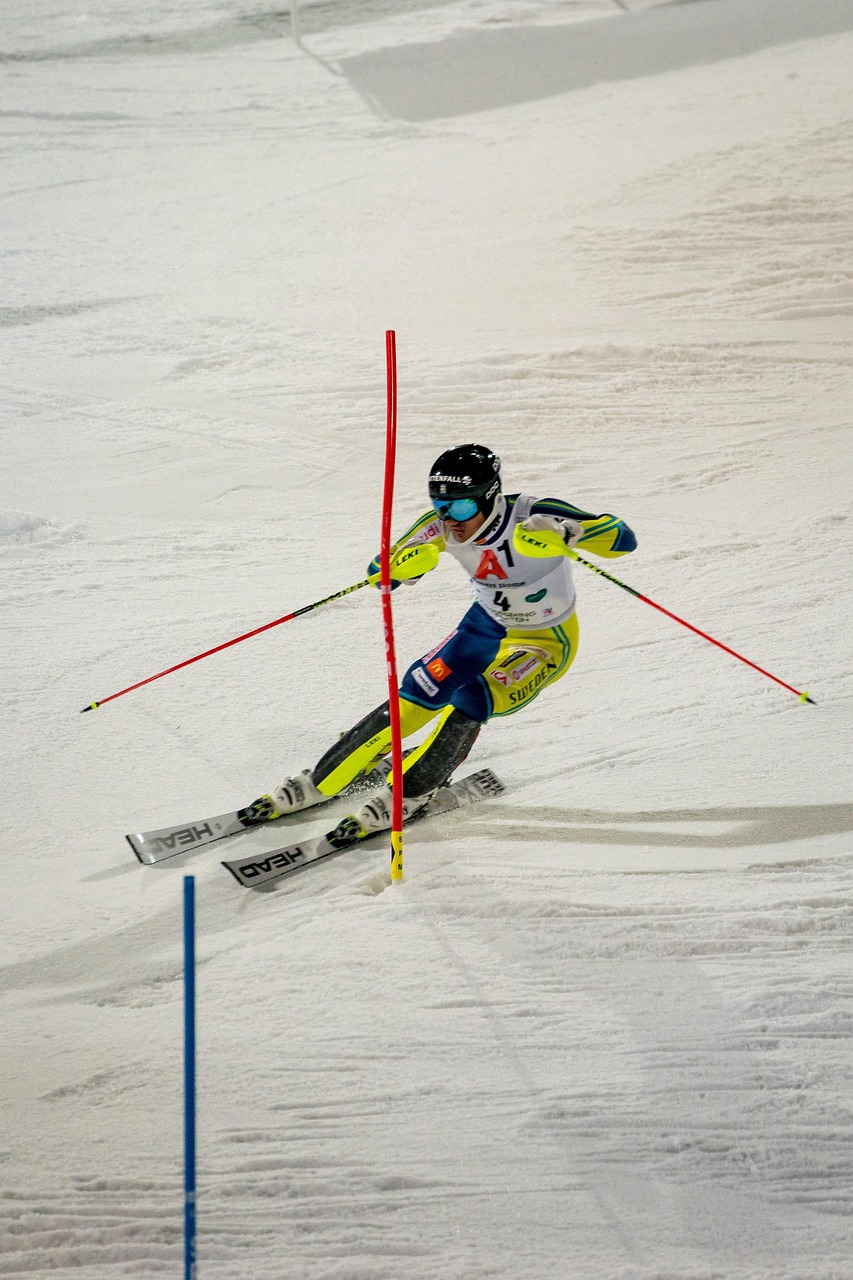
A gate is a pair of poles, alternating red and blue in slalom. The racer must pass between them with the tips of both skis and both feet crossing the gate line; if not, it’s a fault. The classic fault is the straddle, where one ski goes on each side of a pole. Modern slalom poles are hinged at the base, so racers knock them down with their shins and hands (“cross-blocking”), which is why slalom skiers wear shin guards, pole guards, arm guards and chin guards. In the two-run events, a racer’s two times are added and the lowest total wins.
The team combined
The team combined made its Olympic debut at Milano Cortina 2026. Each country enters teams of two: a speed specialist races the downhill and a technical skier races the slalom, and their two times are added. It replaced both the old individual combined (one skier racing both) and the team parallel event, bringing Olympic alpine skiing from 11 medal events to 10. The US women’s pair of Jackie Wiles and Paula Moltzan won bronze in the first one.
World Cup points
On the FIS World Cup, the top 30 in each race earn points, from 100 for a win and 80 for second down to 1 point for 30th. The overall leader at the end of the season in March wins the big crystal globe, and each discipline has its own small globe. How the season, the World Championships and the Olympics fit together is on our leagues and associations page.
Para alpine skiing
Para alpine skiers race in three categories, sitting, standing and vision impaired, and a “factored timing” system lets athletes with different impairments compete fairly against each other. Vision-impaired skiers follow a sighted guide who calls the course by voice; under the rules the gap between them must be less than three gates in slalom and less than two in giant slalom, super-G and downhill.
Freestyle and cross-country rules, briefly
Freestyle events are judged or raced. Moguls, aerials, slopestyle, halfpipe and big air are scored by judges; in dual moguls two skiers go side by side, and in ski cross a small group races head-to-head over jumps and banked turns. Cross-country races are either classic, with skis in parallel tracks, or freestyle, where skating is allowed; formats range from short sprints in heats to mass starts like the Olympic 50 km. The same Your Responsibility Code applies to everyone on a ski area’s trails.
New to racing? Our youth skiing guide explains how kids get started through clubs and school teams, and our skiing gear page covers helmets, goggles and bindings. Back to the skiing hub, or compare the road rules on our cycling rules page.
Skiing rules questions
Who has the right of way on a ski slope?
The skier or rider ahead of you, downhill. Point 2 of Your Responsibility Code says people ahead or downhill of you have the right-of-way and you must avoid them. When you merge onto a trail or start downhill, look uphill first (point 4).
How many points are in the skier responsibility code?
Ten, since NSAA updated it in 2022. The original code had seven; the new points cover loading and riding lifts safely, not using lifts or terrain when impaired, and sharing contact information after a collision.
What do you do after a collision on the slopes?
Stop, check on the other person, call ski patrol if anyone is hurt, and share your contact information, as point 10 of the code requires. If someone hit their head, watch for concussion signs and keep them off the slopes.
What is the difference between slalom and giant slalom?
Slalom has the shortest course and the most, tightest turns, with gates set close together; giant slalom has gates farther apart and wider, faster turns. Both are two-run races where the combined time decides the winner.
What is a straddle in ski racing?
Passing a gate with one ski on each side of the pole. Both ski tips and both feet must cross the gate line, so a straddle is a fault. It happens most in slalom, where the gates come fast and close together.