This article contains affiliate links: if you buy through them we may earn a commission, at no extra cost to you. Learn more.
Eight a.m. at the ski-school meeting spot: rows of tiny helmets, mittens on strings, a parent kneeling in the snow to buckle one last boot, and an instructor with a puppet on her ski pole calling “Pizza! French fries!” By lunchtime half of them are riding the magic carpet on their own. Kids skiing is one of the best things a family can do together, and with the right start it’s also one of the safest. This guide is for parents: how ski school works, choosing ski helmets for kids, gear that fits, staying warm, and the questions parents ask most.
Start with ski school
The American Academy of Pediatrics (AAP) is clear: kids should be taught to ski by a qualified instructor in a program designed for children. Ski schools at most resorts group kids by age and ability, from first-timers on the magic carpet to kids skiing the whole mountain, and many instructors are certified by PSIA-AASI, the national association that educates and certifies ski and snowboard instructors. Lessons matter for grown-ups too: the American Academy of Orthopaedic Surgeons (AAOS) calls them especially important for new skiers, and they teach how to fall safely.
What age can kids start? There’s no single answer. Each ski school sets the ages its programs take, often from the preschool years, and readiness depends on the child: can they walk comfortably in ski boots, follow an instructor and stay out for a couple of hours in the cold? A short first day that ends with hot chocolate beats a long one that ends in tears.
Helmets for kids
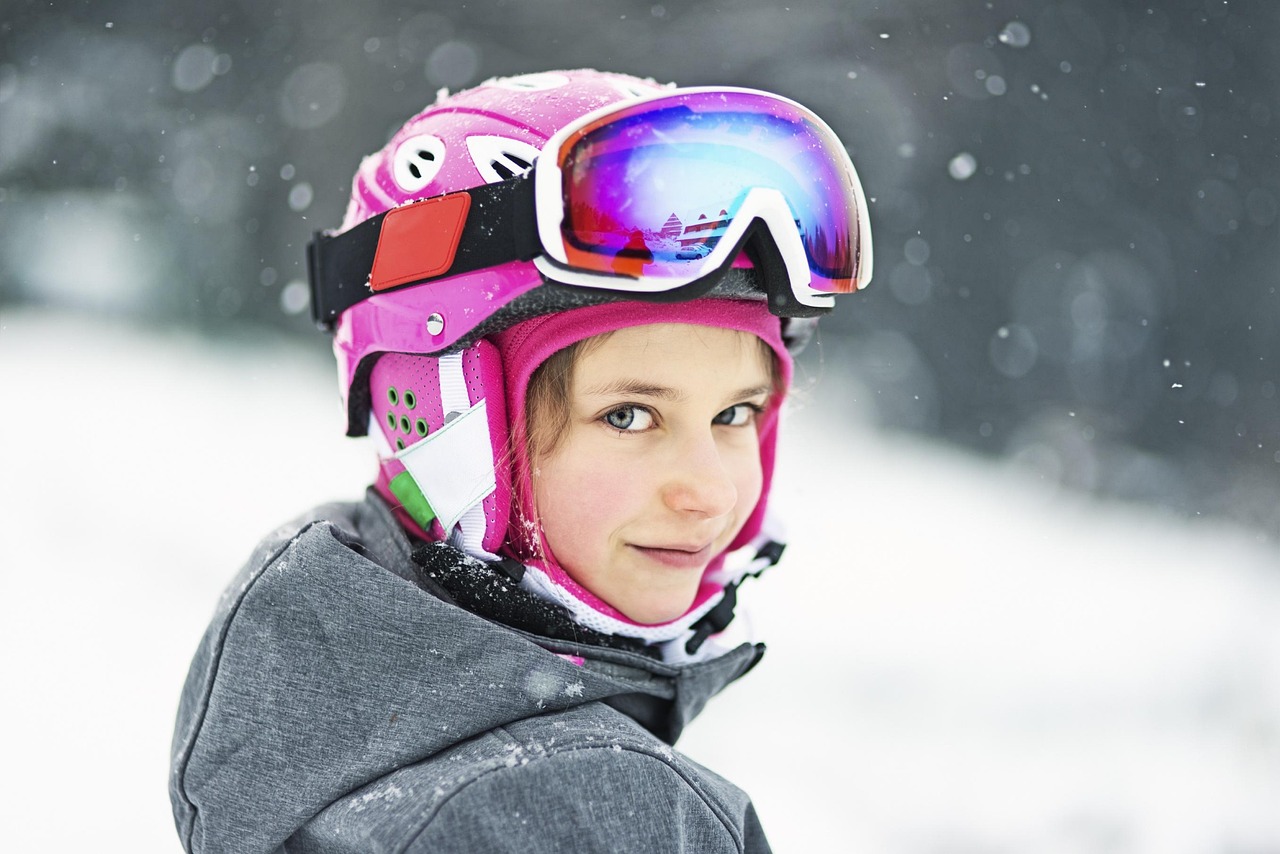
Helmets are now standard for children on the slopes. The National Ski Areas Association (NSAA) reports that nearly 100% of kids 9 and under wear one, without any state or local mandate, and 96% of skiers and riders 17 and under wore a helmet in 2024/25. The AAP says all skiers and snowboarders should wear helmets and that parents should enforce it for their own kids and teens even where the ski area doesn’t require it.
The research backs it up. A 2010 meta-analysis in the Canadian Medical Association Journal found that skiers and snowboarders with helmets were significantly less likely to have head injuries, and in the studies that included children under 13 the link was even stronger (an odds ratio of 0.41), with no increase in neck injuries. Here’s how to choose one:
- Ski-specific, with a snow-sports label. AAOS says skiers should wear a ski helmet, not a bike helmet. Look for ASTM F2040 (the US standard for recreational snow sports helmets) or EN 1077, the European standard.
- Fit, not room to grow. Measure around the head about an inch above the eyebrows and ears, then match the maker’s size chart. It should feel snug: when you gently rock it, the skin of the forehead should move with it.
- No goggle gap. There should be no bare forehead between the top of the goggles and the helmet. Pairing the same brand’s helmet and goggles makes that easier.
- Replace it after a hard hit. Helmet foam compresses in an impact. Many experts also suggest replacing a helmet every 3–5 years of use.
One more thing to teach kids early: ASTM notes that a helmet helps reduce the risk of some head injuries at slower speeds, but its protection is limited. NSAA’s motto is to wear a helmet and ski as if you weren’t wearing one.
Three kids’ picks: the Smith Glide Jr. MIPS, a youth helmet the maker says is certified to ASTM F2040 and EN 1077, with a MIPS liner and a dial fit (about $110); Giro Rev youth goggles, a youth medium frame designed to match Giro’s kids’ helmets (about $30); and Darn Tough Little Yeti over-the-calf ski socks, mostly merino wool and made in Vermont (about $24).
Smith Glide Jr. MIPS Youth Helmet
- ASTM F2040 + EN 1077 (maker)
- MIPS liner, dial fit
- Smith's widest youth size range
Giro Rev Youth Snow Goggles
- Youth medium frame
- Cylindrical lens
- Matches Giro youth helmets
Darn Tough Little Yeti Kids' Ski Socks
- Over the calf, cushioned
- 61% merino wool
- Lifetime guarantee
Gear that fits: skis, boots and bindings
The AAP’s rule is simple: equipment should fit the child, and skiers should use safety bindings that are adjusted at least every year. That matters because kids grow and gain weight, and binding release settings depend on weight, height, ability and boot size. AAOS says boots and bindings should be set, adjusted, maintained and tested by a ski shop that follows ASTM standards. Don’t hand down skis and set the bindings yourself.
- Boots: snug and comfortable, with one thin pair of ski socks; retailer evo’s fitting guide notes that extra thickness between foot and boot shell takes away control. A boot fitter can check the size.
- Skis: shorter is easier for beginners; a shop will size by height, weight and ability.
- Rent or lease at first: many families rent for the first seasons or lease a kids’ package for the winter, which also means a shop checks the bindings.
More on boots, bindings and goggles on our skiing gear page.
Staying warm, dry and sun-safe
Cold is what ends most kids’ ski days. The AAP’s advice:
- Several thin layers to stay warm and dry, plus insulated boots, mittens or gloves and a hat (under the helmet, a thin liner or balaclava). Skip cotton next to the skin, because it holds sweat.
- Change out of wet clothes right away, and plan regular indoor breaks to warm up.
- Know frostbite: fingers, toes, ears and noses are most at risk. Frostbitten skin may hurt or burn, then go numb and turn white or pale gray. Bring the child indoors, don’t rub it, and rewarm in warm (not hot) water.
- Extreme cold: the AAP says to generally avoid playing outside when temperatures or wind chills are below −15 °F, when exposed skin can freeze within minutes.
Sun is the other risk. The World Health Organization notes that fresh snow can reflect up to 80% of UV radiation and that skiers at altitude can get snow blindness, a painful sunburn of the eyes. Goggles or sunglasses with UV protection and sunscreen on every exposed patch of skin, even on cloudy days.
Supervision and slope sense
The AAP says children should never ski alone. Young children should always be supervised by an adult; older kids’ need for supervision depends on their maturity and skill, but they should at least ski with a friend. Slopes should match the child’s ability, crowded slopes and areas with trees and obstacles are best avoided, and kids should learn the skier responsibility code from the start: stay in control, people downhill have the right of way, stop where you can be seen. NSAA adds that anyone who leaves the groomed runs should ski with a partner within sight, because of tree wells and deep snow. Kids heading into the terrain park should learn NSAA’s Park SMART rules first: start small, make a plan, always look, respect, take it easy.
If your child hits their head
Follow the CDC’s HEADS UP approach: if a child seems dazed or confused, can’t remember the fall, or has a headache, dizziness, balance problems or sensitivity to light or noise, take them off the slopes for the rest of the day and have a healthcare provider check them before they ski again. Call ski patrol or 911 for danger signs such as repeated vomiting, growing drowsiness, a seizure or a headache that keeps getting worse. Replace the helmet. More on our skiing injuries page.
From ski school to ski racing
Kids who love speed and gates usually move from ski school into a race program at a local club; U.S. Ski & Snowboard has around 400 member clubs, mostly based at ski areas, that offer introductory training and competition. In the snow states, high school teams follow: 9,411 students raced alpine skiing for their schools in 12 states in 2024-25, according to the NFHS. College skiing comes next, in the NCAA or the club teams of the USCSA. The whole ladder is on our leagues and associations page. Kids who’d rather ride a board have a home too: see our snowboarding section.
Back to the skiing hub, or see how helmets and safety work in other youth sports on our youth cycling guide and youth hockey guide.
Parents’ questions about kids skiing
What age should kids start skiing?
It depends on the child and the ski school. Each school sets the ages for its programs, often starting in the preschool years. What matters most is that kids learn from a qualified instructor in a program designed for children, as the AAP recommends, and that the first days are short and fun.
Do kids need to wear a ski helmet?
Yes. The AAP says all skiers and snowboarders should wear helmets, and research links helmets with a lower risk of head injury, especially in children. Choose a ski helmet certified to ASTM F2040 or EN 1077 that fits snugly now.
How often should kids’ ski bindings be adjusted?
At least every year, according to the AAP, and whenever your child changes boots or gains a lot of weight or height. Have a ski shop do it; the settings depend on weight, height, ability and boot size.
Can my child ski alone?
No child should ski alone. The AAP says young kids should always be supervised by an adult, and older kids, depending on maturity and skill, should at least ski with a friend. Agree on a meeting spot and a time in case you get separated.
How do I keep my child warm on the slopes?
Several thin layers rather than one bulky one, no cotton next to the skin, one pair of thin ski socks, mittens, and regular indoor breaks. Change wet clothes right away, and watch fingers, toes, ears and noses for frostbite.