This article contains affiliate links: if you buy through them we may earn a commission, at no extra cost to you. Learn more.
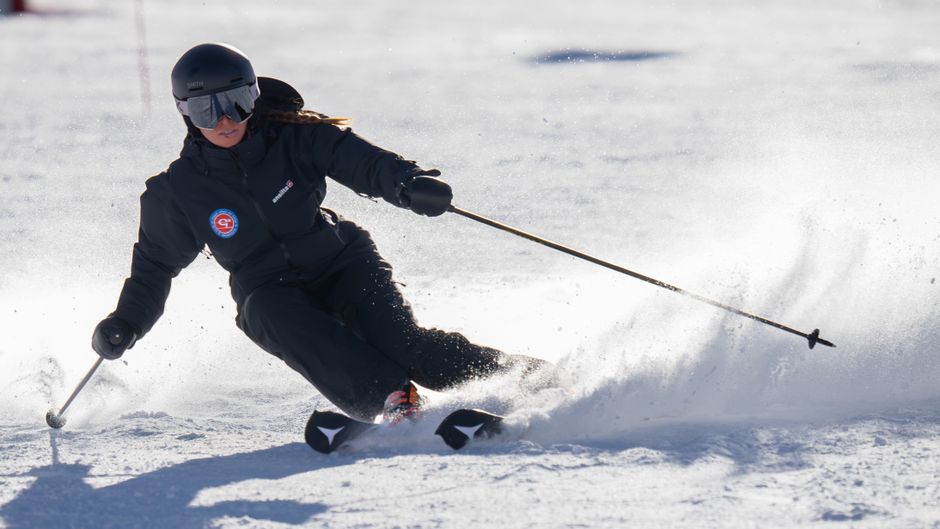
A ten-year-old in a club race bib, pacing in the start corral of a Saturday giant slalom while her coach slips the course. A college team piling out of a van at a mountain in Vermont for the NCAA regionals. And on a February morning in Cortina d’Ampezzo, Breezy Johnson crossing the line to win Olympic downhill gold, the first U.S. gold of the 2026 Winter Games. All of that is organized by a ladder of ski associations, from your local club to FIS, the international federation. Here’s who runs what, and how a skier climbs from one rung to the next.
The governing bodies
FIS (International Ski and Snowboard Federation)
FIS was formed in 1924, during the first Olympic Winter Games in Chamonix, France, and is based in Oberhofen am Thunersee, Switzerland. It has 141 member nations and sanctions more than 7,000 competitions a year, about 330 of them World Cup events. FIS sets the international rules for the Olympic disciplines of alpine skiing, cross-country skiing, ski jumping, Nordic combined, freestyle skiing and snowboarding, and for the Paralympic disciplines of para alpine skiing, para cross-country and para snowboard. It also runs nine World Championships, held every two years, including alpine, Nordic and freestyle/snowboard. FIS counts about 39,000 licensed, active athletes.
U.S. Ski & Snowboard
U.S. Ski & Snowboard is the national governing body for Olympic and Paralympic skiing and snowboarding in the United States. It traces its roots to the National Ski Association, founded in 1905, and is based in Park City, Utah, where its Center of Excellence trains the national teams. It has around 400 member clubs and nearly 40,000 athletes, officials and coaches, and sanctions over 4,000 local competitions a year. Athletes earn points in regional and national races, and the top-ranked are named to the U.S. Ski Team. It also trains coaches and the officials who run races under U.S. Ski & Snowboard and FIS rules.
The industry groups that keep you safe
Two more names you’ll see at every resort. The National Ski Areas Association (NSAA), formed in 1962 and based in Lakewood, Colorado, is the trade group of U.S. ski areas; it publishes Your Responsibility Code, the trail signs and the national injury and helmet statistics. PSIA-AASI, the Professional Ski Instructors of America and American Association of Snowboard Instructors, is the nonprofit that educates and certifies ski and snowboard instructors. Rules of the slope are on our skiing rules page.
The World Cup and World Championships
The FIS Alpine Ski World Cup began in 1967. All winter, the best racers travel mostly through Europe and North America, scoring points in downhill, super-G, giant slalom and slalom: the top 30 in each race score, with 100 points for a win. At the end of the season in March, the leader in each discipline wins a small crystal globe and the overall leader wins the big one. America’s Mikaela Shiffrin won her 87th World Cup race in March 2023, passing Sweden’s Ingemar Stenmark for the most in history. Every two years the season also includes the FIS Alpine World Championships. Freestyle, cross-country and the other disciplines run their own World Cup tours.
The Olympics and Paralympics
Alpine skiing has been on the Olympic program since 1936. At Milano Cortina 2026 there were 10 alpine medal events, downhill, super-G, giant slalom, slalom and the new team combined for men and women, with the women racing in Cortina d’Ampezzo and the men in Bormio. The US won four alpine medals: Breezy Johnson’s downhill gold, Mikaela Shiffrin’s slalom gold (her third Olympic gold, the most of any American alpine skier), Ryan Cochran-Siegle’s super-G silver and a team combined bronze for Jackie Wiles and Paula Moltzan. Freestyle skiing had 15 events, with dual moguls new, and cross-country 12.
Para alpine skiing has been a Paralympic sport since the 1976 Games in Örnsköldsvik, Sweden, which drew 78 competitors from 12 nations. Skiers race in sitting, standing and vision-impaired categories in downhill, super-G, giant slalom, slalom and combined, and FIS took over the sport from World Para Alpine Skiing in July 2022. Austria is the most successful nation, with 280 Paralympic medals.
College skiing: NCAA and USCSA
NCAA skiing is co-ed: men and women race alpine (slalom and giant slalom) and Nordic (classic and freestyle) events, and individual and team titles are decided by points across all four. East, Central and West regions hold separate alpine and Nordic qualifiers. The 2027 NCAA Skiing Championships are scheduled for March 10–13 at Stowe Mountain Resort and the Craftsbury Outdoor Center in Vermont.
For club and team racing, there’s the United States Collegiate Ski & Snowboard Association (USCSA). Founded in 1974, it counts more than 140 member schools and over 5,000 student-athletes a year, organized in 11 conferences and 6 regions. It sanctions alpine (250+ teams), Nordic (40+ teams), snowboard and freestyle; teams enter five or more racers per event and the top three scores count. National championships rotate: Lake Placid in 2026 and Mt. Bachelor in 2027. Its motto is that the student comes before the athlete.
High school ski racing
Ski racing is a varsity sport in the snow states. In the NFHS 2024-25 participation survey, 12 states reported alpine skiing teams, with 5,029 boys and 4,382 girls (9,411 in all) at about 600 schools each for boys and girls. Minnesota and Massachusetts had the most racers, about 2,050 each, followed by Michigan; the others were California, Colorado, Maine, Nevada, New Hampshire, New York, Utah, Vermont and Wyoming. Another 6,508 students raced cross-country skiing.
Clubs: where most racers start
Most young racers come up through one of U.S. Ski & Snowboard’s clubs, usually based at a local ski area. Clubs offer introductory programs, training and competition, and run the races where athletes earn points and move up through regional and national events. Adults can race too, in weeknight beer leagues and masters racing. For families just starting, our youth skiing guide explains ski school, the step into a club and what to buy. And when you’re ready for race day, see our skiing gear page and skiing training page.
Race days are long and cold: hours of inspection, waiting and riding lifts. Three things many racers and parents pack:
Smith Mission MIPS Helmet
- ASTM F2040 + EN 1077 (maker)
- MIPS liner, dial fit
- About $85 to $120
Nuun Sport Tablets
- 300 mg sodium per tablet
- 1 g sugar
- Informed Choice
Theragun Mini (3rd Gen)
- Pocket size, 3 speeds
- 3 attachments
- Travel case
The Nuun Sport tablets are Informed Choice certified according to the maker, and a Theragun Mini fits in a race bag for tired quads (see our massage gun guide and electrolyte guide). Back to the skiing hub, or see how team sports organize on our soccer leagues page.
Skiing leagues and associations questions
What is the governing body of skiing?
Internationally, FIS, the International Ski and Snowboard Federation, founded in 1924 with 141 member nations. In the US, U.S. Ski & Snowboard is the national governing body for Olympic and Paralympic skiing and snowboarding.
Is skiing an NCAA sport?
Yes. NCAA skiing is co-ed, with men and women racing alpine and Nordic events and one combined team title. Many more college skiers race club and team events through the USCSA, which has more than 140 member schools.
How do I start ski racing?
Join a club at your local ski area: U.S. Ski & Snowboard has around 400 of them, with programs from first gates to national-level racing. High school teams in the snow states, adult leagues and masters racing are other ways in.
What is the Alpine Ski World Cup?
The top level of ski racing, run by FIS every winter since 1967. Racers score points in each race (100 for a win), and the season winners take crystal globes, one overall and one for each discipline.
Who has the most Olympic gold medals in U.S. alpine skiing?
Mikaela Shiffrin, with three, after her slalom gold at Milano Cortina 2026. She also holds the record for the most World Cup race wins of any skier.