This article contains affiliate links: if you buy through them we may earn a commission, at no extra cost to you. Learn more.
The swell finally arrives after three flat weeks. You paddle out full of hope, and twenty minutes later your shoulders are burning, you’re a step late on every wave and you get caught inside on the big set. Surfing fitness fades fast when you’re not in the water, and it’s hard to build anywhere else. This page is the off-season and between-swells plan: surf training for paddle power, a quick pop-up, strong shoulders, safe breath-hold work and mobility. It works for a 12-year-old on a school surf team, a college club surfer, a competitor chasing points, and the 50-year-old who wants to surf every weekend for another twenty years.
General information, not medical advice. If you have a shoulder or back problem, a heart condition, or you’re coming back from injury, check with a sports medicine doctor or physical therapist before you start. Back to the surfing hub.
What a surf session asks of your body
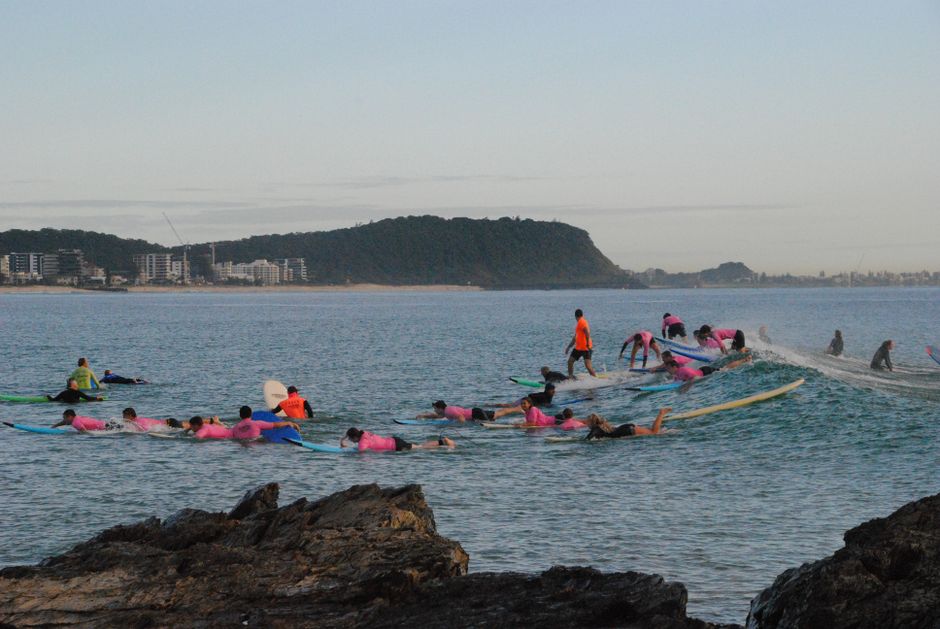
Surfing looks like riding waves, but the numbers say it’s mostly paddling and waiting. In a study of 15 competitive male surfers wearing GPS units and heart-rate monitors through a 2-hour session, they spent about 43% of the time paddling, 4% sprint paddling to catch waves, 53% sitting still and just 2.5% actually riding waves. They covered about 6.3 km and averaged 128 beats a minute, peaking at 171. A 2024 systematic review of GPS studies sums it up: long stretches of paddling and waiting, broken by short, very hard efforts. So you need two engines: aerobic endurance for the paddling and repeated sprint power for catching waves and getting out of the impact zone.
The same researchers noted that free-surf training was easier than contest heats and suggested adding repeated sprint-paddle efforts to prepare for competition.
Paddle fitness: train paddling, not just swimming
Swimming is good fitness for surfers, but it isn’t the same movement. A study that compared front crawl with paddling a surfboard in a pool concluded the two are distinct actions and that surfers training in a pool “should not simply be swimming”. The best paddle training is paddling: on your own board in flat water, a pool lane, or a lake when the ocean is flat.
- Endurance: steady paddles of 20 to 40 minutes at a pace you could hold a conversation at, once or twice a week in flat spells.
- Sprint paddles: after a warm-up, short all-out efforts of about 10 to 15 seconds (the length of a wave-catching sprint) with full recovery between, in sets of 6 to 10.
- Duck-dive and turtle-roll practice in small surf, so getting out the back costs less energy.
These are practical examples, not a prescription; build up over weeks. On land, upper-body pulling strength matters. In a 2025 study of 32 competitive Australian surfers (men and women), faster 5, 10 and 15 m sprint-paddle times went with a stronger pull-up relative to body weight, stronger isometric shoulder rotation and a better balance between external and internal rotation. That points to pull-ups (or band-assisted pull-ups), rows and rotator-cuff work. Pull-up assistance bands such as the WODFitters set let you build up to full pull-ups and double as rotator-cuff bands; see our best resistance bands guide.
Shoulder care for paddlers
A 2021 systematic review on “surfer’s shoulder” found that paddling mostly works the internal rotators and shoulder flexors, while the external rotators work only when the arm is out of the water. Surfers with shoulder complaints had weaker, stiffer external rotation. A simple twice-a-week routine that targets those weak links:
- Band external rotations, elbow at your side, 2–3 sets of 12–15.
- Band pull-aparts and face pulls for the upper back.
- Prone “Y-T-W” raises lying face down on a bench or the floor (the paddling position).
- Rows and pull-ups for strength, with good shoulder-blade control.
If paddling hurts, the shoulder keeps “catching”, or pain wakes you at night, see a PT rather than training through it. More on our surfing injuries page.
Pop-up strength and balance
The pop-up is a push-up that ends in a low, balanced squat, done on a moving board in about a second. Train it on land:
- Push-ups with a fast, explosive push, then land pop-ups: from lying flat, hands under your chest, spring to your feet in your surf stance. Sets of 5–10, quality over quantity.
- Legs and hips: goblet squats, split squats and lateral lunges for a strong, low stance.
- Core: planks, side planks and dead bugs. Rotation drills (cable or band chops) carry over to turns.
- Balance: a roller balance board like the Indo Board Original trains stance and small corrections at home; start next to a wall or with a cushion and progress slowly, since falls are possible.
Low back pain on take-off? A physical-therapy paper describes back pain during the pop-up as a common problem and suggests a “knee pop-up” (coming up through one knee first) as a lower-strain alternative. A board with more volume, which needs less back arch to paddle, also helps many surfers.
Breath-hold training: safety first
Being held under by a wave is part of surfing, and calm under water matters, especially as the waves get bigger. But breath-hold training is where surfers can get hurt badly. Read this before you try any of it.
Hypoxic blackout (often called shallow water blackout) is losing consciousness under water during a breath hold, often after hyperventilating. It can happen in any water, at any depth, and with little warning; survival depends on someone pulling you out right away. A CDC report reviewed 16 drownings and near-drownings linked to dangerous breath-holding in New York State: four people died, all aged 17 to 22, and half of the swimmers were advanced. The behaviors involved were intentional hyperventilation, prolonged breath-holding and long underwater swims, and combining them made a death more likely.
- Never do breath-hold training in water alone. Not in a pool, not in the ocean, not in a bathtub.
- Never hyperventilate (fast, deep breathing) before going under. It delays the urge to breathe, not the need for oxygen.
- No breath-hold contests and no “how far can you swim underwater” games, the patterns in the CDC report.
- Do it on dry land, sitting or lying down, never standing, never in water and never while driving; and a dry-land session still benefits from a buddy.
- Want more? Take an in-person freediving or big-wave safety course with a qualified instructor, where in-water work is supervised one-to-one.
For most surfers, the safest way to handle hold-downs is fitness (a lower heart rate), staying relaxed, and choosing waves that match your skill.
Mobility: hips, upper back and ankles
Surfing needs an upper back that extends for paddling, hips and ankles that let you sit low on the board, and shoulders that reach overhead. A 10-minute routine before sessions and after land training: thoracic extensions over a foam roller such as the TriggerPoint GRID, open-book rotations, world’s greatest stretch, deep squat holds, couch stretch for the hip flexors and ankle rocks. Many surfers add yoga once a week. On the beach, warm up with arm circles, leg swings, a few squats and land pop-ups before you paddle out.
Indo Board Original Balance Trainer
- Deck + roller
- Surf-style balance at home
- Add a cushion to start easier
WODFitters Pull-Up Assistance Bands
- 5-band set, layered latex
- Assisted pull-ups
- Rotator-cuff and pull-apart work
TriggerPoint GRID 1.0
- 13 in, hollow core
- Upper-back extension work
- About $40
Putting it together: a sample week
- Surfing most days: the surf is your conditioning. Add two short strength sessions (pull, push, legs, shoulder care) and daily mobility.
- Flat spell or winter: two paddle or swim sessions (one steady, one sprint), two strength sessions, one balance or skate session, mobility daily, at least one full rest day.
- Competitors before an event: keep the sprint paddles, ease off heavy lifting in the last week, and surf the contest break at heat time if you can.
- Young surfers: the American Academy of Pediatrics recommends at least 1–2 days off a week from organized sport and time off across the year. Bodyweight strength and play beat heavy lifting; see the youth surfing page.
- Adults over 40: keep the strength work year-round; it protects shoulders and makes the pop-up easier. Track recovery on our surf wearables page.
What to eat around training is on the nutrition page, and how team-sport athletes plan their week is on our soccer training page.
Surf training: FAQs
What is the best exercise for surf paddling?
Paddling itself, on a board. On land, research on competitive surfers links faster sprint paddling to pull-up strength relative to body weight and to strong, balanced shoulder rotation, so pull-ups, rows and rotator-cuff work are the best gym additions.
Is swimming good training for surfing?
It’s good fitness and good water confidence, and every surfer should be a strong swimmer. But researchers found front crawl and surf paddling are different actions, so add board paddling too.
Is it safe to practice holding my breath in the pool?
Not alone, and never after hyperventilating. Hypoxic blackout can happen at any depth with little warning, and a CDC report found deaths among young, skilled swimmers. Do breath-hold work on dry land, or in the water only under one-to-one supervision in a qualified course.
How can I make my pop-up faster?
Practice it on land every day: explosive push-ups and land pop-ups into your stance, plus hip mobility so your front foot lands where it should. A balance board helps with the landing.
Do balance boards help surfing?
Many surfers use them to practice stance and small balance corrections when they can’t get in the water. They don’t replace surfing, and falls happen, so start with a cushion or near a wall.