This article contains affiliate links: if you buy through them we may earn a commission, at no extra cost to you. Learn more.
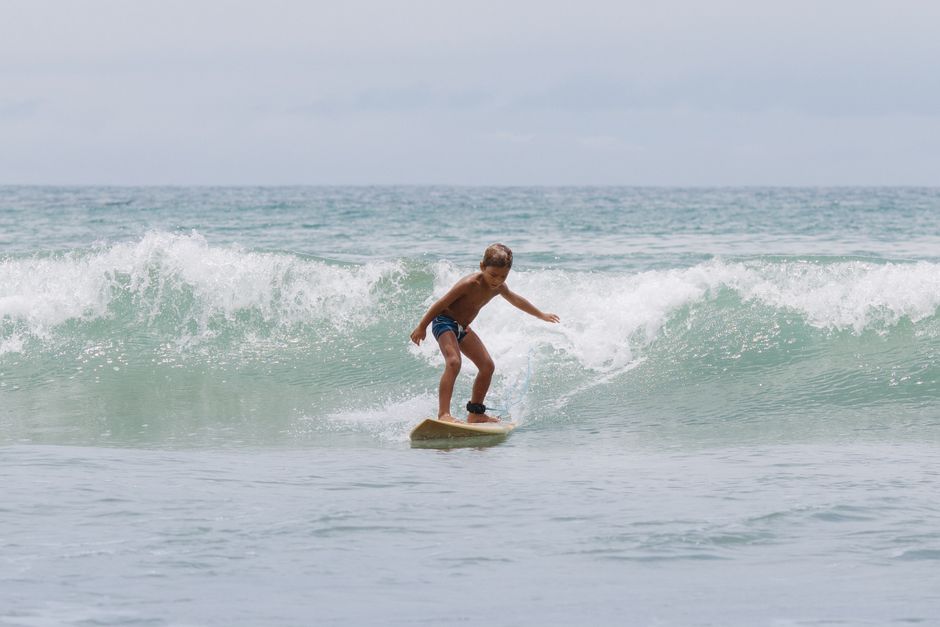
Day three of summer surf camp. A row of foam boards on the sand, a dozen kids in matching rash guards practicing pop-ups, an instructor waist-deep in warm water giving each one a push into the whitewater. Then it happens: a nine-year-old stands up, wobbles, and rides all the way to the beach, arms out, screaming with joy. Parents on the sand cheer like it’s a World Cup final. Youth surfing is one of the best gifts you can give a water-loving kid, and with a few safety basics it’s a sport they can enjoy for life.
This page is for parents and young surfers: when to start, why swimming comes first, how to choose a surf camp or school, ocean safety, sun and cold water, and how kids can compete. For the big picture, see our surfing hub.
When can kids start surfing?
There’s no official starting age. What matters is that a child can swim, is comfortable in waves and can follow an instructor’s directions in the water. Many kids start by playing in the shorebreak on a bodyboard, then move to a big foam surfboard with a lesson. For competition, the National Scholastic Surfing Association (NSSA) has a Mini Groms division for 10 and under and a Menehuene division for 12 and under, so some kids enter contests in elementary school. Most don’t need to: the goal at the start is fun, and lots of waves.
Swimming comes first
A leash can snap, and a child may have to swim in through waves without a board. Before surfing, build real swimming ability:
- Swim lessons. The CDC says formal swimming lessons can reduce the risk of drowning. The American Academy of Pediatrics (AAP) recommends swim lessons for all children and parents as one layer of water safety, starting after a child’s first birthday depending on readiness.
- Open water is different from a pool. The CDC notes that oceans and lakes have hidden hazards such as dangerous currents or waves, rocks and limited visibility. Practice in calm open water with an adult before surf lessons.
- Life jackets. The CDC and AAP say children should wear life jackets in and around natural water. For young or weaker swimmers playing in the waves, that still applies; ask your surf school how it handles life jackets or flotation vests for its youngest students.
- Learn CPR yourself. The CDC notes that your CPR skills could save a life in the time it takes paramedics to arrive.
Ask every camp how it checks a child’s swimming before they go in. If a camp doesn’t ask about swimming at all, ask why.
Choosing a surf school or surf camp
A good first lesson turns a curious kid into a surfer; a bad one, in waves that are too big, can turn them off for years. Questions to ask:
- Who are the instructors? Ask about their surf coaching training and whether they hold current lifeguard, CPR and first-aid certification.
- What’s the ratio of kids to instructors in the water, and do instructors stay in the water with the kids?
- Where do they teach? A gentle beach break with a sandy bottom, near a lifeguard tower, is ideal. Ask what happens when the surf is too big.
- What gear is included? Soft foam boards, leashes, rash guards and wetsuits should be included and in good shape.
- Do they teach ocean safety? Rip currents, how to fall, how to hold the board and basic surf etiquette should be part of day one.
- Permits and insurance. Ask whether the school holds the permit or license its beach requires, and what insurance it carries.
Ocean safety for young surfers
Rip currents
Teach kids to spot rips (ask a lifeguard to point them out; they often show as a gap in the breaking waves) and what to do if one takes them. The National Weather Service says rips usually flow 1 to 2 feet per second and can reach 8 feet per second, faster than an Olympic swimmer, and that pulses can more than double their speed for 30 seconds to a minute. The plan: stay on the board (it floats), stay calm, don’t fight the current, paddle or swim parallel to the beach, or float and wave and yell for help.
Lifeguards, buddies and forecasts
NOAA advises visiting beaches protected by lifeguards, who post flags for the day’s hazards, and checking local rules with them. The CDC’s rule is simple: always swim with a buddy, and check the forecast before you go. NOAA warns that distant hurricanes can send dangerous surf even when the local weather is nice. For kids, “never surf alone” means an adult who can swim is watching, on the beach or in the water.
Falls and boards
Being hit by your own board is the most common way surfers get hurt, and in US emergency room data concussions were 8% of surfing head and neck injuries in surfers under 20 (versus 5% overall). Teach kids to fall flat and away from the board, cover their head with their arms when they come up, and never dive head-first into shallow water. If a child takes a knock to the head and seems dazed, has a headache, is dizzy or confused, take them out of the water for the day and see a health care provider; that’s the CDC’s HEADS UP advice for any youth sport. Our surfing injuries page has the full list of warning signs.
Sun, cold water and comfort
Kids in the water for hours get a lot of sun, much of it reflected off the water. The American Academy of Dermatology recommends a broad-spectrum, water-resistant sunscreen with SPF 30 or higher, reapplied every two hours and after swimming. A mineral sunscreen like Thinkkids SPF 50+ (about $17, 80 minutes water resistant, no oxybenzone or avobenzone per the maker) plus a long-sleeve rash guard like the O’Neill Youth Basic Skins UPF 50+ (about $10 to $30 depending on size and color) covers most of it. Add a hat and shade for the breaks on the sand.
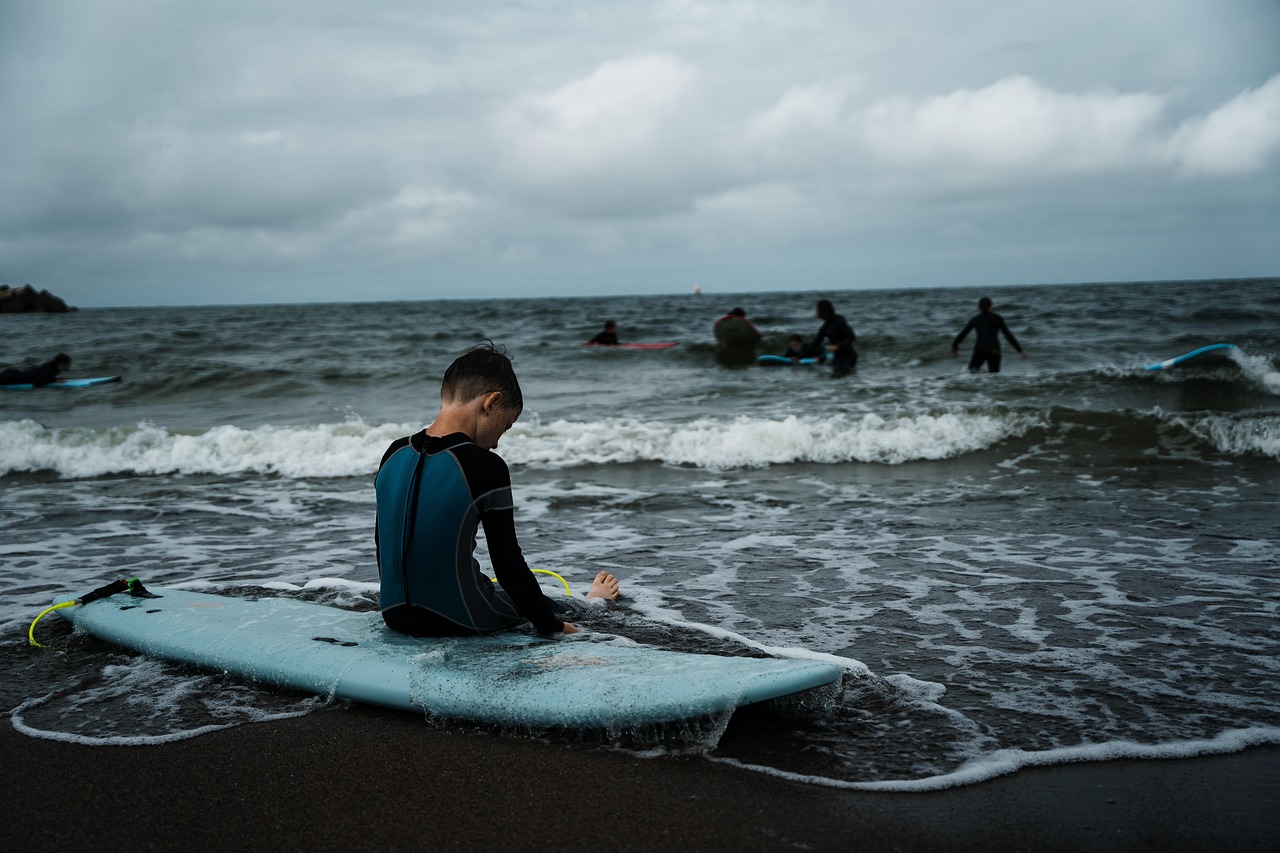
Kids lose heat fast. In cool water, a properly fitting wetsuit makes the difference between a happy hour of surfing and blue lips after 15 minutes. O’Neill’s guide suggests a 3/2 mm or 4/3 mm full suit for water around 64 to 68°F and a 4/3 or 5/4 mm suit for 54 to 63°F. Get them out, dry and warm when they start shivering. Our surfing gear page has the full chart.
From surf camp to contests
Kids who love it can join a local surf club or team and try contests. In the US, the regional amateur associations (Western, Eastern, Hawaiian and Texas Gulf Surfing Associations) and the NSSA all run youth divisions, and USA Surfing’s Prime series and championships are the next step. The NSSA requires its competitors to keep up academic standards, and it has team seasons for middle and high school surf teams. More on our surfing leagues and associations page.
Keep it balanced. The AAP’s report on sport specialization encourages young athletes to play more than one sport and to take time off, and swimming, skateboarding and other sports all build surfing skills. Watch for shoulder pain from paddling that lasts more than a few days, and see a sports medicine doctor, physical therapist or athletic trainer if it does. The surf training page has kid-friendly dryland ideas.
What to get a young surfer
Prices change often. The prices below are what we saw at the maker or a major retailer in October 2026; check the current price before you buy.
A big foam board is the right first board for kids and adults. The Wavestorm 8 ft Classic (about $300) is 8 ft long with 86 liters of volume, enough to float a parent too, and comes with fins, a leash and a traction pad. Smaller kids may manage a shorter foam board better; ask the surf school what size they teach on.
Wavestorm 8 ft Classic Soft Top
- 8 ft, 86 L foam board
- Fins, leash, traction pad included
- 11.5 lb
O'Neill Youth Basic Skins Rash Guard
- UPF 50+
- Skin Cancer Foundation recommended
- Snug performance fit
Thinkkids Mineral Sunscreen SPF 50+
- Mineral formula
- 80 min water resistant
- 6 fl oz
Back to the surfing hub, or see surf etiquette and rules, surfing gear and surfing injuries. Parents of multi-sport kids may also like our youth soccer page.
Parents’ questions about youth surfing
What age can kids start surfing?
There’s no set age. Kids are ready when they can swim comfortably, aren’t afraid of small waves and can follow an instructor in the water. Many start with lessons in elementary school; NSSA contests have a division for 10 and under.
Does my child need to know how to swim to surf?
Yes. A leash can break, and a child may need to swim back through waves. Formal swim lessons lower drowning risk, according to the CDC, and open-water practice with an adult helps before surf lessons.
Is surfing safe for kids?
With a good school, small waves, a soft board and a lifeguard nearby, it’s a reasonable-risk sport. Most surfing injuries are cuts and bumps from the board. The real dangers are the ocean itself, so swimming ability, rip current knowledge and supervision come first.
What should a child wear to surf?
In warm water, a long-sleeve UPF rash guard, board shorts or a swimsuit, and water-resistant sunscreen. In cool water, a properly fitting wetsuit of the right thickness for the water temperature.
What should a surf camp include?
Trained instructors with lifeguard, CPR and first-aid certification, a low kid-to-instructor ratio, soft boards and wetsuits, a gentle beach near a lifeguard, and lessons on ocean safety and etiquette, not just riding waves.