This article contains affiliate links: if you buy through them we may earn a commission, at no extra cost to you. Learn more.
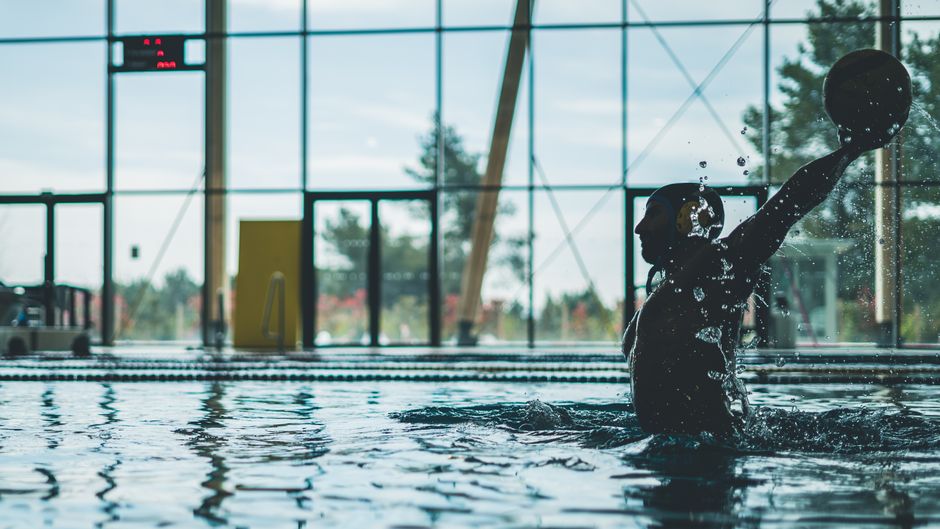
Preseason, 6 a.m.: a line of players in the deep end, hands up out of the water, legs whirring underneath, while the coach counts down 30 seconds that feel like five minutes. Then the same again holding a weight belt overhead. Every water polo player knows this drill, because everything in the game sits on top of the legs. This page is about water polo training: building the eggbeater and leg strength, swim conditioning for a game of sprints, shoulder care for a throwing arm that never touches the ground, and dryland strength work, for youth players, high school and college teams, masters and anyone coming back to the pool.
General training information, not a personal program. Young players should lift only with qualified supervision, and anyone with pain or a past injury should check with a sports medicine doctor, physical therapist or athletic trainer first. Back to the water polo hub.
What the game asks of your body
A World Aquatics game is four periods of eight minutes of actual play, with the clock stopping at every whistle, so real games run much longer. Inside that, the work comes in bursts: an analysis of 17 games at the 2019 World Championships found that 89% of game actions came in unbroken chains, ranging from about one minute up to eight minutes without a real break in play. That means water polo training has to build three things at once: an aerobic engine to keep going, the ability to sprint again and again, and strength in the legs, core and shoulders for wrestling position and throwing. Swimming fitness matters, but a water polo player also has to swim with the head up, stop, turn, and fight for position without touching the wall or the bottom.
Eggbeater and leg strength
The eggbeater kick is an alternating, circular kick that keeps a player high in the water with the hands free. Biomechanics studies using pressure sensors on players’ feet found that the lift comes mainly from the feet, and that the players who produced the most upward force differed from the rest in when and how they angled their feet during the outward part of the kick, not in how fast their feet moved. In plain words: technique first, then strength. Have a coach watch your kick from the deck or on video before you pile on weight.
- Hands-up eggbeater: timed holds with both hands out of the water, then with arms overhead.
- Loaded eggbeater: holding a ball, a water jug or a light weight overhead, or pushing against a partner, built up gradually.
- Boosts: explosive jumps up out of the water from the eggbeater, the “in-water vertical jump” coaches test.
- Lateral and backward eggbeater: moving sideways and back while staying high, as defenders do.
For teams that want numbers, a 2024 study showed that a simple tethered setup (a player eggbeatering against a weight stack on the pool deck, measured with a load cell) gives reliable, repeatable readings, so coaches can track leg strength across a season. Land strength carries over too: squats and jumps on dry land build the legs that drive the kick and the boost, as the strength research below shows.
Swim conditioning
Most water polo swim sets look like the game: repeated short sprints with short rests, head-up swimming, changes of direction, and counterattack sprints the length of the pool. Some longer aerobic swimming builds the base for this, especially early in the season. For freestyle technique, aerobic sets and how swimmers manage yardage, see our swimming training page rather than repeating it here. Two water polo specifics are worth knowing:
- Warm up in the water. In a 2026 study of international-level players, an in-water warm-up (or a dryland plus in-water warm-up) led to much better performance on a water polo sprint test than a dryland-only warm-up. Adding dryland didn’t add anything over in-water alone.
- Watch the load. In elite players, heart rate recovery after a standard swim test tracked short-term changes in training load: after two hard days, heart rate came down more slowly. Easy days are part of the plan, not a sign of weakness.
Shoulder care for the throwing arm
The shoulder is the most commonly injured body part in water polo, mostly from overuse (see our water polo injuries page). The research points to a few habits:
- Band and dumbbell rotator cuff work. In a 2026 trial, young players who did the Thrower’s Ten program (a band and dumbbell routine designed for throwers) three times a week for 10 weeks improved shoulder stability and flexibility compared with players who didn’t. A 2022 study of professional players found a 6-week mobility and strength plan improved shoulder range of motion. Typical moves: external rotations with a band, rows, Y-T-W raises and scapular push-ups.
- Balance inward and outward rotation strength. Players with a past shoulder injury shot harder but had weaker “braking” (external rotator) muscles relative to their throwing muscles.
- Count throws. Researchers studying sub-elite players suggest managing throwing volume, and educating players to report shoulder pain early; in their group, players waited an average of 10 days before telling the physio.
- Add new loads slowly. In a 2023 study where players added either heavy strength or power training in season, shoulder pain rose over the program in all groups and in-water skills didn’t improve. Strength work helps, but stacking it on a full season needs care.
Dryland strength
Does lifting on land help in the pool? The studies say yes, as long as the pool work continues. In a 6-week preseason study of professional men, both a dryland and an in-water strength group improved their jump, but only the in-water group improved their boost out of the water, and only the dryland group gained squat and bench-press strength. The authors recommended doing both. An 18-week in-season study of 56 young male players compared five strength programs: all of them raised throwing speed, most improved jump, boost and lifting strength, and eccentric-overload training (slow, heavy lowering phases) gave the biggest gains in throwing speed and lifting strength. And in a 2025 study, female players who did a heavy lifting session 15 minutes before in-water tests swam, threw and jumped just as well as without it.
- Legs and hips: squats, split squats, jumps and hip-strength work for the eggbeater and boosts.
- Pulling and pushing: rows, pull-ups and push-ups or presses, balanced so pulling isn’t neglected.
- Core and rotation: medicine-ball throws and anti-rotation holds for shooting power and holding position.
- Youth players: the American Academy of Pediatrics supports supervised strength training for kids, about 2 to 3 times a week for 20 to 30 minutes, starting without weights and focusing on form, with no maximal lifts until the body has finished growing.
Planning the season by level
Youth and splash ball: swimming skill, ball handling and fun first; the AAP recommends 1 to 2 days off a week and time away from any single sport each year, and warns that weekly training hours greater than a child’s age are linked with more overuse injuries. High school: a short, intense season; build swim fitness and leg strength over the summer so the first weeks aren’t a shock. College and elite: a long, periodized year; in elite players, morning heart rate variability dipped when preseason load jumped 60 to 70% and improved once in-season load came down by 30%. Masters and adult rec: two or three water sessions plus one or two short strength sessions a week is plenty, with extra attention to shoulders. Whatever your level, sleep and food make the training stick: see water polo recovery and water polo nutrition.
Training gear many players use
A game ball of your own means extra passing and shooting reps: the KAP7 Size 5 HydroGrip is the official NCAA men’s ball, and the KAP7 Size 4 is the official NCAA women’s ball. For dryland, a band kit like the THERABAND Beginner Kit covers shoulder work, and a medicine ball like the Champion Sports Rhino Elite covers rotational throws. To log swim sets and heart rate, see our water polo wearables page.
KAP7 Size 5 HydroGrip Water Polo Ball
- Size 5 (men's)
- NFHS and USA Water Polo approved
- About $40
THERABAND Resistance Band Beginner Kit
- 3 bands: yellow, red, green
- Latex (latex-free kit sold too)
- About $19
Champion Sports Rhino Elite Medicine Ball
- Choose your weight
- Rubber medicine ball
- From about $33
Water polo training: FAQs
How do I get a stronger eggbeater?
Get the technique right first: research shows the best kickers differ mainly in how they angle their feet, not how fast they kick. Then add hands-up holds, loaded eggbeater, boosts and dryland leg strength such as squats and jumps.
Should water polo players lift weights?
Yes, with good coaching. Studies of professional and young players found dryland strength training improved lifting strength, jump and throwing speed, and works best combined with in-water strength work. Kids should train under supervision and skip maximal lifts until they’ve finished growing (AAP).
How can I protect my shoulder in water polo?
Do regular rotator cuff and shoulder-blade work (programs like the Thrower’s Ten have helped water polo players’ stability and flexibility), manage how many throws you take, add new loads slowly, and report pain early.
Is swimming training enough for water polo?
It’s the base, but not enough on its own. Games are long chains of sprints, head-up swimming, wrestling and throwing, so players also need repeated-sprint sets, leg strength for the eggbeater, and shoulder and core strength.
What’s the best warm-up before water polo?
One that includes time in the water. In a 2026 study, in-water warm-ups beat dryland-only warm-ups on a water polo sprint test, and adding dryland on top didn’t add more.