This article contains affiliate links: if you buy through them we may earn a commission, at no extra cost to you. Learn more.
Two meters out from the cage, the center sets up with a defender hanging on his back, legs churning in the eggbeater, an elbow searching for space. The ball comes in, a hand slaps the water, someone takes a palm to the cheek, and the referee’s whistle cuts through the noise. Water polo is swimming, throwing and wrestling at the same time, in water too deep to stand in. World Aquatics’ own rules call it a contact sport with the highest rate of traumatic injuries of any aquatic sport. This page covers water polo injuries at every level, from 10-and-under splash ball to high school, college, masters and Olympic play: shoulder overuse, eyes and face, ears and the role of the ear-guard cap, hands and fingers, concussion, the drowning and blackout risks every player should know, and when to see a professional.
This page is general information, not medical advice. If you’re hurt, see a sports medicine doctor, physical therapist (PT) or certified athletic trainer (AT). For the bigger picture of the sport, start at our water polo hub.
How water polo players get hurt
There are two kinds of injury in this sport, and they come from different places. A 2021 systematic review of 41 studies found that the head, fingers and shoulders are the most common injury sites: sudden injuries mostly hit the hands and head, from unexpected contact with the ball or an opponent, while training injuries mainly affect the shoulder. College data looks the same. In five years of injury records from Pac-12 men’s and women’s teams (729 injuries), the shoulder was the most injured body part (20.6%), followed by the head and face (18.8%) and the hand, wrist and forearm (11.7%). At the 2015 World Championships, water polo had one of the highest injury rates of all aquatic sports, alongside high diving and diving.
Shoulder overuse: the thrower’s problem in the water
A water polo shoulder does everything a swimmer’s shoulder does, plus thousands of overhead passes and shots taken with no ground to push from. In a group of 80 sub-elite players, the shoulder was the most often injured site and caused a quarter of lost training days. Two-thirds of those shoulder injuries came from overuse, and players waited an average of 10 days before telling the team physio. In the Pac-12 study, shoulder tendinopathy (tendon irritation) was the most common shoulder diagnosis, although shoulder problems rarely needed surgery. A smaller group of players have a different problem: shoulder instability after a dislocation or partial dislocation; in one clinic’s 20-year series of 92 players with shoulder problems, more than half (58%) had had at least one instability episode.
What the research and clinicians point to: the review’s main shoulder risk factors were posture, shoulder-blade position, strength, flexibility and shooting mechanics. In a 2026 trial, 46 young players who added the Thrower’s Ten band and dumbbell program three times a week for 10 weeks gained shoulder stability and flexibility. The message: build rotator cuff and shoulder-blade strength, watch throwing volume, and report pain early. There’s more on fitting this into a week on our water polo training page.
Eyes and face
Players don’t wear goggles in games, and hands, elbows and the ball are all at eye level. A 2017 sports medicine review lists eye injuries, lacerations and fractures among water polo’s typical traumatic injuries. Cuts are common enough that World Aquatics tells event medical teams to carry sutures or skin glue, because the rules send a bleeding player out of the water at once and only allow them back as a substitute after the bleeding has stopped. Teeth get hit too: in a 2023 survey of 114 Croatian first-league players, 31 (27%) reported a dental injury from water polo, mostly upper front teeth from contact with another player. Only 7% wore a mouthguard, often because they found it uncomfortable.
The American Academy of Ophthalmology’s advice after any blow to the eye: don’t press on it, and if a black eye, pain or any change in vision appears, even after a light hit, contact an ophthalmologist or go to the emergency room right away. Trimmed fingernails matter too. World Aquatics requires players to arrive with fingernails properly cut and to remove anything likely to cause injury, and referees check.
Ears: ruptured eardrums and why the cap has ear guards
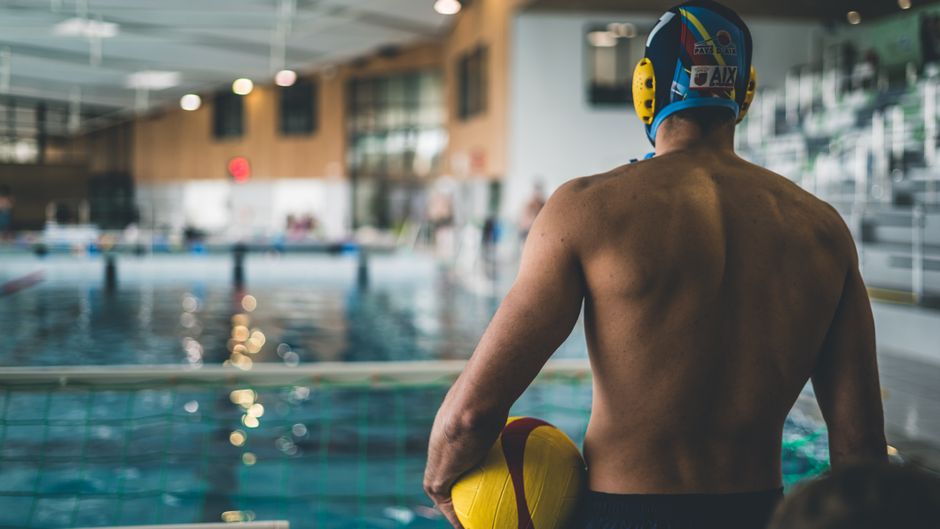
An open hand or a ball slapping flat against the ear can push a wave of water and pressure into the ear canal and tear the eardrum (tympanic membrane perforation), which the 2017 review lists among water polo’s traumatic injuries. That’s why the rules build protection into the uniform. World Aquatics requires caps fitted with malleable ear protectors, fastened under the chin, and the high school rules (NFHS) say every player in the water or on the bench must wear a cap with protective ear guards at all times. Those hard plastic cups wear out and crack; makers such as KAP7 sell replacement ear guards for their caps, so check yours before the season.
Signs of a ruptured eardrum, per MedlinePlus (the U.S. National Library of Medicine): ear pain that may suddenly ease when the eardrum tears, then drainage, buzzing and some hearing loss; dizziness or facial weakness in severe cases. Get it checked by a doctor. While it heals, MedlinePlus says to keep the ear dry, avoid swimming and keep your head out of the water, and that a small hole most often heals on its own within two months. Get care right away for severe dizziness, fever, hearing loss, intense pain or loud ringing. Outer-ear infections (swimmer’s ear) are covered on our swimming injuries page.
Hands and fingers
Goalkeepers block hard shots with open hands, and field players reach for the ball in traffic, so jammed and broken fingers are part of the sport. One to know is mallet finger: the American Academy of Orthopaedic Surgeons (AAOS) describes it as damage to the thin tendon that straightens the fingertip, usually when a hard object like a ball strikes the tip. The fingertip droops and won’t straighten on its own. AAOS says to have it seen by a doctor promptly, ideally within a week; most heal with a splint worn full time for 6 to 8 weeks. For any finger with swelling, bruising, deformity or that won’t move fully, AAOS advises getting it treated as soon as possible, because earlier care usually means a better result.
Concussion: goalies, elbows and the ball
Concussion is a bigger issue in water polo than many parents expect. In a survey of more than 1,500 USA Water Polo members, 36% said they’d had a concussion playing, and goalkeepers reported significantly more concussions than field players. In Pac-12 college records, concussion was the single most common injury diagnosis (11.4% of injuries), had the slowest return to play of the common injuries, and 82% happened outside of competition, in practice. A later Pac-12 study found goalkeepers’ concussions came mostly from ball-to-head contact, while field players’ came mostly from contact with another player.
The CDC’s HEADS UP rule is the same in the pool as on a field: if you think someone may have a concussion, take them out for the rest of the day until a health care provider clears them. “When in doubt, sit them out.” Signs include looking dazed, slow answers, clumsiness, headache, dizziness, nausea, blurry vision or feeling foggy. Call 911 for the CDC’s danger signs: one pupil larger than the other, a headache that worsens and won’t go away, slurred speech, weakness or numbness, repeated vomiting, seizures, growing confusion, or loss of consciousness. Return is gradual and step by step, with no same-day return after a diagnosed concussion (AMSSM). In deep water, a dazed player can also slip under, so a teammate or lifeguard should stay with them until they’re on the deck.
Some goalies and field players now wear padded water polo caps, such as KAP7’s Tuff Cap XRD. The maker says its padding is designed to absorb impact, but no cap has been shown to prevent concussion, so the HEADS UP rules still apply in full. Check with your league or referee before wearing one in games.
Drowning and hypoxic blackout: the deep-water warnings
World Aquatics requires water at least 1.80 meters deep for the whole field of play, so players tread water for the entire game, with no touching bottom. Strong swimmers can still get into trouble, for example a player knocked dazed. World Aquatics asks event lifeguards and medical teams to train in deep-water extraction and to practice reaching players across the lane ropes that mark the field.
- Never hyperventilate or do breath-holding drills or contests. The American Red Cross, YMCA of the USA and USA Swimming warn that hyperventilating before underwater swimming and extended breath-holding are dangerous and potentially deadly; the swimmer can black out underwater without warning (hypoxic blackout).
- Never train alone in deep water. Practice with a coach or lifeguard watching (CDC, AAOS).
- A player who goes under and doesn’t come straight back up needs help immediately: stop play, get them out, and call 911 if they’re unconscious or not breathing normally.
Gear many players keep in the bag
None of these prevent injury on their own. Many players keep a mouthguard like the Shock Doctor Gel Max for scrimmages and games, a light band kit like the THERABAND Beginner Kit for shoulder work before practice, and goalies and some field players try a padded cap. Moldable silicone ear plugs like Mack’s Pillow Soft are popular for lap swimming, but if you’ve had an eardrum injury, ask your doctor before using any plugs.
Shock Doctor Gel Max Mouthguard
- Boil-and-bite gel-fit liner
- Youth and adult sizes
- About $12
THERABAND Resistance Band Beginner Kit
- 3 bands: yellow, red, green
- Latex (latex-free kit sold too)
- About $19
KAP7 Tuff Cap XRD Padded Field Cap
- XRD foam padding
- Chlorine resistant
- About $60
When to see a sports medicine doctor, PT or athletic trainer
- Right away (emergency): a player pulled from the water unconscious or not breathing normally (call 911 and start CPR if trained), any concussion danger sign, an eye injury with pain or changed vision, or a neck injury with numbness or weakness.
- Within a day or two: a suspected concussion, ear pain with drainage or muffled hearing after a blow, a finger that’s deformed or won’t straighten, a shoulder that slipped out or feels unstable, or a cut that may need stitches.
- Soon: shoulder or elbow pain that lasts more than a week or two, pain that changes your shot or stroke, pain at night or at rest, or hip or groin pain that keeps coming back.
A sports medicine physician diagnoses, a physical therapist builds the rehab and the return to throwing and contact, and a certified athletic trainer on deck is often the first to spot a problem. After an injury, look after the basics on our water polo recovery page, plan tournament days on our game day page, and see how other contact sports handle it on our soccer injuries page.
Water polo injuries: FAQs
What is the most common water polo injury?
By body part, the shoulder, mostly from overuse. By single diagnosis, concussion was the most common injury in five years of Pac-12 college records. Head, face and finger injuries from contact with the ball or opponents are also very common.
Why do water polo caps have ear guards?
To protect the ears from slaps and ball hits that can rupture the eardrum. World Aquatics requires caps with malleable ear protectors, and high school rules require every player in the water or on the bench to wear a cap with ear guards. Replace cracked or worn guards.
Can I play water polo with a ruptured eardrum?
Not until a doctor clears you. MedlinePlus advises keeping the ear dry and avoiding swimming or putting your head underwater while it heals; small holes often heal on their own within two months.
Are water polo goalies more likely to get concussions?
Yes, according to two studies: a USA Water Polo member survey and Pac-12 college records both found goalkeepers at higher risk, mostly from balls to the head. Field players’ concussions came mostly from contact with other players.
What should I do if a player goes under and doesn’t come up?
Treat it as an emergency: stop play, get them out of the water, and call 911 if they’re unconscious or not breathing normally; start CPR if you’re trained. Never let players do breath-holding drills or contests.