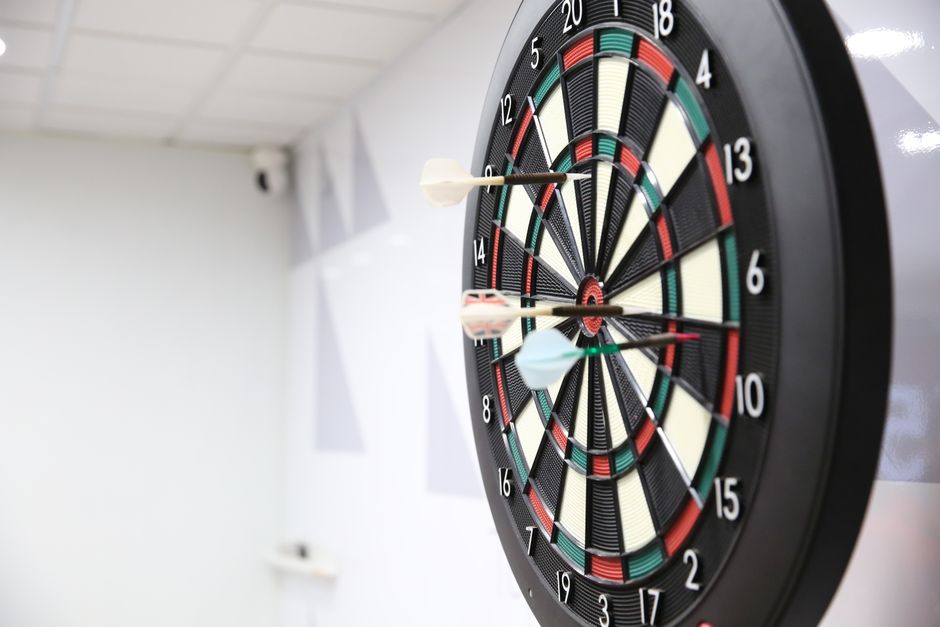
This article contains affiliate links: if you buy through them we may earn a commission, at no extra cost to you. Learn more.
Every darts argument sounds the same. “That was a bust.” “No, it’s open out here.” “You can’t lean over the line.” “Yes, you can.” The new board goes up in the garage, someone eyeballs the height, someone else paces off the distance, and by the third leg nobody agrees on anything. Here are the darts rules that settle it: the two big games, 501 and cricket, how scoring and the double-out work, and the dartboard height and distance for steel-tip and soft-tip, straight from the WDF, the PDC’s rule book (the DRA) and the National Dart Association.
Board setup: height and throwing distance
| Steel-tip (WDF, PDC/DRA) | Soft-tip (NDA) | |
|---|---|---|
| Bull height | 1.73 m (5 ft 8 in) from the floor to the center of the bull | 5 ft 8 in (68 in) from the floor to the center of the bull’s eye |
| Throwing distance | 2.37 m (7 ft 9¼ in) from the back of the oche to a plumb line at the face of the board | 8 ft (96 in) from the face of the target to the front edge of the foul line |
| Check measurement | WDF: 2.93 m (about 9 ft 7⅜ in) diagonally from the center of the bull to the back of the oche at floor level | The NDA measures to the face of the target, not to the front of the machine cabinet |
| The line | A raised oche: WDF 38 mm high and 610 mm long; DRA at least 40 mm high, 20 mm deep and 500 mm wide | A foul line; you may lean over it and step on it, but not across it |
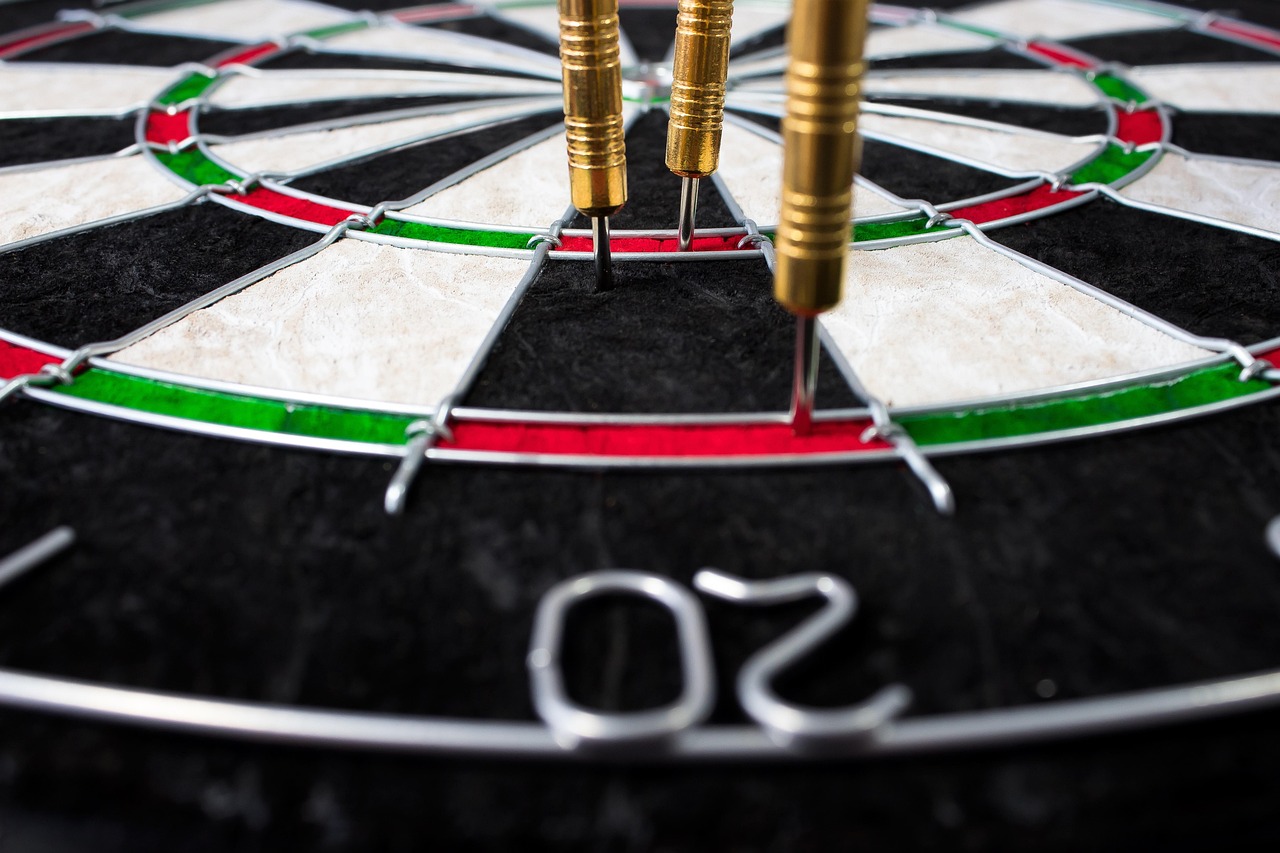
Measure the height from the floor you stand on, at the same level as the oche. Hang a plumb line (or a string with a weight) from the face of the board and measure back along the floor; a Viper throw line marker or a mat with the line printed on it, like the Target Darts mat (it shows both the steel-tip and the soft-tip line), saves you from re-measuring. On a steel-tip board, the 20 segment goes at the top center, and it’s the darker of the two colors under WDF rules (black under DRA rules).
Steel-tip players must keep their feet behind the oche. Under WDF rules you can’t tread on the raised oche, and if you step to one side, your feet must stay behind an imaginary line extending from it. The DRA rule for PDC events is the same idea: your front foot must be grounded behind the toe edge of the oche, or that dart doesn’t score. In NDA soft-tip, the dart must hit the board before your foot touches the floor in front of the line, or it’s a foul.
How a dartboard scores
- Numbers 1–20 around the board in the standard “clock” order, 20 at the top.
- Double ring (the thin outer ring) scores twice the number; treble ring (the thin inner ring) scores three times.
- Outer bull scores 25; inner bull scores 50 and counts as a double (double 25) for finishing.
- A turn is three darts. Three treble 20s make 180, the maximum.
- Wires: a steel-tip dart scores on the side of the wire where its point enters the board, and only if it stays in the board until the score is called. A dart that bounces out or falls out scores nothing and can’t be thrown again.
501: the game of the pros
Each player starts on 501 (or 301, 701 or 1001; the rules call for a fixed odd number) and subtracts each turn’s score. Under WDF and DRA rules:
- Straight start: any dart inside the outer double wire starts your scoring.
- Double out: you must finish on exactly zero with a dart in a double or the bull. With 32 left, you need double 16.
- The bust rule: if you score more than you have left, hit exactly zero without a double, or leave 1, the whole turn doesn’t count and your score goes back to where it was.
- Legs and sets: matches are played as “best of” an odd number of legs, or of sets made of legs, and stop as soon as someone wins a majority.
- Who throws first: each player throws one dart at the bull, and the closest goes first; WDF rules then alternate who starts each leg.
Two numbers every darts fan knows: 170 is the biggest possible checkout (treble 20, treble 20, bull), and a nine-darter is the perfect 501 leg. In WDF play, the scorer calls your remaining score but never tells you which double to aim at (“32,” not “double 16”).
Cricket: the league favorite
Cricket uses only 20, 19, 18, 17, 16, 15 and the bull. Under the NDA’s official rules:
- Marks: a single is one mark, a double two, a treble three. The outer bull is one mark and the inner bull two.
- Closing: three marks on a number “close” it for you. Close numbers in any order.
- Points: once you’ve closed a number, more hits on it score points (the outer bull 25, the inner bull 50) until your opponent closes it too.
- Winning: the first player or team to close all seven targets with an equal or higher point score wins.
Steel-tip vs soft-tip rules
Soft-tip electronic darts mostly follow the same games, with a few differences that cause most league-night arguments. Under NDA rules:
- Open in, open out is the standard ’01 game, with a full 50-point bull. Master-level events play double in, double out on a split 25/50 bull.
- The machine is always right, with one exception: a winning last dart that sticks counts even if the machine misses it. If a dart bounces out, it’s a dart thrown. A dropped dart (one you didn’t throw) can be thrown again.
- Equipment: plastic-tip darts only, no more than 20 grams complete and 8 inches long, with no broken or cut tips. Steel-tip darts can be up to 50 grams and 30.5 cm under WDF rules, and 40 grams and 200 mm under DRA rules.
- Skill ratings: leagues rate players by Points Per Dart (PPD) in ’01 and Marks Per Round (MPR) in cricket. MPR is total marks divided by darts thrown, times three.
Etiquette and safety rules
- Stay behind the thrower. Nobody stands near the board or walks up to it until all three darts are thrown.
- Don’t touch darts in the board until your turn is over. Under WDF rules, touching a dart in the board ends your turn, and pushing a loose dart in to stop it falling means it doesn’t count.
- Pull your own darts after the score is recorded, and pull them gently: WDF referees can warn, and then penalize, a player who abuses the board.
- Light the board well and screen the light from the thrower’s eyes; WDF tournaments require at least 1,600 lumens per board.
- Kids play with an adult around, and broken or bent tips go in the trash. See youth darts.
Want to play by these rules at home? A tournament-spec board like the Winmau Diamond Plus, a throw line and a mat get you most of the way. The rest is on our darts gear page, and you can find a league through darts leagues and associations. Back to the darts hub, or see how another sport handles its rulebook on our soccer rules page.
Viper Throw Line Marker
- Adhesive floor marker
- 23.5 x 3.5 in
- About $11
Target Darts Dart Mat
- Steel-tip and soft-tip throw lines
- Non-slip rubber back
- About $55
Winmau Diamond Plus Dartboard
- Self-healing sisal
- Staple-free bullseye
- About $60
Darts rules questions
What is the official dartboard height and distance?
The bull’s center is 5 ft 8 in (1.73 m) above the floor for both steel-tip and soft-tip. The throwing distance is 7 ft 9¼ in (2.37 m) for steel-tip and 8 ft (96 in) for soft-tip under NDA rules.
What does “bust” mean in darts?
You score more than you have left, reach zero without finishing on a double (in double-out games), or leave yourself on 1. The turn doesn’t count and your score goes back to what it was before that turn.
Does the bullseye count as a double?
Yes. The inner bull scores 50 and counts as double 25, so you can finish a 501 leg on it with 50 left. The outer bull scores 25 and is not a double.
Can you lean over the line in darts?
Yes, as long as your feet stay put. In soft-tip (NDA) you may lean over and step on the line, but not across it. In steel-tip, your feet must stay behind the oche and you can’t tread on the raised oche.
Do bounce-outs count?
They count as a dart thrown but score nothing, and you can’t throw that dart again. That’s true in steel-tip (WDF and DRA) and soft-tip (NDA).
How do you win at cricket darts?
Close 20 through 15 and the bull (three marks each) before your opponent, with a points total that’s equal to or higher than theirs.