This article contains affiliate links: if you buy through them we may earn a commission, at no extra cost to you. Learn more.
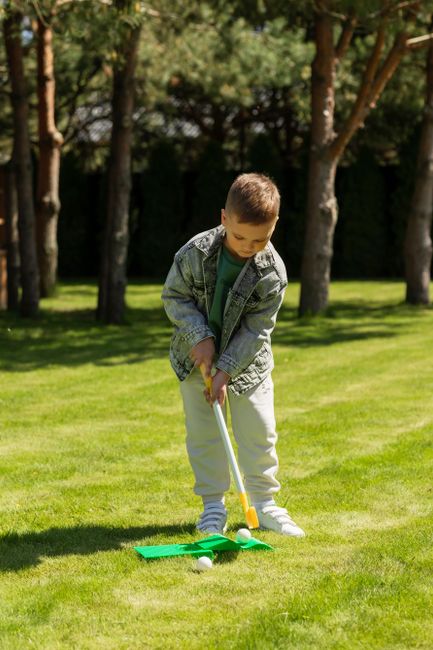
A Saturday clinic on the practice green: ten kids in sun hats, a bucket of balls each, and a coach turning putting into a game of “who can stop it closest to the tee.” A year later, the same kid wants to play nine holes with you, and two years after that, they’re asking about a tournament. Junior golf is booming: the National Golf Foundation counted just under 4 million juniors on golf courses in 2025, more than in any year since 2004, and girls made up 35% of them. This guide is for parents and coaches: where kids start, junior golf clubs that fit, first tournaments, safety, and the basics of college recruiting.
For the big picture, start at our golf hub; the rules page covers the basics every junior should know.
Where kids start
- First Tee: founded in 1997 by the LPGA, the Masters Tournament, the PGA of America, the PGA TOUR and the USGA. Local chapters teach golf together with life skills and values such as honesty, integrity, perseverance and respect, in after-school and in-school programs, with the aim of making golf affordable and accessible.
- PGA Jr. League: team golf for boys and girls of all skill levels in 9U, 13U and 17U divisions, coached by PGA professionals. Kids wear numbered jerseys and play a team scramble, so a beginner never carries the whole score alone.
- Drive, Chip and Putt: a free skills competition for ages 7–15 in four age groups for girls and boys (7–9, 10–11, 12–13, 14–15). Kids hit nine shots across driving, chipping and putting; the national finals are at Augusta National the Sunday before the Masters.
- Your local course: junior clinics, camps and lessons with a PGA professional, and family nines in the evening.
Junior golf clubs: fit by height, not age
Clubs that are too long and heavy teach bad habits and make the game frustrating. Junior club makers size sets by height. U.S. Kids Golf, for example, asks parents to measure the child with shoes on and pick from height-based models that run up to 66–69 inches. Most kids don’t need 14 clubs: a starter set with a driver or hybrid, a couple of irons and a putter covers everything.
- Measure every season. Kids grow fast; when a set starts to feel short, it’s time to move up.
- Light and forgiving. Junior sets use light graphite shafts and oversized heads, which makers say help kids get the ball in the air.
- Don’t over-buy. A starter set and a soft, inexpensive ball are enough until a child plays regularly.
Two sets sized this way: the Precise X7 for ages 9–12 (4’4″ to 5’1″) includes a driver, hybrid, 7 and 9 irons, putter, stand bag and two headcovers, for about $159 on Amazon in October 2026; and the Precise XDJ comes in three height-based sizes, ages 3–5 (3’0″–3’8″), 6–8 (3’8″–4’4″) and 9–12 (4’4″–5’1″), for about $149. Add a 32-ounce Nalgene bottle (about $16) to the bag: a hot afternoon on the course goes faster than kids think.
Precise X7 Kids Golf Set (ages 9-12)
- Driver, hybrid, 7 and 9 irons, putter
- Graphite shafts
- Stand bag + 2 headcovers
Precise XDJ Junior Golf Set
- Ages 3-5, 6-8, 9-12
- Lightweight graphite shafts
- Stand bag included
Junior tournaments: the ladder
- First events: PGA Jr. League games, Drive, Chip and Putt qualifiers, and local junior tours, often 9 holes from forward tees.
- U.S. Kids Golf: local tours, state invitationals and regionals, and a World Championship, with set yardages by age group so young kids play a course that fits them.
- State and regional junior events: run by state golf associations and PGA sections, a step up in field and course length.
- High school golf: 162,357 boys and 85,385 girls played in 2024-25 (NFHS), with team and individual state championships.
- AJGA and national events: the American Junior Golf Association (founded 1978) ran 142 tournaments in 2025 for players aiming at college golf; members can be no older than 18 on January 1 of their graduation year. Entry to many events is based on results (Performance Based Entry). The USGA runs national junior championships too.
Keeping junior golfers safe and healthy
Golf is a low-contact sport, but kids get hurt around it in ways adults don’t. Most of it is preventable with a few house rules.
- Stand clear of swings. In an Australian study of children under 15 seen in emergency departments for injuries from golf equipment, most were aged 5–9, 84% were head injuries and almost all came from being struck by an object such as a club or ball. A US emergency-room study of golf-related face and head injuries (2015–2024) also found children were most often hurt at ages 5–9. Teach kids to stay well back from anyone holding a club, and never to walk in front of someone hitting.
- Golf carts aren’t toys. A national study estimated 156,040 golf-cart injuries treated in US emergency rooms from 2007 through 2017, and the rate of brain injuries was more than three times higher in children than in adults. Kids shouldn’t drive, everyone sits down, and the American Academy of Orthopaedic Surgeons (AAOS) says to keep feet inside the cart.
- Head injuries: if a child is hit in the head and seems dazed, confused, slow to answer or complains of headache, dizziness or nausea, the CDC’s HEADS UP advice is to stop play, keep them out the rest of the day and have a healthcare provider check them. Call 911 for danger signs such as repeated vomiting, a seizure, a worsening headache or growing drowsiness.
- Sun and heat: the American Academy of Dermatology recommends broad-spectrum, water-resistant sunscreen with SPF 30 or higher, reapplied every two hours and after sweating. Hats, water and a snack at the turn help kids last the round.
- Lightning: leave the course at the first thunder and wait 30 minutes after the last thunder or lightning before going back out, as the National Athletic Trainers’ Association recommends.
- Too much, too soon: a review of golf-related low back pain links it to excessive play and practice, and the American Academy of Pediatrics warns that specializing in one sport too early can harm young athletes physically and mentally. Many juniors do well playing other sports too. Back pain, wrist pain or elbow pain that lingers deserves a check with a sports medicine doctor, physical therapist or athletic trainer.
More on all of this on our golf injuries page, and on long tournament days on golf tournament day.
College golf recruiting: the basics
- Know the options: NCAA Divisions I, II and III, the NAIA and the NJCAA all have golf. Divisions I and II can offer athletic scholarships; Division III can’t.
- Register with the NCAA Eligibility Center to play in Division I or II, and keep up with the core courses and grades it requires.
- Timing: in most Division I sports, coaches can start recruiting conversations from June 15 after a player’s sophomore year. Check the NCAA’s current rules for golf, since they change.
- Scores talk: coaches look at tournament results against strong fields, so a junior’s schedule matters. The AJGA reports 975 college commitments from its class of 2025.
- Grades and character matter: golf is a sport where you call penalties on yourself, and coaches notice how a player behaves on a bad day.
Our leagues and associations page explains the college divisions and junior organizations, and the golf gear page covers what to buy as a junior gets serious. Got a two-sport kid? See youth soccer too.
Parents’ questions about junior golf
What age should a child start golf?
There’s no single answer. Junior club sets start at toddler sizes, PGA Jr. League’s youngest division is 9 and under, and Drive, Chip and Putt starts at 7. Start with short, fun sessions on the putting green and range, and let the child set the pace.
What size golf clubs does my child need?
Go by height, not age. Measure your child with shoes on and use the maker’s height chart; for example, one maker’s 9–12 sets fit kids about 4’4″ to 5’1″. Check again every season.
Should my child play only golf?
Not necessarily. The American Academy of Pediatrics warns that specializing in one sport too early can harm young athletes physically and mentally, and too much golf practice is a known risk factor for back pain. Playing other sports in other seasons is fine.
How much does junior golf cost?
It can be cheap at the start: Drive, Chip and Putt is free, First Tee aims to make golf affordable and accessible, and a junior starter set costs about $100–$160 on Amazon. Costs climb with travel tournaments and lessons, so add them step by step.
How do junior golfers get recruited for college?
Mostly through tournament results, plus grades and a short email to coaches with a schedule and scores. Register with the NCAA Eligibility Center for Division I or II, and remember the NAIA, NJCAA and Division III are good options too.