This article contains affiliate links: if you buy through them we may earn a commission, at no extra cost to you. Learn more.
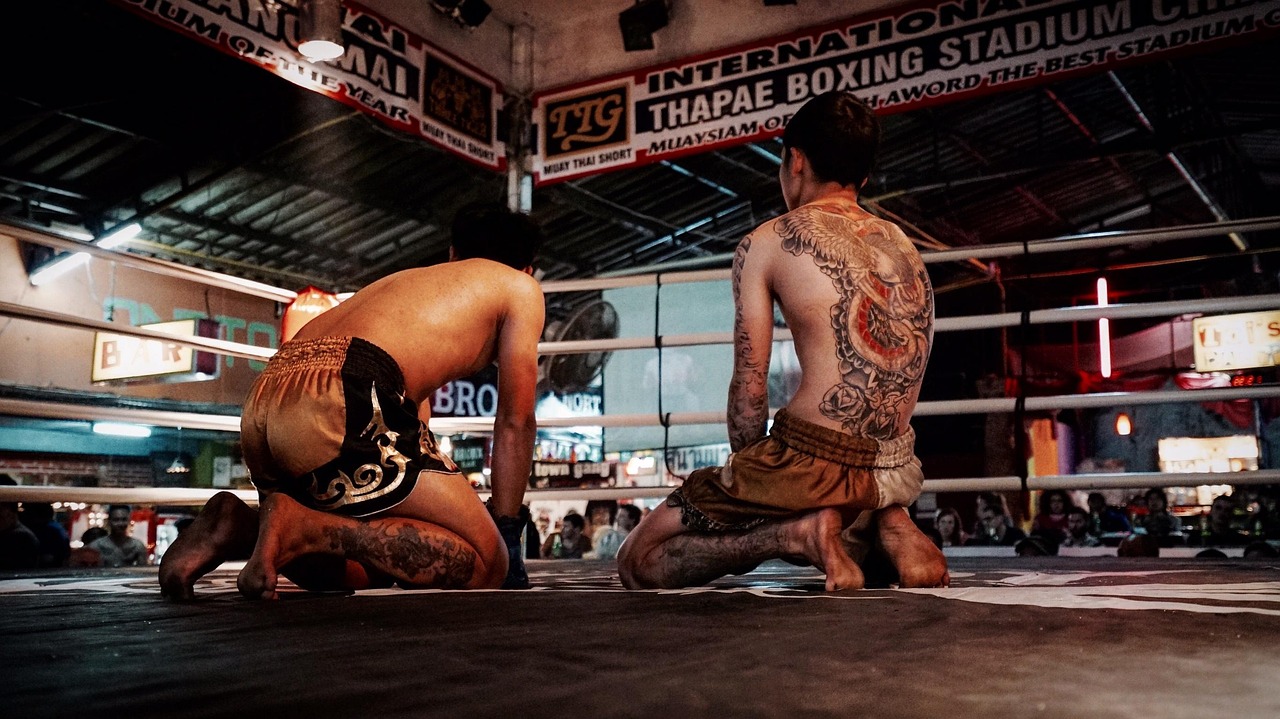
The music starts slow: a reedy pipe, a pair of small cymbals, two drums. Both fighters kneel, bow three times to the canvas with the Mongkon on their heads, and move through the Wai Kru. Then the referee pulls the headbands off, the music speeds up, and for three rounds the fighters kick, knee, elbow and clinch until the referee shouts “Yaek!” to break them. This page explains the Muay Thai rules: the amateur rule book of the International Federation of Muaythai Associations (IFMA), how fights are scored, what’s a foul, how pro rules differ, the protective gear the rules require and what happens after a knockout.
For the bigger picture, start at our Muay Thai hub. Kickboxing’s rules (WAKO disciplines, K1, GLORY) are on the kickboxing rules page.
The IFMA disciplines
IFMA writes the world’s amateur Muay Thai rules (most recently revised in May 2026); in the US its member federation is USA Muaythai. It recognizes three kinds of competition:
- Combat (full contact): the main event, fought under full IFMA rules, and the elite international pathway.
- Technical (semi contact): focused on precision, control and scoring accuracy rather than power.
- Cultural (no contact): Wai Kru and Mai Muay performances, judged on tradition and technique.
Athletes compete in one of three pathways: Elite (18-40), Development by age (U8 to U24) or Masters (35-50). Age is counted by year of birth, and every athlete needs a minimum grade in IFMA’s “Khan” system, from Khan 1 for the youngest to Khan 6 for elite and masters.
Ring, rounds and weight classes
The ring is 6 to 6.5 m square inside the ropes, on a platform 1.2 to 1.5 m off the ground with a padded floor. Rounds are always three, and no extra round is ever added:
| Division | Ages | Round length |
|---|---|---|
| Elite, U24 | 18-40 (U24: 18-23) | 3 minutes |
| Masters 35+ | 35-39 | 3 minutes |
| Masters 40+ and 45+ | 40-50 | 2 minutes |
| U18, U16 | 14-17 | 2 minutes |
| U14, U12 | 10-13 | 1.5 minutes |
| U10, U8 | 6-9 | 1 minute |
Most divisions rest a minute between rounds. Weight classes follow tables for each age group: elite men from 45 kg up to over 91 kg, elite women from 45 kg up to over 75 kg, and separate tables for each youth age group, starting at 16 kg for U8. Fighters weigh in the day before the tournament and again on each morning they compete, and a doctor must certify them fit on every competition day.
The Wai Kru and fight attire
Before the first round, every fighter must perform the Wai Kru, the traditional ritual of homage. At a minimum that means the starting postures and bowing three times to the canvas while wearing the sacred Mongkon headband; fighters are encouraged to do all six starting postures, and other martial arts’ rituals aren’t allowed. Traditional music (Java pipe, small cymbals and two drums) accompanies it, live or recorded. In preliminary bouts the Wai Kru lasts at most 2 minutes.
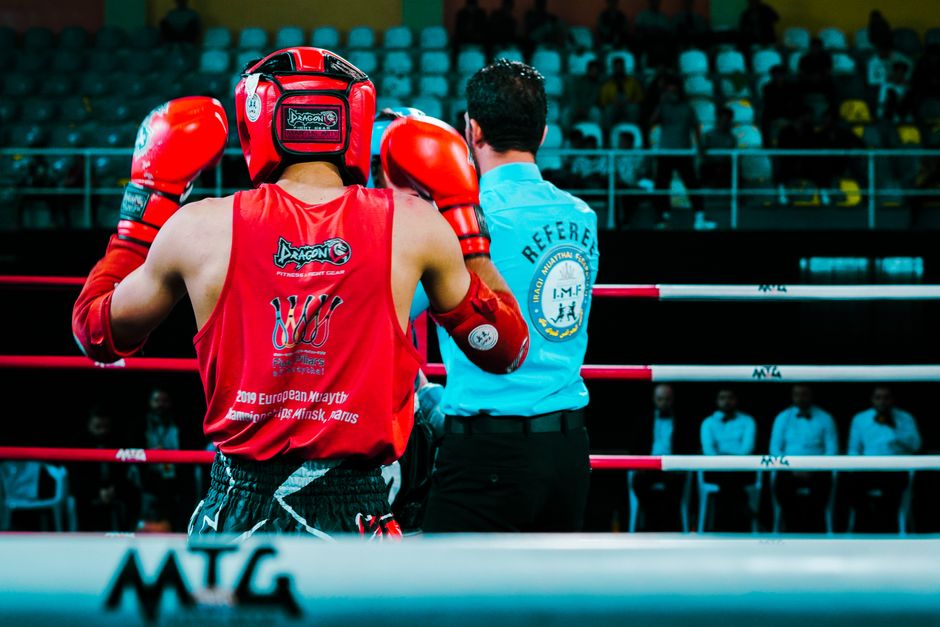
Fighters wear a red or blue singlet to match their corner, tucked into Muay Thai shorts with “Muaythai” on the front. A Prajiad (armband, often with an amulet) may be worn on the upper arm or waist if it’s neatly covered. Long hair goes in a hairnet under the head guard, with no clips. White head and body covers are allowed for religious or cultural reasons, in IFMA-approved designs. No ankle supports or tape are allowed in IFMA bouts.
What scores, and how rounds are judged
- A scoring “Muaythai skill” is a punch, kick, knee or elbow landed with force and intent on a legal target: any part of the body except the groin and the back of the neck and spine.
- 10-point must: the round goes to the fighter who lands more scoring skills. A margin of 7 or fewer is 10-9, 8-14 is 10-8, and 15-21 is 10-7. If skills are even, the more forceful fighter takes the round.
- What doesn’t score: blocked strikes, weak strikes, and throws or sweeps without a strike.
- Deductions: a warning that the judges agree with costs a point.
- No draws: every IFMA bout must end with a winner.
Knockdowns, counts and stoppages
The referee counts in Thai, with a mandatory count of eight after any knockdown. A fight ends by knockout, by the referee stopping the contest (for safety, injury, head strikes or body strikes), by disqualification, or when a fighter reaches the compulsory count limit: 3 counts in a round or 4 in the bout for elite, U24 and Masters 35+; 2 in a round or 3 in the bout for U18 and the older Masters; and 2 in the whole bout for U16 and younger.
The clinch and the fouls
Clinching is legal: fighters tie up, knee, elbow and off-balance each other until the referee calls “Yaek” and both step back. IFMA’s list of fouls includes biting, head-butting and spitting; pressing on the eyes; deliberately spitting out the mouthguard; trying to slam the opponent into the canvas, hip throws and tackles; hooking or trapping the legs; lifting the opponent; locking or hyperextending joints; striking while holding the ropes; holding a caught leg and pushing more than two steps without striking; and passive “double cover” defense. Fouls bring cautions, warnings and, if repeated, disqualification.
Limits for young fighters
U16 and older fight with every strike allowed. U14 and U12 fighters may not throw elbows or knees to the head, and U10 and U8 fighters may not strike the head at all. More on our youth Muay Thai page.
Amateur vs pro
| Amateur (IFMA) | Pro (examples) | |
|---|---|---|
| Head guard, shin and elbow guards | Required, supplied by the organizer | None |
| Gloves | 10 oz, supplied | ONE: 4 oz MMA gloves; WBC Muaythai: 8 oz up to welterweight, 10 oz above |
| Rounds | 3, from 1 to 3 minutes by age | ONE: 3 × 3 min, 5 for world titles; WBC Muaythai titles: 5 × 3 min, 2 min rest; ABC model rules: 3 or 5 × 3 min |
| Scoring | 10-point must, scoring skills first, then force | 10-point must; WBC Muaythai judges damage, dominance and disruption |
| Weigh-in | Day before and every competition morning | WBC Muaythai: 24-30 hours before; ONE adds a hydration test |
| Minimum age | Youth divisions from 6 | WBC Muaythai titles: 18 outside Thailand, 16 in Thailand with a registered boxer’s book |
| Who’s in charge | The federation and its doctors | The promotion, the sanctioning body and, in the US, a state athletic commission |
In the US, state athletic commissions license pro fighters and supervise events, and many adopt the Association of Boxing Commissions’ model rules; its pro Muay Thai rules, approved in 2024, allow punches, kicks, elbows and knees in 3-minute rounds, 3 or 5 per bout. Some states also regulate amateur events, so ask who sanctions a show before you sign up. More on our Muay Thai organizations page.
Protective gear rules
- Head guard: supplied and approved by IFMA, with no cheek, chin or face protection.
- Shin and elbow guards: cloth, with hook-and-loop closures, supplied at the event.
- Mouthguard: required; form-fitted, and not red or pink. If it falls out, the corner rinses it before it goes back in.
- Groin guard: required for men (metal or polycarbonate) and women (polycarbonate or foam), and each athlete brings their own.
- Chest protection: required for women in Elite and Masters 35+, optional for U24, youth and the older Masters.
- Body protector: required for U8 to U24 and Masters 40+ and 45+; not worn in Elite or Masters 35+.
- Hand wraps: up to 5 m long and 5 cm wide, with tape only as a single strap at the wrist.
Two cautions from the doctors: the American Academy of Pediatrics notes there’s no evidence that soft headgear reduces concussion risk, and a mouthguard mainly protects the teeth and mouth. For training and sparring you’ll need your own: slip-on shin guards like the Venum Kontact, a boil-and-bite Shock Doctor Gel Max, compression shorts with a cup such as the Shock Doctor Bio-Flex, and real Muay Thai shorts like the Venum Classic. Our Muay Thai gear page explains how to choose each piece.
Venum Kontact Shin Guards
- Slip-on, shin to foot
- Hook-and-loop straps
- About $28
Shock Doctor Gel Max Mouthguard
- Boil-and-bite gel liner
- Youth and adult sizes
- About $12
Shock Doctor Compression Shorts with Bio-Flex Cup
- Compression shorts
- Cup included
- About $20
Venum Classic Muay Thai Shorts
- Lightweight polyester, made in Thailand
- Elastic waist, drawstring
- About $50
Competition gear is supplied or must pass inspection, so check with your federation before buying for a tournament. For sore days after sparring, see our combat sports recovery gear guide.
Safety rules after a knockout
After a knockout or a stoppage for hard blows to the head, IFMA bars a fighter from competition and sparring for at least 30 days. Two within 90 days means 90 days out; three in 12 months means a year. A neurologist must certify the fighter fit before return, and the same rules apply to head injuries in training. The medical officer can also bench a fighter for at least four weeks after a hard fight with many head blows. IFMA also requires rest after every tournament: at least 7 days after a one-round win, 14 days after up to four rounds, 21 days after four to nine rounds and 28 days after ten or more.
In the gym, follow the CDC’s HEADS UP advice: if a fighter shows concussion signs, remove them from sparring right away and keep them out until a healthcare provider clears them. The full picture is on our Muay Thai injuries page, and how a tournament day runs is on our fight day page.
Muay Thai rules FAQs
How many rounds is a Muay Thai fight?
IFMA amateur bouts are always 3 rounds: 3 minutes for elite fighters, shorter for youth and the older Masters. Pro fights in ONE are 3 × 3 minutes, 5 rounds for world titles; WBC Muaythai title fights are 5 × 3 minutes.
Are throws allowed in Muay Thai?
Off-balancing in the clinch is part of the sport, but under IFMA rules hip throws, tackles, lifting the opponent and trying to slam them into the canvas are fouls, and a throw or sweep without a strike doesn’t score.
Can a Muay Thai fight end in a draw?
Not under IFMA rules: the judges must name a winner. Pro rules vary by promotion and sanctioning body.
Is the Wai Kru required?
In IFMA competition, yes: every fighter performs at least the starting postures and three bows while wearing the Mongkon before the first round. In preliminary bouts it can last up to 2 minutes.
What gloves are used in amateur Muay Thai?
IFMA uses 10 oz gloves, supplied by the organizer along with the head guard and cloth shin and elbow guards. Pros fight in lighter gloves: 4 oz MMA gloves in ONE, 8 or 10 oz by weight in WBC Muaythai.