This article contains affiliate links: if you buy through them we may earn a commission, at no extra cost to you. Learn more.
A summer Saturday in a busy harbor. You glide out past the swim buoys, coffee-calm, and then a ferry sounds its horn somewhere behind you and a ski boat swings wide around the point. Out here your paddleboard isn’t a beach toy anymore: in the eyes of the US Coast Guard it’s a boat, with the same basic duties as a canoe or a sailboat. This page explains the SUP rules that apply on the water, the safety rules that keep paddlers alive, and how SUP races work. It’s general information, not legal advice; your state and local waters may add rules of their own.

For the big picture of the sport, start at our paddleboarding hub.
When is a paddleboard a “vessel”?
In a decision dated October 3, 2008, the US Coast Guard classified paddleboards as vessels. The key phrase: when a paddleboard is used beyond the narrow limits of a swimming, surfing or bathing area, you have to follow the Navigation Rules and carry the equipment required for that kind of vessel. Inside a designated swim area or a surf zone, those carriage rules don’t apply. The Coast Guard counts SUPs in its accident statistics too, defining a standup paddleboard as a vessel, typically 7 to 15 feet long, propelled by a standing operator with a paddle.
What you must carry (US federal rules)
- A life jacket for each person. It must be Coast Guard approved, in good condition, the right size for the person and readily accessible. Paddlers 13 and older must have one on board; they aren’t federally required to wear it.
- Children under 13 wear theirs. On a vessel that’s underway, children under 13 must wear a Coast Guard-approved life jacket. If your state sets a different age, the state rule applies on its waters.
- Inflatable belt packs only count when worn. A belt-pouch inflatable must be worn on your body to meet the rule, not strapped under the bungees. Most inflatable life jackets are approved only for people 16 and older, and the Coast Guard doesn’t recommend them for non-swimmers.
- A sound-producing device. Under the Navigation Rules, a vessel under 12 meters doesn’t need a horn or bell but must have “some other means of making an efficient sound signal.” For a paddler, that’s a whistle clipped to your life jacket.
- A white light after dark. A paddled vessel that doesn’t show navigation lights must have ready at hand an electric torch or lantern showing a white light, shown in time to prevent a collision. A headlamp or a waterproof flashlight does it; an all-round white light is better.
Depending on where and when you paddle, other carriage rules, such as visual distress signals on coastal waters at night, may apply. Many states add their own rules. Oregon, for example, requires children 12 and under to wear a life jacket and requires a Waterway Access Permit for non-motorized boats, paddleboards included. Check your state boating agency before you go, and whatever the law says, wear your life jacket. In the Coast Guard’s 2024 boating statistics, 26 of the 29 people who died on standup paddleboards drowned.
Leash rules: the right leash for the water
No federal law requires a leash, but the American Canoe Association calls it a key piece of safety equipment “in most, but not all environments.” Your board floats, and a board that blows away in the wind leaves you swimming. The ACA’s guidance:
- Flat lakes, tidal areas and slow rivers: a coiled or hybrid leash can save you from being separated from your board.
- SUP surfing in the ocean: a straight leash.
- Whitewater and moving-water rivers: a leash can snag on rocks, branches or the shore. If you make an informed decision to wear one, it must be waist-mounted with a quick-release you can reach with both hands. Never an ankle leash in current.
For rivers, a combined belt and leash like the Salamander Quick Release Belt with Leash (a quick-release buckle belt with a 4 ft partly coiled leash that stretches to 10 ft) is built for the job. Rescue-style life jackets have their own quick-release belt; the NRS Quick-Release SUP Leash (about $60) clips to it.
Right of way: the Navigation Rules for paddlers
Paddlers don’t get a blanket right of way. As a vessel, you follow the same Navigation Rules as everyone else, and in practice the smallest, slowest boat should act early and stay out of the way. The rules that matter most on a SUP:
- Keep a proper look-out (Rule 5). Every vessel must watch and listen at all times. Look behind you often; boats come up fast and you’re low and hard to see.
- Stay out of the way in narrow channels (Rule 9). Keep to the right-hand (starboard) edge of a channel, and a vessel under 20 meters “shall not impede the passage” of a vessel that can only navigate safely inside the channel. Ferries, barges and big boats can’t stop or turn quickly. Cross channels quickly, at a right angle, as a group.
- If you’re overtaking, it’s on you (Rule 13). Any vessel overtaking another must keep out of its way, paddleboard or not.
- Be seen. Bright clothing and a bright life jacket help, and after sunset the white-light rule above applies.
Navigation rules violations were a contributing factor in 34% of US boating deaths in 2024 where the data was known, according to the Coast Guard. A boating safety course teaches the rules properly, and the Coast Guard found that 69% of deaths happened where the operator had never had boating safety instruction.
In the surf: etiquette for SUP surfers
In a surf zone the carriage rules fall away and surf etiquette takes over: the surfer closest to the peak has the wave, don’t drop in on someone already riding, and paddle out around the break, not through it. A SUP surfer stands taller and catches waves earlier, so good manners matter even more: don’t hog the set waves, and never let go of a big board in a crowd. Our surfing rules and etiquette page covers lineup rules in detail. One gear note: in the surf, the ACA recommends a straight leash, and many surfers don’t wear a life jacket because it keeps you from diving under a wave, so this is a place for experienced paddlers only.
How SUP races work
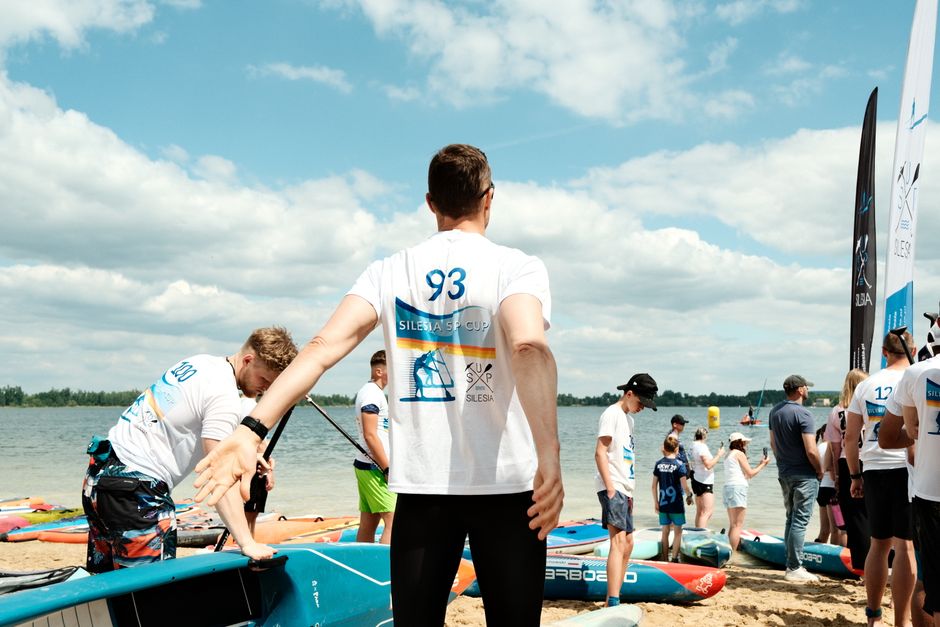
Most SUP racing falls into three formats, used by the American Canoe Association, Paddle Worldwide (formerly the International Canoe Federation), the International Surfing Association, USA Surfing and the pro APP World Tour:
- Sprint: speed and power over a short course. The American Canoe Association describes sprints as up to 250 meters, in a straight line with separate lanes, usually on flat water. On the APP World Tour the sprint uses an M-shaped course with elimination heats and water starts.
- Technical: usually 800 meters to 5 kilometers, with straight lines and lots of buoy turns, often with beach starts and surf, testing board handling and changes of direction as much as fitness.
- Distance (long distance): the endurance test, from about 5 to 35 kilometers, where pacing and strategy matter. At the 2026 USA Surfing Championships, the distance race was a 10K.
Boards are raced in classes. At the 2026 ICF SUP World Championships (Sabaudia, Italy, October 14 to 18), Junior, Open and Masters paddlers race sprint, technical and long distance on hard boards up to 14 feet, with separate inflatable races, foil sprints, kids’ races for ages 12 to 15 and a fun race. Entrants confirm they can swim at least 200 meters unaided. Local races often add shorter-board and inflatable classes and age groups; check the event’s rules for board length, leash and life jacket requirements before you enter. More on who runs what on our SUP associations page, and race-day fueling on paddle day and race day.
Water safety rules every paddler should follow
- Check the wind and weather. Offshore wind (blowing from land toward the water) can push you out faster than you can paddle back while the water near shore looks calm. Paddle into the wind first.
- Dress for the water temperature. Cold shock hits in the first minute in cold water. Wear a wetsuit or drysuit when the water is cold.
- Tell someone your plan and when you’ll be back, and carry a phone in a waterproof case.
- No alcohol on the water. It’s the leading known contributing factor in fatal boating incidents in the Coast Guard’s data.
- Paddle with a buddy and within your ability. A bump on the head from a fall? Follow the CDC’s concussion advice: off the water for the day. Our SUP injuries page has more.
The gear the rules call for
Prices change often. The prices below are what we saw at the maker or a major retailer in October 2026; check the current price before you buy.
Two kinds of life jacket suit SUP. A foam paddling vest like the Onyx MoveVent Dynamic (about $69; Coast Guard and Transport Canada approved, for adults 90 lb and over) works for everyone, including weak swimmers and moving water. On flatwater, many adults wear the Onyx M-16 belt pack, a manual inflatable approved for ages 16 and up. Clip a Fox 40 Classic whistle (about $7) to it and you’ve covered the sound-signal rule. Board, paddle and the rest: our paddleboarding gear page. Bringing kids? See SUP with kids.
Onyx MoveVent Dynamic Paddle Vest
- USCG and Transport Canada approved
- Adults 90 lb and over
- Mesh back, reflective trim
Onyx M-16 Belt Pack Inflatable PFD
- USCG approved, manual inflation
- Ages 16+ and over 80 lb
- Must be worn to count
Fox 40 Classic Safety Whistle
- No-pea design
- Loud and reliable (maker)
- About $7
Salamander SUP Quick Release Belt with Leash
- Quick-release buckle belt
- 4 ft leash, stretches to 10 ft
- River-specific break-away
SUP rules and water safety questions
Is a paddleboard considered a boat?
In the US, yes, once you’re outside a swimming, surfing or bathing area. The Coast Guard has classified paddleboards as vessels since 2008, so you follow the Navigation Rules and carry the required gear.
Do I have to wear a life jacket on a paddleboard?
Federally, adults 13 and older must have one with them, and children under 13 must wear one; some states require more. An inflatable belt pack only counts if you’re wearing it. Wearing any life jacket is the single best safety step.
Do I need a whistle on a paddleboard?
Yes, outside swim and surf areas. Small vessels must have some way of making an efficient sound signal, and a whistle on your life jacket is the simplest way to meet it.
Do paddleboarders have the right of way?
Not automatically. Keep a look-out, stay to the side of channels and out of the way of vessels that can only navigate in them, and keep clear when you overtake. Bigger boats may not see you or be able to stop.
Should I wear a leash on a river?
Only a quick-release leash attached at the waist that you can reach with both hands, and only if you’ve decided it’s right for that river. An ankle leash can snag and pin you under water in current.
What are the main types of SUP races?
Sprint (up to about 250 meters), technical (about 800 meters to 5 kilometers with lots of buoy turns) and distance (about 5 to 35 kilometers). Races often run in heats, with the fastest moving on. Big events also run inflatable, foil and kids’ classes.
Back to the paddleboarding hub, or see SUP associations and races, SUP with kids and paddleboarding gear. Other water sports: surfing, kayaking and sailing rules and boating safety.