This article contains affiliate links: if you buy through them we may earn a commission, at no extra cost to you. Learn more.
Late October in Boston: tents along the Charles River, crews from both coasts and overseas warming up below the bridges, alumni eights with gray hair and teenage fours racing the same three miles. A few weeks later the same rowers are back on the erg, logging a 2,000-meter test into a ranking that compares them with people all over the world. Rowing’s map is wide: an international federation, a national governing body, college championships run by two different organizations, thousands of clubs, giant regattas and a world of indoor racing. This guide to rowing organizations lays it all out, so you know who runs what and where every level of rower can race, as of the 2026 season.

New to the sport? Start at our rowing hub.
World Rowing: the international federation
World Rowing, founded in 1892 as FISA, was the first international sports federation, according to USRowing. It writes the international Rules of Racing and runs rowing’s world events:
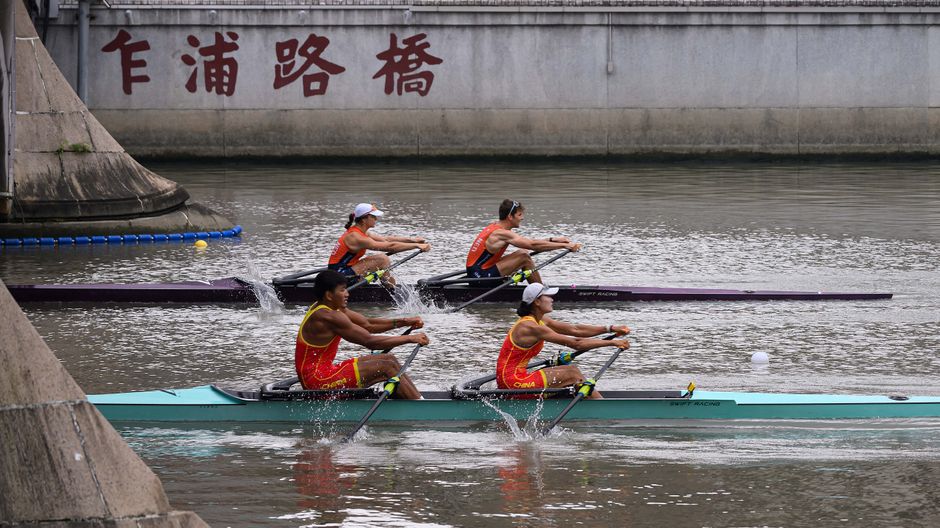
- World Rowing Championships: the 2026 edition was held August 24–30 at the Bosbaan in Amsterdam. The 2025 Worlds in Shanghai introduced the mixed eight.
- Age-group worlds: under-23 and junior (under-19) world championships each year.
- Coastal rowing and beach sprints: World Rowing’s newest discipline, raced on the sea and heading to the Olympics in 2028.
- Indoor rowing: a virtual indoor championship each February and an in-person World Rowing Indoor Championships, held in Birmingham, England, on December 5–6, 2026, with 2,000 m, 500 m and relay races.
- Masters: the World Rowing Masters Regatta, open to rowers 27 and older, was held in Bled, Slovenia, on September 9–13, 2026.
USRowing: the national governing body
USRowing governs the sport in the United States. It was formed in 1982 by merging the National Association of Amateur Oarsmen (founded in 1872) with the National Women’s Rowing Association (1963), and says it has more than 92,000 individual members and 1,400 member organizations: juniors, college rowers, masters and people who row for fitness. USRowing:
- writes the US Rules of Rowing and the Safety Guidelines most clubs follow (swim tests, launches, cold water; see our rowing rules page);
- runs national championships, including the Youth National Championships (June 11–14, 2026, Sarasota, with nearly 4,000 athletes from 236 clubs who qualified through 11 regional regattas) and the RowFest National Championships for club and masters crews (July 11–19, 2026, Ford Lake, Ypsilanti, Michigan, masters racing July 16–19);
- selects and supports the US national teams, from juniors and under-23s to the Olympic and Paralympic teams;
- certifies coaches, including Level 1 “learn to row” instructors, and offers a “Find a Club” search for new rowers.
College rowing: NCAA and the IRA
College rowing is the oldest intercollegiate sport in America: Harvard and Yale first raced in 1852, and the Harvard–Yale Regatta is still rowed every year. Today two organizations run the national championships.
NCAA women’s rowing
The NCAA has crowned a women’s rowing champion since 1997. In 2026 all three divisions raced at Lake Lanier Olympic Park in Gainesville, Georgia:
- Division I: 22 teams (10 automatic conference bids, 12 at-large), each fielding a first eight, a second eight and a four over 2,000 meters; points from all three decide the team title. Texas won in 2026, its fourth title.
- Division II: eights and fours; Western Washington won in 2026.
- Division III: teams race a first and a second eight.
Women’s rowing teams are big. Under the House settlement, Division I schools that opted in have a roster limit of 68 in women’s rowing and may give scholarships to any rostered athlete; before, the cap was 20 full scholarships’ worth. Division III schools don’t give athletic scholarships. Our youth rowing page explains recruiting.
The IRA: men’s and lightweight women’s rowing
Men’s rowing isn’t an NCAA championship sport. The Intercollegiate Rowing Association (IRA) runs the national championship for heavyweight men, lightweight men and lightweight women, plus a Division III men’s event. The 123rd IRA National Championship was held May 29–31, 2026 on Lake Natoma in Gold River, California: Washington’s men won their 22nd IRA title, Harvard’s lightweight men won a third straight, Trinity repeated in Division III, and Princeton’s lightweight women won a fifth straight Commissioner’s Cup. The IRA moves to Mercer Lake in New Jersey for 2027–2029.
Scholastic and junior rowing
- Stotesbury Cup Regatta: run by the Schuylkill Navy in Philadelphia since 1927, it bills itself as the world’s oldest and largest high school regatta; about 4,000 rowers raced on May 15–16, 2026.
- SRAA National Championship: the Scholastic Rowing Association of America’s invitational for school crews, always on the Friday and Saturday of Memorial Day weekend.
- USRowing youth regionals and nationals for club and school crews, with U19, U17 and U15 events.
Clubs and masters rowing
Clubs are where most Americans row. The first US rowing club, Narragansett Boat Club in Providence, dates to 1838, and Philadelphia’s Schuylkill Navy (1858) was the first amateur sports organization in the country, per USRowing. Today’s clubs run learn-to-row classes, junior teams and adult programs from beginner to elite, often sharing boathouses with schools and colleges. Masters rowing starts the year you turn 21 under USRowing’s rules, with age categories from AA (21–26) to K (85 and over) and handicaps that let a 60-year-old crew race a 40-year-old one on time. Masters sprints are usually 1,000 meters.
The big regattas
- Head of the Charles (Boston and Cambridge): the biggest head race, a three-mile time trial. In 2025 it drew more than 11,000 athletes from over 850 clubs in 74 events, from youth to veterans and parent-child doubles. The 2026 edition is October 16–18.
- Other fall heads: many regions have their own, run on the same time-trial format; check each regatta’s entry rules early, as popular events fill up.
- Henley Royal Regatta (England): two-boat knockout racing over 2,112 meters upstream on the Thames; Henley says winning there has long been one of the greatest achievements of a rower’s career.
- Harvard–Yale Regatta: America’s oldest college sporting event, first rowed in 1852.
Indoor rowing: Concept2 rankings and championships
Indoor rowing has its own scene. Concept2, maker of the RowErg, runs a free online logbook where anyone can enter results and see world rankings by distance (2,000 m is the classic), age, sex and weight; Concept2 says the system compares results across more than a million logged workouts and that World Rowing recognizes the machine as a competition standard. The rankings also show which results are verified. On top of that come World Rowing’s virtual and in-person indoor championships and many local indoor races each winter.
To take part you need a Concept2 machine (at a gym, school or at home) and a logbook account. The Concept2 RowErg lists at $990 with standard legs, with a PM5 monitor that records your pieces and, Concept2 says, pairs with Bluetooth and ANT+ heart rate straps such as the Polar H10 (about $105 at Polar). After a hard 2k, a small massage gun like the Hypervolt Go 3 (about $149) is a favorite for tight quads and glutes; see our best massage guns guide.
Concept2 RowErg (PM5)
- PM5 monitor included
- 500 lb max user (maker)
- Splits in two for storage
Polar H10 Heart Rate Sensor
- Bluetooth and ANT+
- ECG-accurate chest strap
- Up to 400 h battery
Olympics and Paralympics
Rowing has been on the Olympic program since 1900. For Los Angeles 2028 the IOC kept the rowing quota at 502 athletes but reshaped the program: 12 classic events (lightweight events are gone after Paris 2024) and three new coastal beach sprint events, men’s and women’s solo and a mixed double scull, with 64 athlete places. Classic rowing will be at Long Beach’s Marine Stadium on a 1,500-meter course, the same water that hosted the 1932 Olympic regatta on a full 2,000 m. The mixed eight was judged “too soon” for 2028 and is under discussion for Brisbane 2032.
Para rowing joined the Paralympics at Beijing 2008. There are five events, all over 2,000 meters: PR1 men’s and women’s singles, PR2 mixed double, PR3 mixed double and the PR3 mixed coxed four, in which the US won silver at Paris 2024, its third straight. US rowers reach the Games through USRowing’s national team selection and World Rowing qualification regattas.
Keep going: rowing rules, rowing training, race day and the best rowing wearables. For another sport’s map of governing bodies, see swimming leagues and associations.
Rowing organizations FAQs
Who governs rowing in the United States?
USRowing, the national governing body. It writes the US rules and safety guidelines, runs national championships and selects the national teams. Internationally the sport is governed by World Rowing.
Is men’s college rowing an NCAA sport?
Men’s teams compete at college, but the national championship is run by the Intercollegiate Rowing Association (IRA), not the NCAA. The IRA also runs the lightweight women’s championship. The NCAA runs the women’s openweight championships in Divisions I, II and III.
How do the Concept2 rankings work?
You log a result (for example a 2,000 m piece) in Concept2’s free online logbook, and it’s ranked by year, age group, sex and weight class against everyone else who logged the same distance. The rankings also show which results are verified.
How big is the Head of the Charles?
In 2025 it had more than 11,000 athletes from over 850 clubs racing in 74 events over three miles of the Charles River. The 2026 regatta runs October 16–18.
What rowing events are in the 2028 Olympics?
Twelve classic flatwater events (no lightweight events) on a 1,500 m course in Long Beach, plus three coastal beach sprint events: men’s solo, women’s solo and a mixed double. The Paralympics keep five para rowing events.