This article contains affiliate links: if you buy through them we may earn a commission, at no extra cost to you. Learn more.
Six boats sit motionless on the start line, their sterns held by volunteers lying on the stake boats. The aligner, in a hut at the side of the course, waves a white flag until every bow is even. The starter calls the crews to attention, the horn sounds, and 48 blades hit the water at once. Every race, from a scholastic regatta to the Olympics, starts with that same quiet, and the rowing rules behind it are simpler than they look. This page explains them in plain words: the boats, race formats and distances, steering and the coxswain, regatta rules, weight rules and, most important, the safety rules on the water.
New to the sport? Start at our rowing hub.
Sweep and sculling: the boat classes
In sweep rowing each rower holds one oar with both hands; in sculling each rower has two oars, one in each hand. Boat names are a shorthand: the number is how many rowers, “x” means sculling, “+” means a coxswain is aboard and “-” means no coxswain.
| Boat | Code | Rowers | Coxswain |
|---|---|---|---|
| Single scull | 1x | 1, two oars | No |
| Double scull | 2x | 2, two oars each | No |
| Quadruple scull (quad) | 4x | 4, two oars each | No |
| Pair | 2- | 2, one oar each | No |
| Four | 4- or 4+ | 4, one oar each | Either |
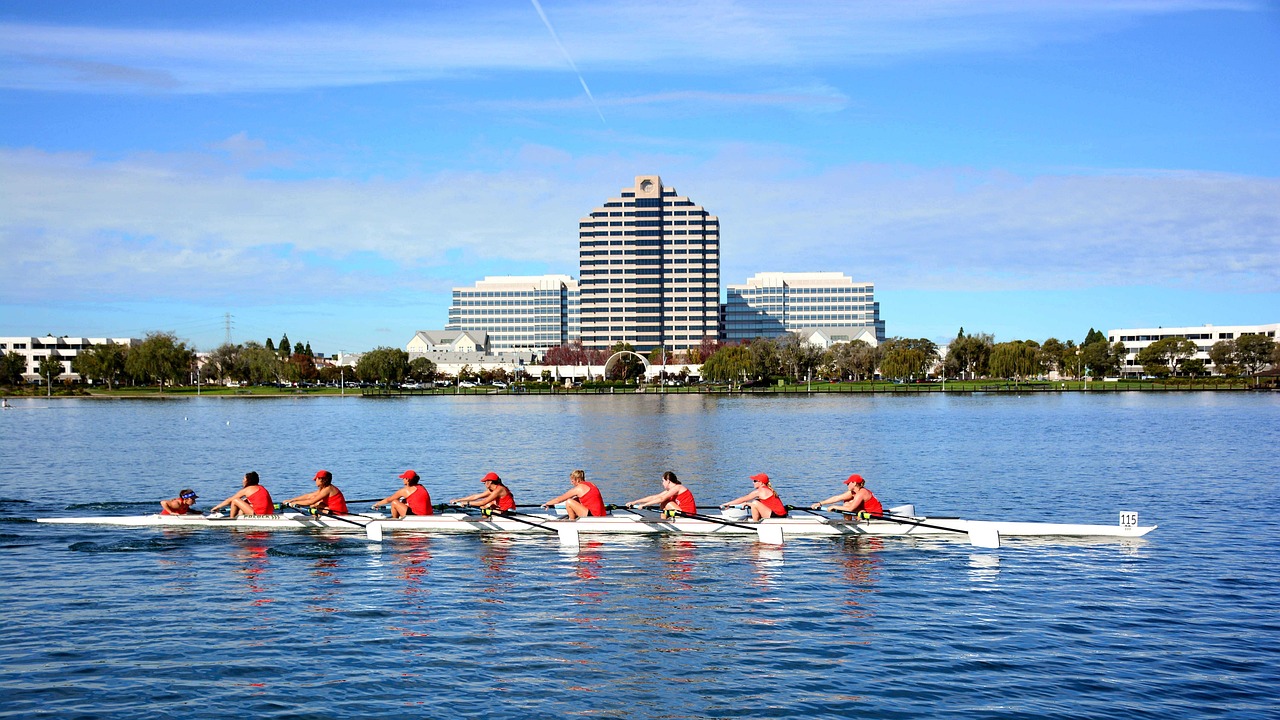
| Eight | 8+ | 8, one oar each | Always |
USRowing describes a single as narrow as 10 inches, about 27 feet long and as light as 23 pounds, and an eight as about 60 feet long. Since 2025 World Rowing also races a mixed eight (four women and four men) at its World Championships.
Race formats and distances
Sprint racing (spring and summer)
Crews race side by side in lanes. USRowing says national, collegiate, world and Olympic sprints are 2,000 meters (about 1.25 miles), on courses of six to eight lanes with a buoy marker every 500 meters. Shorter distances are common below the elite level: 1,500 m for many scholastic and junior races and 1,000 m for most masters races. The LA 2028 Olympics will race 1,500 m too, because Long Beach’s Marine Stadium can’t fit a full 2,000 m course.
- The start: an official called the aligner makes sure every bow is even. USRowing’s summary: each crew gets one false start, and a second means disqualification.
- Lanes: USRowing notes that crews may leave their lane without penalty as long as they don’t interfere with another crew’s chance to win. Clashing oars or blocking a crew can mean a penalty or exclusion.
- The finish: a boat finishes when its bow crosses the line, so the bow seat crosses first.
- Progression: big regattas use heats, then semifinals, then A (medal) and B finals. Since 2025 World Rowing has replaced repechages (second-chance races) with a “fastest loser” system: the top two in each heat go through, and the remaining places go to the fastest times.
Head races (fall)
Head races are time trials, rowing’s version of cross-country. USRowing describes them as about 2.5–3 miles, with boats sent off one at a time at intervals of usually 10–15 seconds; the fastest elapsed time wins. Rivers with bends and bridges make steering and passing part of the race, and each regatta publishes passing rules: a slower crew must give way when a faster one closes in, and crews that don’t can be given time penalties. The Head of the Charles in Boston, about three miles, is the best-known example.
Side-by-side knockouts, beach sprints and indoor races
- Henley Royal Regatta in England races just two boats at a time, knockout style, over one mile 550 yards (2,112 meters) upstream.
- Coastal beach sprints, new at LA 2028, are head-to-head: a run down the beach to the boat, a row of about 250 m out around buoys and back, then a sprint up the sand to the finish.
- Indoor rowing is raced on machines, most often over 2,000 m; World Rowing’s indoor championships also race 500 m and relays.
Steering and the coxswain
In coxed boats the coxswain steers with the rudder, runs the race plan and gives the commands; USRowing calls the cox the on-the-water coach. In coxless boats and all sculling boats a rower steers: in sweep boats usually with a steering mechanism worked by the foot, and in sculling boats by pulling a little harder on one side and glancing over the shoulder.
Coxswain weights. World Rowing’s minimum is 55.0 kg in racing kit, and a lighter coxswain carries up to 15 kg of deadweight placed close to them in the boat. USRowing’s rules use 120 lb for a coxswain of a men’s event and 110 lb for a women’s event. USRowing has dropped coxswain weigh-ins at its own youth regattas, so check each regatta’s rules for juniors.
Commands everyone must know. USRowing’s safety guidelines list them: “Weigh enough!” (stop rowing) and “Hold water!” (square the blades in the water to stop the boat), plus “Sit ready,” “Back,” and the tie-in and untie calls. Rowers must respond to “Weigh enough! Hold water!” immediately.
Weight classes and age categories
- Lightweight (World Rowing): men’s crews average no more than 70.0 kg with no rower over 72.5 kg; women’s crews average no more than 57.0 kg with no rower over 59.0 kg. Lightweight events go on in college (the IRA) and at World Rowing championships, but leave the Olympics after Paris 2024.
- Juniors (USRowing): you’re a junior through December 31 of the year you turn 18, or of the year you finish high school if later. USRowing also races U17 and U15 categories at its youth championships, and no youth lightweight events.
- Masters (USRowing): from the year you turn 21, in age categories AA (21–26) to K (85+), with age handicaps added to finish times.
- Para rowing: three classes, PR1, PR2 and PR3, by how much trunk and leg function a rower has; PR3 includes rowers with visual impairments.
Equipment rule: shoes that let go
Rowers’ feet are fixed in shoes bolted to the footboard, so a capsize could trap them. World Rowing’s rule is that every rower must be able to get clear of the boat with no delay. Where the shoes stay in the boat, each shoe needs its own heel restraint so the heel can’t lift more than about 7.5 cm (3 inches) and the foot pulls free. British Rowing still reports incidents of trapped feet, so check heel ties before every outing.
Water safety rules
These come from USRowing’s Safety Guidelines, and most clubs and schools write them into their own rules:
- Swim test: every rower and coxswain passes one, run by a lifeguard: at minimum, float or tread water for ten minutes and put on a life jacket while floating. Non-swimmers wear a life jacket in the boat at all times.
- Supervision: minors are never on the water without a safety launch, and shells stay within hailing distance of it. Unsupervised scullers carry a life jacket in the boat and, ideally, row with a buddy.
- The launch: a life jacket for every rower and coxswain in the coach’s care, every person in the launch wearing one, plus a throwable flotation device, first aid kit, emergency blankets and a horn or whistle. The driver wears the kill-switch cord and should hold a boater safety certificate.
- Traffic patterns: each waterway should have a posted traffic map with hazards and safe landing spots. Follow it.
- Fog and darkness: don’t launch in fog with less than 100 yards’ visibility, or in the dark without lights (red on the port bow, green on the starboard bow, white at the stern).
- Lightning: don’t launch if you hear thunder or see lightning; if a storm catches you, get ashore, out of the boat and wait it out.
- Cold water: below 50°F is very dangerous. When the air is below 40°F or water below 50°F, keep a launch within 100 yards of every shell; some clubs require boats with at least four oars for stability.
- Capsize or swamp: stay with the boat, even if you’re a strong swimmer. It floats; swimming for shore makes you lose heat faster.
Life jackets for coaches and launches. Coast Guard-approved jackets come in two main types. Foam vests such as the Onyx MoveVent Dynamic (US Coast Guard and Transport Canada approved, for people 90 lb and over) float on their own. Inflatable belt packs such as the Onyx M-16 are slim enough to wear all day in a launch, but they’re approved only for people 16 and older and must be inflated by pulling a handle, so the Coast Guard’s boating safety program doesn’t recommend them for non-swimmers or younger teens. A launch also needs spare jackets for the crews it follows. Hot practices call for a full bottle, like the Nalgene Sustain 32 oz, in every boat and launch.
Onyx MoveVent Dynamic Paddle Vest
- USCG and Transport Canada approved
- 90 lb and over
- Mesh back, reflective trim, whistle
Onyx M-16 Belt Pack Inflatable Life Jacket
- USCG approved, ages 16+
- Manual inflation, 16 g CO2
- Fits up to 52 in waist
Nalgene Sustain 32 oz Wide Mouth
- 32 oz, wide mouth
- BPA-free Tritan
- Made with 50% plastic-waste material
Keep going: the leagues and associations that write and run these rules, youth rowing for swim tests and parents’ questions, race day for regatta routines and rowing gear. For summer heat, see our electrolyte powder guide, and for how another sport handles its rulebook, our swimming rules page.
Rowing rules FAQs
How long is an Olympic rowing race?
2,000 meters, the standard since the early 1900s. LA 2028 is the exception: the course at Long Beach’s Marine Stadium is 1,500 meters, the shortest in Olympic history. The new beach sprints are much shorter, head-to-head races.
What happens if a crew false starts?
The race is called back. Under the rules USRowing summarizes, each crew is allowed one false start; a second false start means disqualification.
Who steers a boat without a coxswain?
One of the rowers. In coxless sweep boats a rower usually steers with a foot-operated rudder; scullers steer by pulling harder on one side and checking over their shoulder.
What’s the minimum weight for a coxswain?
55 kg under World Rowing rules, with up to 15 kg of deadweight allowed to make it up. USRowing uses 120 lb for men’s events and 110 lb for women’s events. USRowing’s own youth regattas no longer weigh coxswains.
What’s the difference between a head race and a sprint race?
A sprint is side by side in lanes over a set distance (usually 2,000 m), first across the line wins. A head race is a time trial of about 2.5–3 miles with boats starting one at a time; the fastest time wins.
Do rowers have to wear life jackets?
Not usually in racing shells, because life jackets get in the way of the stroke. Instead USRowing requires a swim test, a launch with life jackets for everyone, and a life jacket worn at all times by anyone who can’t swim. Coaches and everyone in the launch wear one.