This article contains affiliate links: if you buy through them we may earn a commission, at no extra cost to you. Learn more.
A ten-year-old touches the wall in her first 100 breaststroke and looks up at the scoreboard, beaming. Then she sees the official in the white shirt with one hand raised. One flutter kick off the last wall, and she’s disqualified. Every swimmer has a story like that, and it’s how most learn that swimming rules are strict. This page explains the rules in plain words: the four strokes and what makes them legal, starts, turns and finishes, relays, the events swum at each level, and the basics of open water racing. We follow World Aquatics, the international federation, and note where US high school (NFHS) rules differ.

New to the sport? Start at our swimming hub.
Pools and courses
World Aquatics competition pools are 50.0 meters long, with lanes at least 2.5 meters wide. That’s long course, the Olympic format. Short course meters uses a 25-meter pool and has its own World Championships. In the US, high school and college racing is mostly short course yards, in 25-yard pools. A 100 in yards is shorter than a 100 in meters, so times from different courses can’t be compared directly.
The start
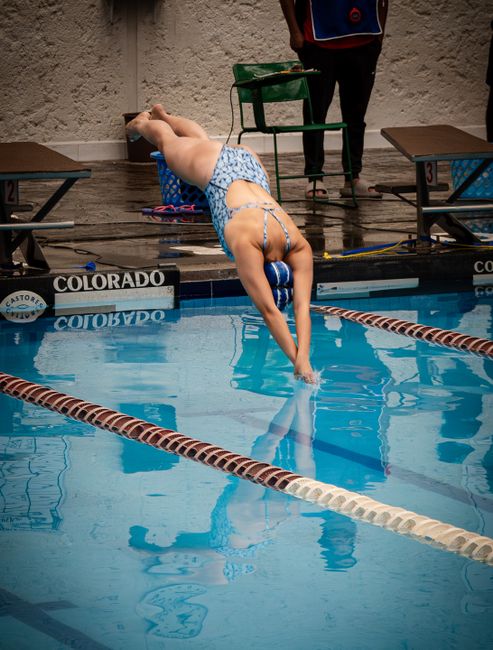
Freestyle, breaststroke, butterfly and individual medley races start with a dive. On the referee’s long whistle, swimmers step onto the blocks. On “take your marks,” they take a starting position with at least one foot at the front of the block, and once everyone is still, the starter sounds the signal. Backstroke and medley relays start in the water: swimmers face the wall holding the starting grips. If a backstroke ledge is used, at least one toe of each foot must touch the wall or touchpad, and curling the toes over the top of the touchpad isn’t allowed.
False starts: under World Aquatics rules, any swimmer who starts before the signal may be disqualified. If the signal has already gone, the race continues and the swimmer is disqualified afterward. In US high school meets, NFHS rules require both the referee and the starter to confirm a false start before a swimmer or relay is disqualified. From 2025–26, NFHS also allows backstroke starting ledges where the state association adopts them, but only in water at least 6 feet deep from the starting end out to 5 meters.
The four strokes: what’s legal
Freestyle
Freestyle means any style, and almost everyone swims front crawl. In an individual medley or medley relay, though, freestyle means any stroke other than backstroke, breaststroke or butterfly. Some part of the swimmer must touch the wall at every turn and at the finish. Swimmers may be fully underwater during the turn and for up to 15 meters after the start and each turn; by then the head must have broken the surface.
Backstroke
Swimmers stay on their back for the whole race except during a turn. A roll of up to (but not including) 90 degrees still counts as being on the back. The 15-meter underwater limit applies. At the turn, a swimmer may roll onto the front and take one continuous arm pull (or one double-arm pull) straight into the turn. They must touch the wall and be back on their back when they leave it. Finish on your back: rolling onto your front before touching the wall is a disqualification.
Breaststroke
- The pullout: after the start and each turn, one full arm stroke back to the legs is allowed underwater, plus a single butterfly (dolphin) kick any time before the first breaststroke kick. The head must break the surface before the hands turn inward at the widest part of the second stroke.
- The stroke: body on the front; one arm stroke then one leg kick, in that order; arms move together, never alternating; hands push forward together from the breast and don’t go back past the hips (except in the first stroke off each wall).
- The kick: legs move together, and the feet must turn outward during the propulsive part. Flutter kicks, scissor kicks and extra downward dolphin kicks are disqualifications.
- The head: some part of it must break the surface during each stroke cycle.
- Turns and finish: touch with both hands, separated and at the same time.
Butterfly
The body stays on the front. Both arms come forward together over the water and pull back together under it. The legs move up and down together; they don’t have to be level, but they can’t alternate, and a breaststroke kick isn’t allowed. Off each wall, a swimmer may take any number of underwater kicks but only one arm pull underwater, and must surface within 15 meters. Touch with both hands, separated and at the same time, at every turn and at the finish.
Individual medley and medley relay
In the individual medley (IM) one swimmer swims a quarter of the distance in each stroke: butterfly, backstroke, breaststroke, freestyle. In the medley relay four swimmers go backstroke, breaststroke, butterfly, freestyle, which is why the relay starts in the water. Each leg has to finish by the rules of its own stroke, so the butterflier and breaststroker need a two-hand touch.
The most common disqualifications
| Stroke | Common DQs (World Aquatics infraction sheet) |
|---|---|
| Start | Starting before the signal |
| Freestyle | Not touching the wall at a turn; head not up by 15 m |
| Backstroke | Leaving the back outside a turn; a delayed turn after rolling onto the front; finishing on the front |
| Breaststroke | More than one dolphin kick off a wall; alternating (flutter or scissor) kicks; one-hand touch; arms not together |
| Butterfly | Alternating kick; breaststroke kick; arms not recovered together over the water; one-hand touch |
| Medley | Wrong stroke order; backstroke, breaststroke or butterfly swum on the freestyle leg |
| Relays | Feet leaving the block before the incoming teammate touches; swimming out of the listed order |
New in 2026: World Aquatics’ infraction sheet in force from March 13, 2026 adds a call for being completely submerged during the stroke in freestyle, backstroke and butterfly. The only exception is the last 5 meters while reaching for the finish.
Turns, lanes and the rest of the race
- Stay in your lane, and touch the end of the pool at every turn. Turns are made from the wall; you can’t push off or step from the bottom.
- Standing on the bottom during freestyle doesn’t disqualify you, but walking does. In other strokes, standing is a DQ.
- No pulling on the lane rope and no crossing into or blocking another lane.
- No fins, paddles, webbed gloves or anything else that helps speed, buoyancy or endurance, and no tape on the body unless approved. Goggles are allowed. Data-collecting devices are allowed if they don’t send signals to the swimmer.
- Relays: four swimmers; each one starts from the block (no running starts from the deck in World Aquatics meets) and must not leave before the teammate touches. Mixed relays have two men and two women. NFHS rules allow deck starts for relay swimmers in some pools, with one foot at the edge of the deck.
- A swimmer who isn’t in a race and jumps in before everyone finishes is disqualified from their next event. When you finish, get out without getting in anyone’s way.
Your gear has to be legal too. World Aquatics approves racing suits, and USA Swimming doesn’t allow tech suits for swimmers 12 and under at most meets. Our swimming gear guide explains suits, goggles and caps. Goggles, such as the Speedo Vanquisher 3.0, and a silicone cap like the Speedo Elastomeric Silicone Cap are what most swimmers race in:
Speedo Vanquisher 3.0 Goggles
- Anti-fog, low profile
- Interchangeable nosepieces
- Low-profile racing fit
Speedo Elastomeric Silicone Swim Cap
- Silicone, latex-free
- Stretchy, easy on and off
- Adult size
Events at each level
Olympics: at Los Angeles 2028, swimming has 41 medal events, up from 35 in Paris, with the 50 m backstroke, breaststroke and butterfly added. Until now, the 50 freestyle, first swum at Seoul 1988, was the only 50 on the Olympic program. Freestyle runs from the 50 to the 1500, and the open water 10 km is a separate event.
High school (NFHS): the standard championship order is the 200 medley relay, 200 freestyle, 200 IM, 50 freestyle, 1-meter diving, 100 butterfly, 100 freestyle, 500 freestyle, 200 freestyle relay, 100 backstroke, 100 breaststroke and 400 freestyle relay, all in yards, with girls’ and boys’ events alternating.
College and club: NCAA championships are swum in yards in March. USA Swimming age-group meets use events and time standards by age group (10 and under, 11–12, 13–14, 15–16, 17–18). Masters meets run in age groups for adults. Our leagues and associations page explains who runs what.
Open water basics
Open water races are swum around buoys in lakes, rivers and the sea. In World Aquatics races, wetsuits are required when the water is below 18°C (about 64°F), and a 2026 World Aquatics review backed 16°C (about 61°F) as the minimum safe temperature. Classic marathon swims have their own rules: for an English Channel swim to be ratified by the Channel Swimming Association, swimmers wear a “standard” sleeveless, legless costume that gives no warmth or buoyancy, plus one cap and goggles, and solo swimmers must be at least 16. The Channel is about 21 miles across at its narrowest, and tides usually make the swim longer.
Safety rules every swimmer should know
- Never dive into shallow or murky water; dive only where the water is deep enough (AAOS).
- No hyperventilating or breath-holding contests. USA Swimming, the Red Cross and the YMCA warn that these can cause hypoxic blackout.
- Don’t swim alone, and in open water swim where lifeguards are on duty.
- A swimmer who hits a wall or another swimmer and seems dazed comes out and stays out until cleared, following the CDC’s HEADS UP guidance. More on our swimming injuries page.
Want to swim the strokes better, not just legally? See swimming training, swim meet day and our youth swimming guide. For another sport’s rulebook in plain words, see soccer rules.
Swimming rules FAQs
Can you do a dolphin kick in breaststroke?
Only one, after the start and after each turn, any time before the first breaststroke kick. A downward dolphin kick anywhere else in the race is a disqualification.
What is the 15-meter rule?
In freestyle, backstroke and butterfly, swimmers may stay fully underwater for up to 15 meters after the start and each turn. By the 15-meter mark the head must break the surface.
What happens if you false start in swimming?
Under World Aquatics rules you can be disqualified; there’s no warning start. In US high school meets, both the referee and the starter must confirm the false start before a disqualification.
Can you stand on the bottom of the pool during a race?
In freestyle (and the freestyle leg of a medley), standing isn’t a disqualification, but walking is. In backstroke, breaststroke and butterfly, standing on the bottom is a DQ.
Why do breaststrokers and butterfliers touch with two hands?
Because the rules say so: both strokes require a touch with both hands, separated and at the same time, at every turn and at the finish, to keep the stroke symmetrical to the end.
Can you wear a wetsuit in open water races?
In World Aquatics races, wetsuits are required below 18°C (about 64°F). Traditional marathon swims such as a ratified English Channel crossing don’t allow them. Check each race’s rules before you enter.